Was Robin Boyd on Acid? The multimedia Space Tube at Expo 70.

Robin Boyd’s Space Tube, designed for the Australian pavilion at Expo 70, was a commission that came at a time when Boyd’s practice was struggling to make ends meet. From mid-1968 through to Boyd’s death in October 1971, his practice consisted of mainly residential houses and some more speculative projects. Amongst these projects, the Expo 70 commission was one of Boyd’s more significant commissions because of his use of multi media.

For todays architect’s multi-media technology is ubiquitous and Expos in the 21st century are mostly hyped up trade shows. Expo 70, the site of the Space Tube, in Osaka Japan, was the culmination of the 1960s neo avant-gardes dreams for architecture aligned with futuristic and universal values. Expo 70 crystallised the experiments of the 1960s neo Futurist avant-garde even more so than the previous Expo 67 in Montreal; this was perhaps because of the influence of the Metabolists who were directly involved with the planning of the many of the exhibits at Expo 70. (1)

DSC09059

Original sketch of the Space Tube from the Boyd Archive at the SLV

In general media coverage and most publicity photos, Boyd’s space tube is generally overlooked in preference to the “coathanger” structure of the Australian pavilion designed by the Government architect James McCormick. The Space Tube gained very little publicity from either the architectural press of the time or historians since. This is surprising given that it is one of Boyd’s most significant later commissions. The cost of the project, in 1970 Australian Dollars, was then estimated to be $700,000 and Boyd’s fee for the work was to be $75,000 (2 ). More importantly, it was a commission which was actually completed; of the 28 or so commissions that Boyd received from 1968 until his death, 7 were domestic commissions and 13 were speculative schemes. (3)
Slide1

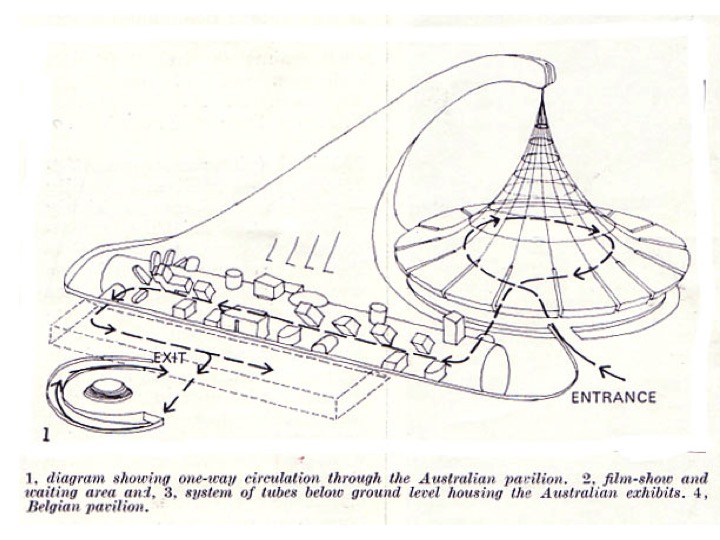
As the Australian Expo 70 exhibits architect Boyd was responsible for the planning and circulation of the interior exhibition area, principally within the space tube. Boyd, in consultation with the Commonwealth Government committee overseeing the project, proposed that the exhibit would have four subject themes: “Man, Man and Nature, Man and the Man Made, Man and Man”. It was intended that these themes would divide the space tube or tunnel into four parts, which would then contain 19 exhibits (4). In notes for an early press release, Boyd makes note of these display boxes, which were to be built in Australia before being shipped to Japan, to be “simply bolted on and plugged into the power supply.”

The experience for the visitor within the tube itself was designed as a sequence of experiences controlled through movement. Boyd’s intention was that the motion should be barely noticeable. According to Boyd, “[t]he function of the moving platforms is not to excite or even to relieve the feet. Their main function is to give control.”(5). Through this use of multi-media technology, the architect was able to control the flow of visitors through the space, and hence “present a sequence of exhibits, knowing that the visitor can view them only in that sequence.” After leaving the first crush space and stepping onto the travelator, the visitor was presented with a view of the entire tube for the first time. As the opening of each display was inset from the tube surface and arranged at a right angle to the axis of movement, all that could be seen was a series of bright lights and colours shining onto the visitors ahead.

In the final scheme there were 20 displays or subject areas in all. Each display or subject area was comprised of up to four display boxes, arranged radially around the tube. The visitor was moved past the displays by means of twin moving travelators which positioned the visitor’s eye level roughly in the centre axis of the tube. The travelators were supported from below by a minimum of structure, to allow an unimpeded view in all directions from the moving platform. The tube itself was made from “Gunnite”, a form of shot concrete on mesh reinforcing which created a thin shell. Attention was paid to the finish of the tube, with construction drawings stipulating a smooth, uniform finish on the outside surface and a matt black “acoustic surface” on the inside. The tube’s status as a design object was as important for Boyd as its role in presenting a view of Australian society.

Slide1

Boyd was also responsible for the design of what was termed “technamation effects”. This was a multi-media technique achieved by projecting from two or more lights or projectors onto a polarised screen. As the viewer moved past the display, the screen would shimmer and ripple with colour and light. These effects were incorporated in a variety of ways into six of the display boxes. The best example is exhibit 17C, ‘Night City’. A model of a city block in exaggerated perspective was fitted on top of the polarised screen. Beneath the screen were six projectors mounted in opposing directions, creating the illusion of night traffic through moving red and white lights. What was otherwise a quite simple and almost dull model was in this way enlivened through animation. However, instead of a moving image or mechanical device, it was the viewer in motion which brought these displays to life. Visitors within the Space Tube were thus tangled in a complex set of visual relationships. The layout of the displays, in particular their height and angle in relation to the visitor, was one method used to control and organise these views. For example, the displays mounted horizontally (in the cardinal arrangement referred to above) made use of the level horizon line to suggest an equivalence between the visitor’s gaze and the subject matter. For instance, in exhibit 13C ‘Repco Brabham’, a cutaway model of a Formula 1 racing car is surrounded by a projection screen showing the car driving around a track. The view is arranged so that the visitor watches the track from just behind the car as Brabham makes his lap.

In contrast, the displays mounted at 45° to the horizontal present a more varied set of views. The displays below the walkway, such as 2C, 2D, 6C and 6D, present stylised views of the abyss – the mine, soil and what Boyd referred to as “the beasts in the pit”.(6) The circular frame of the display openings emphasise the detached and special view, appearing to be the viewfinder of an enormous microscope in exhibits 2C, ‘Some of the Body’s Microscopic Enemies’ and 2D, ‘Defence Cells Emerging from a Lymph Node’. The displays above the walkway more often include images of authority figures as part of their design. For instance, in exhibits 2A, ‘Immunology’ and 2B, ‘Organ Transplants’, circular screens were included which displayed projections of Gustav Nossal and Macfarlane Burnett, respectively. These images literally and figuratively look down on the visitor, countering the visitor’s gaze. These two displays include another recurring motif of Boyd’s design, the life-size transparent acrylic mannequin. A toy called “The Visible Man” and a teaching aid developed at the University of Michigan called “TAM” inspired Boyd (7). Both were human figures created with a transparent skin which revealed the organs inside. Boyd’s use of figures and bodies seems more scientific and anatomical than overtly erotic; however the experience for the visitor was doubtlessly voyeuristic (8).

Boyd was also central to the design and production of all the film, visual sequences and sound effects. He specified in detail the subject matter of each sequence, and personally chose the images used for each slide and film sequence. Though concentrated in the final displays, visual and multimedia effects were used throughout the tube as the central element of most displays. This was probably one of the largest and most extensive Australian multimedia projects of its time. In Boyd’s own words the purpose of the displays was to “capture the eye and the ear with light and colour and movement with music and sounds with 28 movie projectors and 46 synchronised slide projectors with hundreds of fluorescent tubes and 200 incandescent lamps.” (9). Circular screens were incorporated into most of the displays. Some of these screen arrangements were highly complex – for instance, exhibit 7B ‘Asian Aid’ was composed of six circular screens at the end of tubes housing a slide projector, each of which slid forward into the main space to reveal captions and subsidiary information printed on the side of each tube. Exhibit 3 ‘Tennis’ was made up of two projection screens facing one another across the tube, showing two players – Lesley Hunt and Yvonne Goolagong – playing a game above the visitor’s heads. Exhibit 17A ‘Ballet’ made use of moving screens, variable focal lengths and multiple projections to create a complex sequence of images (10). Sound effects were synchronised to visual cues for most of images, all of which were described and stipulated by Boyd. The Australian composer George Dreyfus was responsible for composing four variations of the pavilion theme, which were played at equal intervals along the tube.

The motion of the viewer through the tube constantly reinforced the logic of inevitability and progress within the subject matter of the exhibition material, and vice versa. For example, in Exhibit 20, the ‘abstract colour image’ designed in association with J.S. Ostoja-Kotkowski, was intended to literally be the “light at the end of the tunnel… visible all the time that the visitor is in the tube”(11). In effect, it was also a visual echo of the kaleidoscopic sun of first exhibit. From the very beginning, the Space Tube was thus a passage from a red/yellow stylised contemporary sun to a blue/green argon laser ray abstract future, toward “an absolutely explosive visual phantasmagoria in 3-D ” (12).

Of course this all makes me wonder if Boyd had at some stage taken LSD. Boyd’s thematic explorations certainly mark him as an architect of his time. But the design for the Space Tube does hint at the media driven technological future architects now find themselves immersed in (13). The degree to which contemporary architects have the same control over, or experiment with, new media technologies as Boyd did  is debatable. Boyd may not have actually taken acid. But it would be nice if we could direct such an accusation at contemporary Australian architects a bit more often.

This is an edited version of a conference paper co-authored with Simon Wollan.Peter Raisbeck And Simon Wollan Boyd As “Bower Bird”: Robin Boyd’s Space Tube And The Global Avant-Garde. SAHANZ 2003. 

NOTES.

1. For details of Expo 70 in architectural magazines see the entire issues of: Architectural Design June 1970 especially p 271 for comment on the Australian pavilion and Japan Architect 1970 Vol 45 N0. 5/6-164 see especially Koichi Sone, Sei Oyuki, and Yuji Morioka, “Moving Walkways and Urban Traffic” as well as p. 69 for a comment on Kikutake’s Expo tower.

2. Fee agreement for the project was signed on the 22nd of October 1968; to be paid in monthly instalments as the work proceeded. For this fee, Boyd’s brief was to design the Space Tube and its display cases in a way which would depict Australian life and industry to a primarily Japanese audience. The Commission also extended to producing and managing the construction of designs for the merchandising which was to be associated with the exhibit. Refer to Box 104, GRB Archive, State Library of Victoria.

3. His most significant civic architectural commissions during this time were Churchill House, exhibition designs for the Australian Chancery in Washington and the ”First 200 years exhibition” in the foyer of Harry Seidler’s Australia Square building.

4. In the original proposal the exhibits were numbered from 1 to 19 with the following subject titles and in the following order: origins of humanity, the battle against disease, science of the mind, enjoyment of life, Australian invention in agricultural technology, Soil and Water, Exploring and preserving resources, Exploring the Universe, utilization of Polar Regions, Transportation, Modern Living, Urbanisation, Automation, Language and Literature, Communications, Fine Arts, Lively Arts, Australia-Japan Relations, The Film. Refer to Box 104, GRB Archive, State Library of Victoria.

5. Robin Boyd, “Australia at Expo 70 for Walkabout” , undated text, Box 103 (c), GRB Archive, State Library of Victoria.

6. Letter from Boyd to Prof. G. Nossal, 11 July, 1968. Box 103 (a) GRB Archive, State Library of Victoria.

7. Letter from Boyd to J.P. Tyrer (Acrylic Industries), 7 October, 1968. Box 103 (a) GRB Archive, State Library of Victoria.

8. Further work, which is outside of the scope of this paper, is required to fully establish how Boyd fetishised these figures as objects, and the more general effects of the technological gaze within his designs.

9. Robin Boyd, “Australia at Expo 70 for Walkabout”, undated text, Box 103 (c), GRB Archive, State Library of Victoria.

10. First, a film loop showing dancer’s legs was projected onto the front screen, nearest the opening to the tube. Next, an image from a slide projector appears small and out of focus on a screen behind. As this screen moved forward the image enlarged and came into focus, before again going out of focus and diminishing in brightness. From the visitor’s point of view the slide image passes through the film image, literally deepening the visual field of the screen. Refer to Box 100/3, GRB Archive, State Library of Victoria.

11. Letter from Boyd to J.S. Ostoja-Kotkowski, 16 July, 1968. Box 103 (b) GRB Archive, State Library of Victoria.

12. Letter from Boyd to J.S. Ostoja-Kotkowski, 9 October, 1968. Box 103 (b) GRB Archive, State Library of Victoria.

13. This compression of time and consequent distortion of space also appeared in individual exhibits. For instance, exhibit 13D ‘Shipbuilding’, displayed a model of a ship growing from blueprints to steel structure to dry-dock construction to finished bow steaming steadily ahead through a technamation wave. However, instead of showing each ship in sequence, each stage occurs on a portion of a single hull, giving the sense that the ship is impatiently sailing through time into the future. That this exhibit is the only one mounted directly below the visitor, between the two travelators, ensured that this movement was aligned with that of the viewer.

Is BIM as good as it looks ? What Deleuze can teach us about BIM

In the Building Information Modelling (BIM) utopia representations of time are linear and easily progresses into a future where BIM enables seamless collaboration across the full gamut of design orientated disciplines. The viewpoint presented in the various BIM representations and advertising that litter the internet is often that of an eagle, or angel, freed of all earthly constraints and propelled towards a future BIM revolution. But unlike the critical theorist Walter Benjamin’s iconic image of an angel looking back on the wreckage of progress these images of BIM do not indicate a reflexivity that recognises that not every technical innovation succeeds or that technology has a social-technical dimension.

In theory, BIM project models paired with collaboration tools offer a number of significant improvements and benefits over traditional design, delivery and supply chain processes. Proponents of the BIM utopia claim that the BIM will change and be linked to augmented reality, enhance lean construction, scheduling, safety management, trade scheduling, progress measurement, design visualization and even architectural design studios.

But as some researchers have noted the BIM dream is not all it seems to be. For example the IFC’s, which are at the heart of BIM collaboration often “fails to provide complete interoperability.” 

BIM careerists, proponents and evangelicals claim that BIM is a new mode of visualization. Someone once said to me you can tell a BIM building because of the limitations of form that seem to be built into BIM software. Nonetheless, emerging from and circulating in BIM research discourse and the public domain the above claims are supported by a plethora of BIM representations. These often include strategic and operational diagrams, screenshot images and animations available in research papers, publications, reports, various how to do BIM manuals and numerous animations across the internet.

As the BIM industry has arisen as numerous, and in some ways glamorous, case studies and screenshot images are published and promoted as examples of successful BIM operation. The colours employed are seductive and colour is the key feature in numerous BIM screenshots. For example, a shimmering green is a often contrasted with yellows for services and purple. The viewpoint is often from a point looking above or below and is positioned to emphasise the layering of different systems and suggests a layered complexity constituted by the overlapping of many different small scale construction elements. With these highly seductive images it is argued that BIM can improve workflows through clash detection and management, better two dimensional drawing extraction, automated quantity take-offs, supply chain integration and facilities management integration.

bim-4

The French Philosopher Gille Deleuze’s encounter with cinema is a useful, although to some it might seem surprising, critical framework in the BIM context. Deleuze wrote two philosophical books about cinema. Deleuze saw cinema as a “new practice of images and signs, whose theory philosophy must produce as conceptual practice.” Deleuze’s concern is not a philosophical investigation of cinema’s essential nature. Unlike the proponents of BIM Deleuze did not simply proclaim cinema as a technological revolution. Rather, he was interested in interrogating the cinema for its possibilities about what it might become. Deleuze argues that cinema establishes the problems of traditional subject orientated epistemologies. Deleuze cites Henri Bergson as a philosopher who opposed a view of the world that is predicated on a static and centred viewpoint or subject. Deleuze sees in Bergson a philosophy that accounts for the early technological advances of cinema as well as anticipating its later developments. But, Deleuze also saw the cinema as constituting a language of images. Deleuze’s conception of image is something which is neither representation, secondary copy, imitation or mimesis.

These perspectives suggest that BIM research R&D should oppose a concept of BIM that privilidges linear sequences, singular perspectives and robotic notions of construction that ignore the randomness of craft.

The above considerations suggest that new methodological approaches are needed in the area of architecture and BIM R&D. If BIM is to reach it’s full potential as a tool which saves resources and allows better architectural design outcomes. Future BIM research needs recognise the power of different representational modes, stochatsic and random events, social milieu and avoid seeing a building as a simplistic digital-technical object or diagram linked to a database.

Stochastic processes which are random and are capable of using agents and swarms to predict what will happen within BIM models may reveal more than the static and mechanical models which seem to plague BIM research today. Notions of time should be seen as being multi-layered and interdependent of sequential BIM animations and screenshots. BIM models should be seen as entities which develop over time from the beginning of the design process where there is a iterative transfer of information between designers, teams, and 3D representations of buildings built in computers.

In BIM research critical theory should be employed to ensure that the architects of the future do not relinquish their canon of knowledge regarding the craft of building to mindless databases.

Design Activism: Expanding architecture as advocacy after #Occupy.

This last week or so I have been teaching a new intensive subject just at MSD, the Melbourne School of Design. As a subject Design Activism explores the dynamics and effectiveness of architecture in relation to the politics of advocacy, activism and protest. The discussions in class linked architectural and urban design to critical theory, activism and community development. We discussed many case studies in class and the students themselves bought in examples in order to begin to understand the strategies and governing principles which guide activist campaigns.

The case studies included perspectives from both international and local contexts, as well as from the virtual world.

One of the most exciting aspects of the subject was that it bought together various activists, academics and practitioners involved in the interfaces between alternative architecture, protest and community organisations. This time around our guests included:

Bev Polzin and Dr. Wendy Salter of the AVP movement.  Who discussed non violent protest and alternatives to violence.

Peter Hogg  who discussed inner city urban planning activism in Melboirne.

Cathy Alexander who sketched out the mechanics and dynamics of the Australian media.

Lorel Thomas National Convenor of Safeground who discussed how to best lobby politicians.

Gary Muratore of Burger Off. Who discussed one of Australia’s most succsefu

Dave Phillips of Mccann who graciously explained the inner workings of advertising campaigns and the advertising industry.

Leandro Caputto of TOMA. A collaborative group of architects working in Santiago Chile recently represented at the 2016 Chicago architecture biennale.

and Derrick Jensen of the Deep Green Resistance movement. Derrick shared his own journey with students explaining his views on militancy.

Mirjana Ristic now of TU Berlin who demonstrated how concepts of spatial urbanism can be used to map conflict.

Design Activism goes against traditional models of architectural practice normally taught in architecture schools. There are usually two views of architecture as a career. In the first view architects graduate and then find a internship or find a reasonable firm to work in. Slowly but surely we gain experience and get to the decision point of staying in someone one else firm or starting practice yourself. Both of these career pathways are based on the traditional model of practice. In other words, the model in which architects are paid by clients to design and deliver buildings. As time has gone on this model has come under increasing pressure, from other competitors who claim to do what architects do, and the traditional model of practice, with all of its uncertainties and has been called into question as a viable and satisfying career path. Often the architects who subscribe to the traditional model of practice either as employees or owners of firms are confined and limited in their ability to act due to issues of patronage, politics and funding.

As a subject Design Activism was designed to explore the ways out of the above traditional nexus and associated conundrums. With the demise of the Occupy movement it is timely for architects to now reflect on architecture’s role as a vehicle for political protest. Thinking about Design Activism, in terms of both theory and practice, is a good vehicle to do this.

Moreover, in recent years, in architecture schools across the globe, community development or “global design” design studios have been all the rage. For many students and architects this has been seen as the prevailing way to make architecture more relevant to global concerns of injustice. These studios usually have a simple formula: Take a group of architecture students to an island or developing country and get them to do stuff. As I found during the studio I ran in Mexico these types of studios raise ethical concerns about the architects relationship in networks of colonialism. Sometimes a FIFO (Fly in Fly out) mentality reigns supreme and perhaps it is not effective. What happens after the architectural experts fly out? How do we as architects decolonise our practices? A recent book by Clare Land based on her thesis begins to suggest how we might begin to do this in relation to indigenous issues. Architects have along way to go.

The Design Activism course allowed the students space to explore and discuss the contradictions of power across the interfaces of urban infrastructure, architecture and the territories of political protest. In future blogs I will discuss and present more of their work. Design Activism is an attempt to expand the domain of architectural design into the realm of advocacy and political activism. Exploring where the interfaces and fault lines are between architecture and the politics of protest is important if architecture is to evolve as a discourse.

Of course, I don’t want to be overly critical of the FIFO studios; not all of them are bad; although I decry the often woeful design aesthetics produced by these studios; however, I do think we need to ask: how, as architects we can be activists? It shouldn’t simply be a matter of taking a trip, or as Derrick Jensen suggests putting a green roof on a building, and then feeling warm and fuzzy because as architects we are thinking that we are doing good. That may not be enough.


Schumacher vs Aravena’s Pritzker: Slugging it out in Monterrey Mexico.

Now that Aravena has won the 2015 Pritzker prize it might be worth discussing the current fault lines in architecture that run between the technologists and what Patrik Schumacher declaims as a “safe and comforting validation of humanitarian concern”. To do this I want to briefly analyse two projects by these very different architects in Monterrey Mexico. Just after Aravena won the prize there was an unusual outburst via Facebook and across social media from Schumacher:

“The PC takeover of architecture is complete: Pritzker Prize mutates into a prize for humanitarian work. The role of the architect is now “to serve greater social and humanitarian needs” and the new Laureate is hailed for “tackling the global housing crisis” and for his concern for the underprivileged. Architecture loses its specific societal task and responsibility, architectural innovation is replaced by the demonstration of noble intentions and the discipline’s criteria of success and excellence dissolve in the vague do-good-feel-good pursuit of ‘social justice’. 

When I read proclamations about political correctness I instantly associate this with a neoliberal and regressive politics. A politics intent on discounting social difference. Please forgive my skepticism but I am an academic after all. But an architecture focused on “specific societal tasks” might just mean: important big projects. For “responsibility” the cynical might read: more big projects designed by Patrik and Zaha and “architectural innovation” could refer to an architecture driven by all of the new technologies: drones, 3D scanning, 3D printing, AI and above all parametrics; and all of this innovation is promulgated through the new digital media: Facebook, Twitter, Instagram, TED talks and Linked-in-Profiles (I should talk) and maybe even Snapchat. Social media is nowadays the new collective imagination of architecture.

A more clear sighted and less cynical analysis might ask if Schumacher is correct in his stance and is Aravena’s position any more worthy? Is it any more innovative and to what extent does it lose any sense of societal tasking and responsibility? Does the work of Elemental, Aravena’s firm, posit itself as a credible and alternative architecture?Schumacher goes on to directly criticise Aravena suggesting that it is a kind of comforting opiate for the “humanitarian” set. Perhaps he might just be right?

I respect was Alejandro Aravena is doing and his “half a good house” developments are an intelligent response. However, this is not the frontier where architecture and urban design participate in advancing the next stage of our global high density urban civilisation. I would not object to this year’s choice half as much if this safe and comforting validation of humanitarian concern was not part of a wider trend in contemporary architecture that in my view signals an unfortunate confusion, bad conscience, lack of confidence, vitality and courage about the discipline’s own unique contribution to the world.”

Reading this I was intrigued by what Schumacher meant by the terms “frontier” and  “our global high density civilisation.” It starts to conjure up images of John Ford’s film The Searchers.  Interestingly, I found that both architects have produced schemes in Monterrey Mexico which in its own way is a frontier city. A city where narcotics, capital and America’s free trade agreement with Mexico collide. I know Monterrey reasonably well having visited a few times with post graduate MSD students in 2010 and 2012.

Monterrey is a city that has little planning regulation, has grown in a adhoc manner and contains extremely rich suburbs along side informal settlements.  It is a city full of contradictions it is a large industrial city with many factories supplying the United States whose border is only 3 or so hours away by truck. The total amount of Nuevo Leon’s exports, the state in which Monterrey sits, in 2012 were 35 Billion USD, 11% of Mexico’s total exports.  The city is home to one of the most important universities in Mexico and Latin America: Tecnológico de Monterrey (ITESM). It is even home to a large Lego factory. It contains both the richest and poorest suburbs in Latin America. It is where   Narco-Mansions are sited near informal settlements with no sewerage or drainage exist within close proximity of each other.

Don’t get me wrong I love Monterrey and would go back anytime. But it is an example of what happens to a city when global capital is allowed to run wild. It is in many respects a test bed of free market urbanism

Aravena’s and his firm Elemental’s 2009 project in Monterrey Mexico sums up a lot about their approach to affordable housing. The housing is designed to be incremental, in the sense that the inhabitants can add to the housing themselves as personal economics allow. It is an open ended approach and adhoc approach. A relinquishment of architectural agency in a sense. The final form of the housing appears to respect the surrounding grid pattern and typology of Monterrey. I don’t want to impose a european reading on this work but the project arguably sits formally in a European canon. The flat roof and form of the housing seems to have its precedents in Corbusier’s Pessac project and even seems to evoke the urban morphologies of a Rob Krier or a Latin American version of  Taut’s housing in Weimar. In other words it is affordable housing with an aesthetic and tectonic edge. It is an effort, I think, to forge a frontier in the gap between ordinary lives and high architecture.

In contrast Hadid and Schumacher’s scheme for Monterrey there is nothing adhoc about this project; there is not doubt that it has been designed with a capital D; nothing has been left to the residents to design; its hive like cells and sinuous and curvilinear forms are at odds with the cities surrounding typology. The central landscaped space is full of nice people enjoying the sun. The renders have a lot of gym action and treadmills in them. This is another Monterrey development that proclaims its wealth. A project made to take advantage of Monterrey’s low cost wage structure and labour intensive concrete technologies. Complete with 981 units that look like they could be anywhere in the global and urbanised civilisation that Schumacher aspires to cover the earth with.

I remember as a young naive architecture student, in the dinosaur age, Eisenman coming to visit my architecture school. Replete with Brooks brothers button down shirt and braces he proclaimed that architecture was “autonomous” and in no way political. Architecture could only do what it could do. Schumacher’s position is not dissimilar but it is perhaps more dangerous because it is driven by the new technologies, with scant regard to the politics of the neoliberal frontier. The contradiction, of course is that Hadid’s early work seemed to claim a political position via the use and reference in it to the Russian Constructivists. It has morphed into something else now.

In contrast Aravena’s work speaks of the small architect. Aravena’s work clearly positions itself on the margins and in the cracks of cities. After all when everything is said and done we are all small architects trying to fill the gap between high architecture and ordinary lives.


The Australia Day Hangover: Architecture, sovereignty, Hitler and Australian democracy

Driving around my city on Australia Day and watching all of the people picnicking in their green and gold outfits, Aussie flag eskies, stubby holders and other bits of Aussie slightly Springtime-for-Hitler kitsch, got me thinking about this year’s lamb ad with its militaristic overtones and last year’s lamb ad with Ritchie Benaud and Cookie in it. Any serious reflection regarding all of this Australia Day merchandising and marketing must lead to the notion of indigenous sovereignty and the transient nature of our so called democracy.

A few years ago I collaborated with my friend Alan Chan, a MSD graduate, on a competition for the Prime Ministers residence. The brief was to design a Prime Minister’s residence on the shores of Lake Burley Griffin. I would like to congratulate the University of Canberra and the judges for conducting this competition. It was entitled The Lodge on the Lake design competition and was sponsored by the University of Canberra. Thankfully the website is still up. The designs of the finalists, including our entry, was exhibited at the Gallery of Australian Design from 15 August to 19 October 2013. It was a great initiative. But like many architectural competitions and initiatives it seems to have got lost in the bottom drawers of the web.

Whilst the competition was held over 2 years ago in 2013 the 242 entries, including the judged winners, are worth briefly discussing as they point to a number of prevailing views about the notion of Australia, its histories, myths and architecture’s complicity in promoting these.

The location for the new Prime Ministers Lodge was Attunga Point, a peninsula with a northern outlook over Lake Burley Griffin (perhaps it should be Lake Marion Mahony Burley Griffin ) towards Black Mountain. The winning scheme, by Jack Davies and team members Nicholas Roberts and Henry Stephens, evoked a kind of up market holiday house you might find in a coastal suburb. The architects of this scheme draw on the well worn trope of the relationship between the architectural artefact and the so called Australian landscape. Claiming Griffin and Mahony’s plan for Canberra as an exemplar they argue that the scheme is both a “critique and a development of the relationship between Australian landscape and dwelling. An intersection of public assembly, intimate domesticity and ground plane.” There is no mention here of the Australian landscape as a violent frontier; although, the scheme does look a little defensive. It encircles a courtyard and is partially embedded in a slope and it is not without it’s predictable delights and nuances. But for the most part it depicts a relaxed and comfortable nation inhabited by citizens without fault-lines or class strata. A people who no longer need to expand outwards across the frontier. A people enjoying themselves, with a PM in a nice holiday house, with no self loathing bogan supremacists to be seen anywhere.

Some of the other schemes, are a little more cautious in resolving and recirculating the myths of the Australian landscape and its attendant histories. For example, Entry 6744 by  John de Manincor, Imogene Tudor, Christopher McDonald and Adam Russe produced a scheme overtly critical of Australia’s immigration detention policies. As they note, “Lake Burley-Griffin will offer our leader and their family security and beauty. However they will, at times, require some force for additional protection from intruders.” Another scheme of interest was the second prize winner by Alan Pert, NORD and Atelier 10 which evokes a kind of Athenian temple on the peninsula, I am not sure if this iconography is meant to be ironic or not; or to give some authentic nobility to the office of Prime Minister. The landscaped courtyard, with a single tree, is also conceptually akin to the winning scheme.

I liked the ugly schemes the best as these seemed to be more confident and in contrast to the mannered modernism of many entries. The Bird, Spooner and Fahey entry appears to epitomise a kind of suburban baroque. Suburban iconography is of course evident in the Edmond and Corrigan scheme. This is a rambunctious scheme and in some ways reminds me of extremely palatial footy oval toilet block. Entry 6920, Milbourne, Laura Martires and John Doyle, produced a scheme that dealt with the issues of landscape using abstract and rational process of generating geometry. The end result, evokes the work of Claude Parent, and seems to be a better approach to the Australian landscape problem than the winning scheme.

Our scheme also explored the dichotomy the planned city and the natural landscape. In much the same way that Walter Burley Griffin’s plan for Canberra was an extrinsic and extraneous intervention on the indigenous landscape, our scheme for the Lodge was based on a grid which has been laid onto the Attunga Point site. But this is done without pretension to the myths of uniting the landscape with architecture. We saw this as a departure point of conflict. We arranged chaotic and monumental rammed earth skylights and associated garden beds across a regular grid in order to contrast with the undulating topography of the site. We saw the Lodge as much as an extrinsic object to Attunga Point as the plan for Canberra is to the landscape; as the Australian Capital Territory entity is to the state of New South Wales in 1908; and as extrinsic as a population of migrants – colonial and recent – to Australia.

The primary rammed earth extrusions house the private rooms of the PM’s residence and function centre, with the visible external protrusion acting as skylights to allow natural daylighting. Underground, the rammed earth extrusions continue and demarcate the private rooms from the semi-public circulation spaces. The extrusions – the Lodge’s rooms – act metaphorically to anchor the building to the surface. The placement of the building’s functions underground allows the surface to be completely accessible by the public. The citizen can weave through the entire complex and its gardens, and down the terraces to Lake Burley Griffin, without compromising security. It is possible to approach the rammed earth extrusions, and up close one could observe and look into the glazed perforations in the rammed earth walls.

By being underground our scheme is a bit like Parliament House itself. Which, as we all know, is partially underground. Our scheme is more underground and more bunker like. We did this knowingly, and thought it would contrast with Parliament house: with its supposedly integrated landscape, seemingly, accessible to the public hilltop, a building open to the possibilities of democracy: yet, an artifice ignorant of country. In contrast we proposed that the Lodge would be open to the public as an art museum and gallery much like the Lyons House museum in Melbourne. The private lives of the Lodge’s occupants are safely secured inside their rammed-earth rooms when the main floor is opened to the public.

Our project was predicated on two underlying ideas. Firstly, the questionable nature of Australian sovereignty and the fragility of its democracy. An inspiration for the design was Sokurov’s cinematic masterpiece of 2000 about Hitler and Evan Braun called Moloch. This has always been a favourite movie of mine. The film’s setting is a kind of mirky bluestone and dark granite castle. It is shot on very grainy film stock. In the film, there are no open views from the castle to the external landscape over Obersalzberg. I wondered if we could design something with a similiar tone for our Australian politicians.

The project took considerable time to undertake. It involved considerable design research as we sifted through various options and discussed how we could try and dismantle, or at least contend with, the prevailing myths of the Australian landscape, democracy, and contemporary executive government. We made some study models and the project was exhibited along with the winners of the competition. No one rang us up, least of all the Prime Minister.

Our project was exhibited and published in the exhibition catalogue but I didn’t manage to get any RBP’s (Research Brownie Points for it) for it. Certainly, the work involved was equivalent to a journal article or a conference paper. The project indicates the dilemmas faced by both architects and academics in Architecture schools who collaborate on these types of projects and enter competitions. You get nothing for it (at least Alan got a job after he graduated). Most competition entries go to waste. It is not counted towards your research quantum and the research administrators don’t really get it if you tell them its a design for an architectural competition (Let alone telling them you are contesting notions of what underpins Australian nationhood). The category these things get lumped into is Creative Works or Non Traditional Research Outputs. I am not sure anyone really knows what that is. It would be better if there was simple, separate category, under the Australian Research Council’s publication system, for architectural works (built and unbuilt) that contribute to knowledge. A single specific category and one not muddled up with other creative works. Architects would then have more reasons to produce work that prompted the kind of public debates only architects can prompt. Such a category in the ARC system would really disrupt the status quo and set the cat amongst the pigeons. Now that would be disruptive innovation.


Sex, Drugs and Rock and Roll: Online Culture, Universities and the Architecture School.  

Bowie is dead and this made me think about the rock and roll life style. I just thought great maybe I should listen a bit to his Berlin trilogy of albums and ponder the sex, drugs and rock and roll lifestyle. Questions rang in my head. Why couldn’t I be more like Bowie? Is 69 the new 27 0r 28? Naturally, these thoughts made me think about my experiences at architecture school 30 years ago. Then I saw an article in the Harvard Business Review which argued that developing a organisational culture is critical if an organisation or enterprise is to be successful. In my grieving Bowie mind it all seemed to link up and this got me thinking about the context I work in and how the issue of culture is currently playing itself out in Architecture schools and more broadly universities via social media.

Teaching and research academics, like myself are increasingly regulated, measured and administered. I concur with the article in the HBR that play is an important part of developing a organisational culture. Organisations that are constantly monitored, managed and measured end up being crap organisations with a transactional culture of individuals incentivised to blame, use sticks on each other and amass brownie points rather than contributing to a collective culture of ideas (Or as the HBR article summarises it more politely, “emotional and economic pressure combined with inertia” erode motivation).  Organisational culture is all too often managed out of the equation. I once had to explain to a university manager why it was a good idea to buy a few dips and have a few bottles of wine for cohort function for new architecture students. They kept saying: “why would you bother to do that?”

The reputation of a school like the AA in Bedford Square London is famously said to be built around its bar. The architecture school I attended, which will remain nameless here, quickly built its reputation as one of the best architecture schools in Australia on similiar factors.  Firstly, it developed a culture around the rituals of the end of semester drinking fest, opening night parties and long alcohol soaked dinners with local architects. It became a hot bed of gossip and trivial scandal. It appointed a Head of Department who appeared to want to do nothing more than party with the local architects and put on great parties for the students. Of course as a young graduate teaching at the place I took all of this ethic on wholeheartedly. This was until I got into trouble for standing in front of a group of prospective students and their prim parents and said that attending architecture school was all about sex and drugs and rock and roll.

It was a highly effective strategy by the HOD. All of this activity, quickly drew in practitioners, decision makers, graduates and students. It wasn’t too long before the discussions, debates, controversies, and alliances engendered by this activity resulted in the school being seen as the centre of the known architectural universe. The parties were the places where business was done: where the school’s students formed their career networks, where recent graduates found jobs and where industry did deals. It became a culture where architectural ideas were promulgated and debated and this culture inevitably became associated with the school itself. Quickly the school gained an international reputation as a place to be. The product’s of the school’s vibrant culture became associated with the schools brand and this contributed to the school’s reputation. A reputation which it still holds today 30 years after its formation. Building a culture within any tertiary program adds to the student experience, helps to foster links with industry and position a school as a place of disciplinary leadership.

As an architectural academic who now works at a university I am conscious of the technological differences between today and when I was taught. The web and social media now reign supreme. Building a culture in an architecture school, or in any university cohort for that matter is now very different. All of the activities of student experience are often programmed and managed via web interfaces. Relationships to industry are fostered by industry nights and public lectures managed though online ticketing. Alumni are managed via databases and contact software. It’s all pretty boring.

Web pages abound for every graduate architecture school in Australia but when I look at these many seem to be stale and lacking in interactivity. Few, if at all any, seem to contribute to building an online culture or a community of interest around a school. Yet,  it seems that social media, in addition to the parties, is one critical way that a school or university department could build its reputation as a place of intellectual excitement and controversy. Digital content needs to be actively produced, and social media should be used to both foster and connect students to the events and architectural culture of the school.

So along with having more cocktail parties, exhibition openings, public seminars and lectures. I offer the following suggestions:

  1. Forget print. Develop a digital platform and a governing architecture for this platform. All faculties should have a sub-Dean responsible for digital policy and delivery. Other organisations in the Industry have digital CEOs.
  2. Build a community of influence centred the school. Get recent and distinguished alumni, members of industry and students themselves to influence and write short pieces or blogs on issues of interest to both student and industry (my friends at Parlour have been able to do this very cleverly with few resources).
  3.  Tweet and Instagram and Snapchat all the time. One way to do this is to get a different academic, distinguished alumni, student or staff member to take on this role each week.
  4. Connect social media to real time events. Use the real time social media channels such as Tweet and Instagram and Snapchat (and I forgot to mention Tumblr).  Use these to follow and stay in touch with exhibitions, events and the student lifecycle.
  5. Communicate to cohort segments via the most ubiquitous platforms such as Facebook. 
  6. Publish the selected work of every studio each semester on the web.
  7. Use a central web page that directs and connects to all of the other digital points of connection.
  8. Forget the corporate branding and get the web graphics right. The best design schools have the best graphics. Change the look every two to three years.
  9. Publish multimedia and rich content on the web: simulations of projects, cartoons, interviews with architects and architectural presentations and guest lectures.
  10. Send out a monthly newsletter to all alumni who want it. Use it as away to get alumni to contact each other.

Too often universities and the managers see a digital platform as a way to market the school rather than as a means to build a culture. Filling web pages with pictures of the brightest looking students and recent graduates doesn’t really do it for me. Too often the managerial class sees regulation and administrative rules as the solution to everything.  As noted in the HBR article by Lindsay McGregor “A great culture is not easy to build — it’s why high performing cultures are such a powerful competitive advantage.” As universities move to, and impose, online modes of teaching it would be a tragedy if  the old ways and culture of the architecture school was erased.


Managing Creative Teams: 5 lessons from the architectural design studio

Architectural design studios exist in a highly complex industry sector with multiple stakeholders and numerous financial pressures. Architects must both educate and guide their clients through a highly complex and risky process. For the most part the property and construction industry is one of the most brutal industries that a firm can compete in. This is primarily because most property development and work in the sector is driven by the economics of price competition. Apart from architects, and perhaps interior designers, few other actors in the industry really care about design and design outcomes. Certainly not in the same way, or the same extent, that architects do. As a result the design studio, the team which creates the theories concepts and ideas driving a project, needs to be effectively nurtured and fostered. This team needs to be led in a way that fosters its capabilities to generate ideas but also to ensure that those ideas are robust. It’s no good leading a team in a way that prevents it from producing ideas or generating ideas that are easily diminished as soon as the cost cutters and value managers turn up.

 1. Be Diverse

Of course it goes without saying that gender and ethnic diversity is essential in any creative team. I like teams where everyone is different. Good leadership should be able to harness the difference’s between team members rather than turning difference into conflict. Clone teams are boring for those who work in them and I think clone like teams only ever aspire to mediocre results. Celebrating, fostering and supporting difference, enables a team to produce design knowledge that has the ability to produce a range of options. It also enables a team to critique a design from a multitude of perspectives.

Unfortunately, one of the biggest mistakes architecture students make is to form into groups and teams with their friends. They all live in the same area, or come form the same town or have the same skills. They don’t often realise that once they are in the real world they will work in teams full of strangers and people with diverse expertise and even age groups. One year I tried to change this and I selected the groups in my subject. I got the architects together with the landscape architects in order to do the assessment tasks. The idea was to try and simulate the kind of disciplinary exchanges that take place. The result was high degrees of conflict against me and within the groups. The architecture students resented not being with their friends. The next year I set up a whole lot of group formation exercises in order to facilitate students forming groups with complementary skills. There was less conflict and I thought it was working until I realised, despite my efforts, they had all got into their same old groups with their peer groups. After that I gave up and now my students self select their groups. The problem is that students then dot stay in these groups for the duration of the course poorly performing groups always perform poorly and better groups always do better.

My colleagues at the Parlour web site have written a lot about gender, diversity and equity and it is certainly worth looking at their site. Notions of diversity can of course make a difference to the outcome. A building I am familiar with ended up being mediocre, rather than great, because the culture of the office and the project team that produced it did not actively pursue diverse thinking.

The team itself needs to be diverse. Recruiting clones is fine if you want everyone to agree with you or produce nuances of the same idea. Worse still is a team where everyone has the same skill set or the same way of thinking. Diversity means having people in a team with different skills and ways of perceiving. In architectural teams, or any creative team for that matter, it is really important to have people who can thing in 3 Dimensions; who can think spatially.

2. Form a team culture 

The first 5 minutes of a team meeting are the most important. This is when the culture of the creative team is formed. In these crucial minutes do the team leaders suggest that the culture is collaborative? Do they espouse the highest conceptual and design aspirations for the project? Do they suggest that people in the team can make mistakes and take risks without recrimination? Do they suggest it is important for the team to have a sense of its won identity? Is difference and diversity in the team acknowledged and accepted? Will  contributions be acknowledged and praised? Or is it one of those teams where the slightest  misstep leads to censure and underlying and unspoken criticism.

3. Foster and tolerate ambiguity

The design process is highly ambigous. Often there are no right answers to a given scenario or problem. I think we have all heard or read about wicked problems. For architects, the design outcome is not exactly or precisely prescribed or understood at the beginning of the process. Nor can the design process be described as a logical sequence of precise actions (architectural thought is different to engineering). Moreover, sometimes the team, or some members of the team, might generate or pursue options that seem bizarre or unrealistic. All of the factors tend to mean that their is a high degree of ambiguity in the design decision making process.

It is the role of the team leader to know when to hold open and tolerate the ambiguity and risks of the generative design process and when to conclude various lines of flight. In other words there are times when ambiguity needs to be tolerated in order to pursue new lines of thought or ideas, that do not accord with a prevailing line, that just might be worthwhile. These ideas may not seem immediately instrumental or pragmatic. But they need to be pursued and their possibilities held open as strategic options or design options. A good design leader or architect will lead his team in a way that ensures there is a range of  different options being pursued and considered at any one moment in time. This should be done in a way that is systematic and considered. In contrast, the not so great design leader, creative  or architect will suddenly have a new idea out of the blue and make everyone change the design, or bits of the design, at a whim and usually at an inopportune time.

4. Increase the feedback speed 

Ever wondered what those thousands of interns do at the star architect firms. Well they often produce options and lots of them for any given scheme. I remember seeing thousands of options for the CCTV building in Shanghai at a OMA exhibition in Berlin. For those interested, Optioneering processes have been written about by my colleague Dr. Dominik Holzer and at CIFE at Stanford 

Option generation and then feedback in a team needs to be frank, honest and open. It needs to be delivered without conflict. Teams members need to understand there is no such thing as a dumb question; another common mistake of architecture students is to be afraid to ask dumb questions.  Communication needs to take place in an environment that is supportive. Team members should not feel that there are no wrong answers or a sense of criticism or censure.

Things will of course, and inevitably, do go wrong. the more open the channels of communication within the team the quicker ideas can be generated and problems solved as these ideas are defined. Open communication will also ensure that the connections and linkages needed between each step in the workflow are seamless rather than dysfunctional.

The quicker feedback can be incorporated into the design process and the greater the ability of the team to reiterate processes and provide recursive solutions the more robust the team is. Again one of the great mistakes architecture students make is to produce a design that has never gone through any iterations or its elements have never been explored in a recursive way.

5. Excellence in team leadership is critical

Team leadership is critical in the above mix. Studio leaders and the leaders of creative teams need to support difference, tolerate ambiguity, foster continuous feedback, build a team culture and do things quickly. Strong creative teams well led will produce great ideas. The best teams produce ideas that are well integrated with and closely matched to their project circumstances. As a result, great designs or campaigns are resilient to the travails and sniping of cost cutting, project risks and the mindless search for profits over the value of design.

All of the above are attributes arise out of and are taught in the best architectural design studios. To produce great graduates these attributes must be allowed to flourish in architecture schools.  In the university system, an emphasis on rigid policies and processes over fostering studio culture – or any kind of culture for that matter – loading up staff student ratios and cost cutting has eroded this culture.  I worry that the proponents who dream of a new higher education system, based around technology and virtual reality, are eroding what really counts because it cheaper or faster or better. At the moment I think that what really counts can only be taught face to face and that the architectural studio can teach us a lot about managing high performance in creative teams across many disciplines.

Apple and Google: The 21st Century Mega Office as Starship Destroyer

In Cupertino itself the new Apple headquarters has been design by Fosters and in London the new Google complex is also being proposed. Both projects remind me that architectural modernism is still with us; but, maybe it has just been beefed up a bit with innovation and technology. Both projects seem to be 21st Century version’s of the West Office Building at John Deere World Headquarters in Illinois. Both the Deere Building and these projects are designed around a landscaped arena. Both epitomise a campus model of  urban design. Like the Deere building both attempt to make a productive working environment. Both are testaments in symbolic form to the success of corporate America.

I like the American comedy the Internship starring Owen Wilson and Vince Vaughan. These two buddies are sales hacks who need a job because the company they worked for has gone out of business. They manage to gain an “internship” at the so called Googleplex and then wreak havoc amongst the young software engineers. The Googleplex is depicted as a kind of sandpit or playroom for very smart well educated people.  Perhaps these companies can afford to build these mega buildings because they are not paying any tax. 

The proposed Google complex in London with its “climbing wall, indoor football pitch and a rooftop swimming pool” comes complete with an Eames, oh-so-designer, aesthetic (apologies to fans of the Eames). These buildings seem to propose a new kind of managerialism which allows employees the prospect of doing what they like. After all if you have spent your life studying software engineering and you go to Google or Apple straight after completing that PhD at Stanford you are probably going to want to have a bit of fun after years of studying algorithms. The London project stretches 300 metres along a new street, carved out between King’s Cross and St Pancras stations and as described in the Guardian “the new HQ will stand like a vast ocean liner run aground.” Like all good ocean liners or motherships this building is designed around a public promenade that lo0ps through the building. Of course there is nothing about the building’s facade or exterior that is in any sense ironic or hints at a self awareness. All the functional and playful programmatic gadgetry is internal and what we see on the outside is a pretty standard office facade (now apparently being reworked).

In contrast the new Apple complex designed by Foster is huge and its plan form is circular and it said to be one mile across. It is said to be 2.8 million-square-foot area and will house 13,000 employees.  It reminds me of the a 21st century version of the Italian city Palmanova. Palmanova was a defensive city built by the Venetians to protect the lagoon’s  hinterland from attack. Like Palmanova, the Apple complex is defensive in the sense it encircles and protects a central landscape. This internal landscape has been designed to recreate and evoke the landscapes of California. The Apple complex is decorative at a global scale. Like Palmanova, the Apple complex would quite likely be seen from space. A enormous circular wedding band adorning the Californian earth. We are all married to Apple now. Every inch of it has been designed and prototyped just like an Apple product. There will probably be a lot of burnished stainless steel. With its 300,000 square feet of research labs and almost seamless glazed walls, on both the interior and exterior it is, like Palmanova both a defensive and a counter attacking headquarters. A kind of starship, or mothership, for the Apple empire.

It is argued that its circular form will enable Apple employees to work more effectively because they are not subect to “rectangles or squares or long buildings or buildings with more than four stories” all of which according to Apple “would inhibit collaboration.” This naivety may disguise any real effort to create, what i would call, diverse teams or foster creative research and disruption in-house.

The building as an ocean liner has a long lineage in the history of Modern architecture and this trope seems to haunt these complexes. But now this iconic trope has been updated by technology and the virtual world. The corporate headquarters is now both mothership and starship destroyer. Both of these these proposals are 21st Century Ocean liners with their simulated internal landscapes, promenades, roof decks and campus like entertainment facilities. They are not unlike the SS Patris II which set sail with all the worlds most notable avante-garde architects across the Mediterranean from Marseilles on July the 29th 1933. The Patris II was the mothership for CIAM 4 the world’s congress of modernist architects. The debates and discussions that followed this voyage resulted in the formation of the Athens Charter: ‘the defining text of CIAM urbanism.’ Like the ocean going  liner, which was integral to the founding myths of modernist architecture, these buildings are integral to the myths of corporate capitalism in our time.

Motherships and starship destroyers now abound in popular culture and certainly both appear to be be gendered constructs. A kind of return to the protective womb in the case of the mothership and the maleness of empire and violence of colonisation in the case of the starship destroyer. I wonder if these buildings do contain really open organisational systems which foster innovation. Like the idealised and glamourous star architects that grace our newsfeeds these buildings are idealised tropes and are a great distance away from the low-fi technologies that provide the real engines of growth for the global cities.  These mega offices are quite different to the grungy data centres, Chinese productions lines or the sweat shops in the informal cities of the south. These buildings represent the points at which capital is aggregated, captured and then redirected to inhabitants of the kingdom of Richistan.

Call me utopian but I would like to see Google employ more Vince and Owen types and I would like to see the Apple complex constructed from all the bits and pieces of an IT landfill. Now that would be disruptive innovation.


Architects and weird robots: Architects and Disruptive Innovation.

Disruptive Innovation has become a bit of a fashionable phrase to bandy about in polite conversation. As an idea it has its intellectual sources in the work of Schumpeter and of course the more recent work of Clayton Christensen whose classic book the Innovators Dilemma is a must read for all architects and even academics no matter what discipline they are from. Of course, Schumpeter’s notion of creative destruction and Christensen’s work point to the economic horrors of late capitalism and the need for constant unsustainable growth. Be that as it may, understanding innovation theories, models and frameworks, is essential if  architects are to understand how technology can be managed both within and outside of the firm.

The Innovator’s Dilemma

As Christensen argues in the Innovators Dilemma firm’s are often adept at responding to evolutionary changes in their markets but they may not be capable at either initiating or managing market changes that are the result of what Christensen calls “disruptive innovation.”  Christensen defines “sustaining technologies” as innovations that make a product or service perform better in ways that customers in the market already value. In contrast “disruptive technologies create an entirely new market through the introduction of a new kind of product or service.” Christensen suggests that initially, at least, that these types of innovations may actually appear to be less effective in performance terms as judged by mainstream and traditional clients. As Christensen states “Disruptive innovations create an entirely new market through the introduction of a new kind of product or service”.

The S-Curve

Christensen’s original research was based on the technological history of the disk drive industry . This has given us a useful framework for considering how technologies evolve and this evolution is not necessarily predictable and this is why I am a technology skeptic (remember when VR studios were going to replace the face to face design studio).

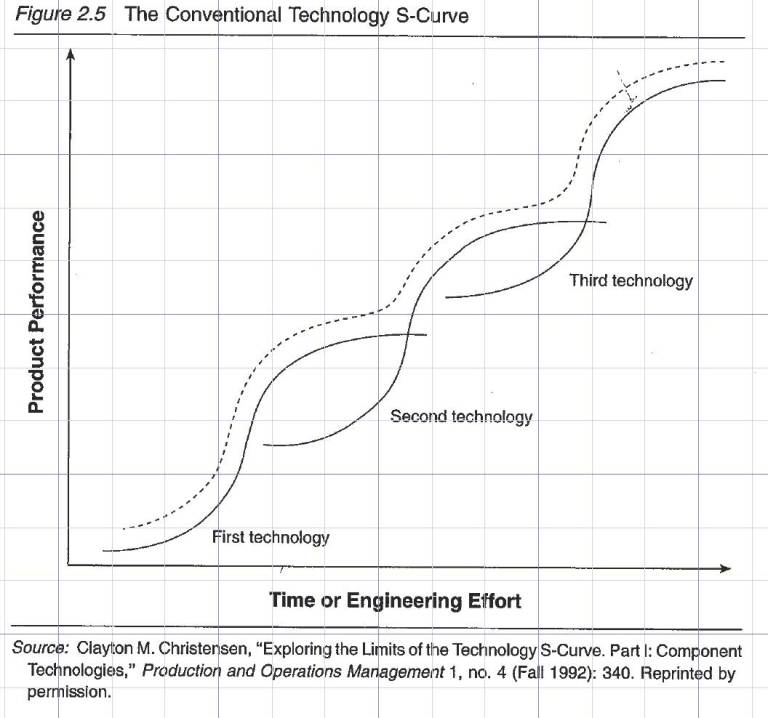
The S-Curve model of technological evolution maps  product performance against time or engineering effort to effect this performance. In this model technologies follow a S-Curve pattern of improvement but there are often alternatives and other technologies that can be switched to as a technology matures and it becomes more difficult for it to achieve particular gains. This is true of most technologies but if we regard particular bundle of business processes or workflows as a technology then then the S-Curve model can be viewed in broader light.  In other words the S-Curve model may be applied to either technological components or a new technological architecture or platform or a nexus of organisational processes and technologies. I think that even cities can be regarded as and conceptualised as global technology.

Christensen_2

The next big thing and things 

Arguably BIM allied digital fabrication is a disruptive technology that provides the possibility that new markets and services within the construction and property industry will emerge. These new markets might include a market for 3 dimensional modelling services directly connected to digital fabrication and industrialised construction methods. The parametric design and lean construction movements have forecast and predicted that disruptive technologies will change design and construction markets. Artificial Intelligence and robotics are also emerging technologies that some pundits also see as being disruptive in the foreseeable future. Certainly the emergence of coding as a competency in architectural practices is something that is now becoming increasingly necessary. This is evident for example when one looks at the business model of Design to Production  who intercede, using coding expertise, between architectural and fabrication and installation. One future scenario is that as a result of these changes design decisions and design knowledge creation will be made directly within at  the level of new digitised supply and construction chains.

The rise of new mobile applications may also have implications for how architects work on site and relate to clients. The implication of these forecast is that this will lead to architects, who have traditionally been upstream controlling and overlooking supply chains, no longer being needed at all. To what extent all of these technologies are disruptive and to what extent they might change the market, or the way architects practice is debatable.

As Christensen’s mapping of memory technology in the disk drive industry indicates industry innovation and competition is less predictable and more chaotic than one might suppose. The next big thing or disruption may not be the next big thing. Emerging technologies or innovations may overlap or intersect and not neccesarily follow each other in lockstep.

Christensen_1

It may sound strange but when I look at the above diagram and the phenomena it represents I think: This is reason why it is more important to teach architecture students how to think about technology strategically rather than to teach them the technology itself. Very few architecture schools teach anything about the strategic management of IT. We can fill our architecture schools full of subjects that teach digital skills. All over the globe there is always someone on an accreditation or visiting panel who says the architecture school isn’t teaching the right things for employability or CAD monkey utility. But if that is the case, and thats all architects do,  we might as well all go home and forget about architecture as a social, cultural and political practice.

Architects and weird robots 

Some technologies and innovations will create new markets and it is in the nature of capitalism that old markets destroy old ones. Given this there are two schools of thought about the impact on architecture. Will architecture as a discipline survive and adapt to the continuing onslaught of new technologies or will it disappear as a domain of knowledge and a practice and be replaced by weird AI robots? Architects are already pretty weird. Certainly, for architects in Australia the emergence of the project managers in the 1980s with a different and associated set of skills and technologies could be regarded as a disruptive innovation. IN Project managers were able to “create an entirely new market through the introduction of a new kind of product or service.” I personally think that apps will help to create new markets for architectural services and change the way architects do their business.

Architects, both in firms and as a profession, need to scan the horizon in order to anticipate the emergence and impact of disruptive technologies within the design, property and construction industry. But overscanning the firm’s event horizon as new technologies emerge can also be a danger. Skepticism is required. Not all new technologies or innovations will be the next big thing. Architects need to distinguish between disruptive as well as sustaining, or incremental innovations or technologies.  Not all new technologies or innovations are going to be disruptive and not all incremental technologies and innovations are going to be effective. It could be year’s before the latest app, fabrication or manufacturing process or new super nanomaterial changes the market for architectural services. Similarly, the next big thing may only be the next incremental innovation rather than what its proponents and marketers claim it to be.

Given the artisanal and seemingly primitive nature of most construction processes it is all too easy to latch onto the next big technological thing and see it as being disruptive. The contrast between new technologies and the chaos of manual labour and the scatalogical nature of building sites is an easy one to be seduced by. Architects managing firms need to assess emerging technologies and decide if they either pose a potential threat to a firm’s competitive advantage or business model or if they should be part of the firms strategic infrastructure. This assessment is important if architectural firms are to decide if a new technology is simply evolutionary, in other words an incremental improvement, or in fact is disruptive. Such an assessment will also determine the kinds of alliances a firm might take up or pursue in order to remain competitive. Architects also need to understand how emerging and disruptive technologies are changing the markets and landscape in which there clients exist in.

Architects need to debate how emerging technologies will effect their traditional markets of creating and selling design knowledge. These debates need to go beyond simplistic arguments about the employability of recent graduates and what they need to learn. How might market and industry structures change and what kind of technologies will the architectural firm of the future contain? I don’t really know the answer to these questions but I do know that Architects, architectural researchers and architectural educators need to be skeptical about the next big thing.

What architecture students should try and do over the festive season.

Architecture school won’t teach you architecture 

Don’t rely entirely on architecture school to teach you architecture. If you do you won’t learn enough to be an architect. A good architecture school is only an introduction to architecture. It should teach you a few different ways to design and give you an insight into architecture’s political, technological, cultural and historical dimensions. It’s up to you to be responsible for your own architectural education and educate yourself as an architect.

I came to this view as an architecture student in the dark ages of the 1970s and 1980s I spent very little time looking at a computer screen. At that time I  went to an architecture school that went through a lot of changes in the way that it taught its student’s architecture. When I began architecture the do-it-yourself hippies reigned supreme and by the time I graduated 10 years later the highly mannered post-modernist architects, with a regionalist bent, had the school in their grip. This instability in the school’s curricula (and staffing) meant that I could not rely on the architecture school itself to teach me everything I needed to know. It was certainly not like today’s factory like, and pedigreed, architecture schools with stable curricula and a tick the boxes approach to completing subjects. As a result, I took it upon myself to learn architecture.  As a result and to a large degree I was self taught. The festive season and holidays, depending what hemisphere you live in, is a good time to teach yourself a few things about architecture.

Get out of the computer

To live under the impression that you can learn all there is to know about architecture from a screen is a curious delusion. Ensconced in the computer some architects, and architecture students, never really leave it. The work needed to develop the lines of a computer model or simulation is intense. But all too often the 3D lines aggregated into form and then given a sense of volume take on a life and a power of their own. It is all too easy seduced by the bright lines and images on the screen. Its all too easy to privilege your own viewpoint as you use the computer.

However, architects intervene in the real world. They translate data, information and knowledge between the material world and the virtual and back again. For this reason it is extremely important  to study and observe the architectural phenomena of the so-called real world: Buildings, doors, windows, gutters, trees, spaces and the grain of different materials.  Be mindful in the way you observe these things. The purpose of this is to build up for yourself a knowledge of form and space and the relationship between things. It’s a good idea to develop a curiosity about details and try and figure out how things are made. How does a glazed window frame work? Where do the down pipes take the water? What kind of pattern is on the brick wall? What is happening in the timber grain.

Use a sketchbook

Corbusier did it. He used a sketchbook almost everyday of his life to observe and record things of interest. To included very bring and in it life, art and architecture merged. Now of course, Corbusier was the ultimate alpha male colonialist architect who would have probably worked for anyone if he had a chance. Nonetheless, his sketchbooks are full of his travels, his early sketch books show his journeys through the Orient. Greece, Rome, Venice, Istanbul and what the romantics and Beux-Arts architects called the grand tour. Many of these sketches informed his urban polemics about the modernist city. His sketches of Algerian woman became the contour lines in his paintings, plans, sections  and perspectival sketches. Of course, this has raised questions about the way he thought of women and his relationship to them.

His sketches of India include landscapes of the Himalayas drawn from the air, animals, Indian monuments and all the symbols of India’s religions. A kind of Instagram of the sub-continent. All of these sketches moments moments and sketched contributed to Corbusier’s design process. The icons and symbols that he collected through his sketches, as recorded in his sketchbook, were often re-used or  run up in his projects for the Capitol at Chandigarh. The scheme for the unbuilt Governors Palace is a good example of this. But none of the sketches made by Corbusier are in any way conventional, or academically correct, in the way they are drawn. They are messy, they are quick they re in pencil, sometimes they are coloured in. A few of them show an incredible poignancy for example the sketches of his wife’s hand the night that she passed away.

A sketchbook if kept diligently is a collection of material images and moments that can be drawn upon and used later in the design process. A sketchbook like those of the Italian architect Aldo Rossi merge life with memory and art.

Read a book

Recently in my friend’s studio the students were asked to read a book. It was like pulling teeth because architecture students hate reading. The book had words and sentences in it that if read would help the students design an important part of the community building they we asked to design for the semester. Towards the end of semester there were still a few people who did not read the book and as a result they did not do so well.

But, the great thing about being an architect is you don’t have to read that much. Nor do you have to read in English all that well. You only have to look at the plans and sections and all the other images and diagrams that describe buildings.  When I did my PhD in architectural history much of the material was written in French and sometimes German or Japanese. Most of the schemes I was studying were unbuilt and only existed as fragments in architectural magazines or in various libraries. But as an architect I was able to reconstruct what I was looking at by “reading” the plans of the utopian schemes I was studying. I did not have to read much of the text. My analysis and recovery of these schemes from the archive rested on my ability to reconstruct them in my mind as if they were real.

Go on a road trip

Get your friends and go on an architecture tour or road trip. I learnt so much doing this. Visit some buildings and try and figure out what you think of them. Are they what you imagined them to be? Are they well designed? Is their siting appropriate? Did the architect deserve the award or accolades the project was given? How does the real project differ from the way it was represented on the internet?

Can you tell from the completed project how it was designed? By this I mean is it evident if a project has been designed by a committee or has gone through a number of different, or too few iterations, in the design process. Can you tell from the physical reality if a project has been designed in particular software packages.

Make something (with your hands)

This is a really good idea. I don’t just mean attend the latest robot workshop or do some fancy stuff with the Architecture school’s 3D printer or laser cutter. Those things are good to do but I also mean that it is good to actually make something with your hands, a collage a physical model, or even a tree house. A bit of furniture. Use some tools. I was fond of making collaged comics with photocopies and sticky tape.

Sketching, reading, making, and even the architectural pilgrimage all help to bridge the gap between how something is in our minds and its constructed reality. Learning how to imagine spatial phenomena in your mind is a central element of architectural education. I fear that the computer all too often destroys this type of thinking. It is a type of thinking that seems to link memory and emotion with spatial imagination. It is a kind of thinking that is critical if architects are to create the cities of the future.