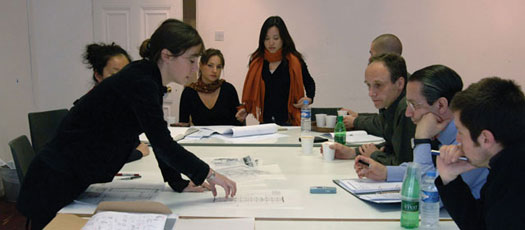

Avoiding architectural extinction: The hazards and joys of interdisciplinary architectural practice and research.

Last week I blogged about branding and I got some comments back saying that it was all about the actual design of the building and “branding” was a superficial concept. Of course, design should be  paramount. In this week’s longer blog  I write about the need for authentic interdisciplinarity in architectural education, research and practice. 

In architecture there has always been a lot of talk about interdisciplinarity. Architecture, both as a field of research knowledge and as it is practiced has always crossed borders. Architectural education at its best gives, to those of us who subscribe to the cult of architecture, both generalist skills and the ability to understand, in detail specific areas of knowledge. Well trained architects are knowledgeable in construction techniques, urban planning, the  sciences (particularly the environmental sciences) and for some mediating cultural difference is essential; not to mention the world of organisational behaviour and science. On a design project architects are expected to make decisions about space planning, function, structure, environmental services, statutory regulations, contracts, construction methods (costs and details), organisational behaviour and heritage issues. In addition, knowledge of aesthetics is important: tectonics, style, methods of visual abstraction and how things look in the finished form (colour, paint, materials). And of course, and uniquely, spatiality. By this latter term I mean how things will appear, and made present, in three dimensions in space.

History of the city

High in my pecking order of things architects need to know about and research is  history. Why? In some way’s history can glue all the diverse archipelago of knowledge that constitutes architecture together; also architecture has its own traditions and histories. Buildings, cities, cultures, people all have history. These histories are all intertwined with architecture. The gradual erasure, of history and theory, in architecture schools is probably one of the most barbaric things to happen to the discipline. Nowadays, who needs history when you have the immediate gratifying moment of architecture in the internet world of dezeen, archdaily or snapchat.

Architects are expected to have knowledge across many domains as well as enough detailed knowledge within different domains to make decisions. The architect must make decisions that are both strategic and detailed and operational.  Some  architects can easily move across the spectrum and between these different scales of decision. But some architects get stuck at the extremes of these two poles. In other words some architects think more towards the “big picture” end of the spectrum and strategic and other architects can only think around the detail end of the spectrum. The best architects are those that can do both, or at least recognise both ends of the spectrum. This is what we might call interdisciplinary thinking.

Of course this kind of interdisciplinary thinking, or the idea of it at least, has its hazards. In higher education I would be rich if I had a few dollars for every time I heard the words interdisciplinary. It is an idea, with its associated mantras, that seems to have been been around forever. When I started architecture school the Yakka overalled, bearded (original hipsters?) greenie architects were always talking about. Well, talking about it between tokes on their spliffs. It was their way to take down a provincial profession centred on the gentleman architect.

Systems theory

I think to some extent the idea of interdisciplinarity it is related to the dream of systems theory. The idea that by understanding the world as a series of systems we can then begin to link together different systems and l of knowledge. The multi-talented Gregory Bateson was a key proponent of this and it has been said of him that “Bateson’s epistemology proposes a ‘communicational world’ based on cybernetics, systems theory, and ecology.” Wow ! Let me write that again: WOW ! In the 1920s, Bertalannfy, the founder of General Systems Theory, was to contrast the mechanistic approach to biological disciplines and he consequently ‘advocated an organismic conception in biology which emphasizes consideration for the organism as a whole or system, and sees the main objective of biological sciences in the discovery of the principles of organization at its various levels.’  (Bertalanffy, General System Theory, 12.). In 1968, he wrote that ‘If someone were to analyse current notions and fashionable catchwords they would find “systems” high on the list. The concept has pervaded all fields of science and penetrated into popular thinking, jargon and mass media’(General System Theory, 3.). It kind of sounds familiar and such sentiments appear to point to the influence of General Systems Theory in architectural discourse. In effect, and arguably without systems thinking, and related concepts we may not have all of the discourse and polemics attached to parametric design.

Higher education and research 

The above dreams of unified and general systems seem to spur on the idea that universities are one place where systems and cross disciplinary thinking can be fostered and encouraged. But, the problem is real collaboration comes together when common platforms of thought are bought together, and in a sense even into conflict, from disparate fields of knowledge (not to mention inclusiveness). For  architectural educators working with educators from other disciplines this generally means: agreeing on a common design processes, understanding different disciplinary conceptions of design, agreeing on hierarchies of knowledge and circumscribing what should be included in any particular curricula or syllabus.

In the architectural education setting this means agreeing on joint learning aims and outcomes. This is not to sound critical of any one university or program. We all want to teach the modes of interdisciplinary thinking as this is important for future graduates. It is not simply about teaching a bit of architecture and then teaching a bit of engineering, or product design or whatever it is side by side each. It’s not simply a matter of offering broad humanities subjects alongside architecture, or just renaming things. Too often this kind of thing ends up being about teaching by committee. where the committee devises the syllabus and the syllabus is a grab bag of topics. I suppose one of the reasons I hate planners is that they are always talking about interdisciplinary perspectives and yet when push comes to shove few of them seem that interested in the aesthetics, spatial considerations and design processes. I would love to run a studio with planners but they never seem to be that interested. As I have written elsewhere few planners seem interested in learning about design thinking.

In this context implementation of truly interdisciplinary teaching and research programs is the key to real success and positioning in the competitive word of the future knowledge economy. Not just packaging up, shuffling subjects, or research topics, around, renaming and then branding these different units.  But effective leadership and implementation is so important if interdisciplinary architectural and research education is of real concern. And this is why the studio is so important in architectural education and research because it is the central, perhaps the only place, for this kind of thinking to take place.

My sad experience in the discipline of architecture is that interdisciplinary research is too often overlooked in favour of research that is narrow and highly specific and technical. Maybe, it’s always been like this I guess. Of course I don’t want to sound like a pompous whiner. But, if you are a generalist, as most architects trained before the millenia are, or a humanities graduate with some ideas of crossing a few different areas, or conducting research on the perimeter, or at the limits of your discipline, you will probably have trouble getting funding. Perhaps this is why architectural research is so underfunded.

Doing it 

Thankfully, in the real world interdisciplinary thinking is embedded in architectural practice itself. In getting projects built architects, engineers, consultants, user groups of different cultures all come together. One of the really key parties in the project mix are the sub contractors. Often, despite their unfashionable high-viz vested ways and penchant for non inclusive language, they are the ones where the information is. My friend, the esteemed professor, of construction management once said that in the future he thought that all the design decisions would be made in the supply chain.  Of course one thing he meant is that it is in the supply chain where real interdisciplinary practice often takes place. That is where  architects conveying the concerns of the clients across a number of dimensions, problem solving with other specialist disciplines, seeking information from both contractors and subcontractors in order to make complex and difficult decisions.

The prospect of extinction. 

architects need to acknowledge the interdisciplinary aspects of architecture in design studio education, research and practice. Otherwise, our profession will become increasingly typecast as a profession of “technical specialists” who draw the design. Otherwise, our work will become increasingly commodified and that’s a recipe for diminishing returns and extinction.


It is what is called swot vac here in our graduate school of architetcure. We are now well and truly in the crazy season and quite a few of my students have gone to ground; hopefully to remerge, like butterflies form a chrysalis, with beautifully imaged projects next week at the studio juries.  

Loathing the the bow-tied, botoxed yellow traced architect dandy: In search of a new brand strategy for Australian architecture.

This week I consider the necessity of taking a more spohisticated approach to branding the architectural profession.

Recently a friend told me the story of visiting an eminent architect on the weekend in his specially designed holiday house. My friend was visiting with her partner, and another friend, a  wealthy philanthropist who potentially had oodles of money to spend on architecture and architects. To my friend’s horror the party of visitors found the eminent architect reclining in his Eamesy Carlo Mollino chairy chaise lounge thing and casually doing a few Sunday afternoon sketches with, of all things, charcoal sticks and yellow trace. He was even wearing a bow tie for god’s sake (I can’t even tie one of those) and my friend swore she could see signs of Botox on his brow. The contrived nature of this scene, he had been warned that th emoney was coming to visit, shocked both my friend, and the philanthropist, who afterwards felt no desire to commission anything with someone so flirtatiously pretentious.

The architecture brand, and the branded architect, is bedevilled by superficial gestures that seem to play up on a broader notion of the architect as a kind of creative genius with yellow trace. Whenever I go out to dinner and meet bankers, lawyers, managing consultants, doctors or medical specialists (especially the anesthetists) they all say, “oh so you are an architect” and then “that’s SOOOO interesting” and then the punch line ” I always wanted to be an architect.” I hate that so much. But usually, like most architects I just grit my teeth and try to smile. However, we really should stop putting up with this shit and tell people what we really do. And then charge them lots of moolah for it.

But, my own pet hates aside, the above situations do raise the question of branding. How should architects brand themselves and their services? Should we rely on the old tropes of the creative dandy with the yellow trace? Or should the profession seek to brand and promote itself in entirely new ways? Ways that address the global commodification of space, the rapid evolution of social media and the  disconnection of community experienced by various publics.

Interestingly Assemble, who won the 2015 Turner prize, are a collective that suggest how changes in contemporary practice require architects to think about branding. Firstly assemble is not one (one genius), or two (one male genius plus one “business” type) or even three architects (one genius, one “business” type and one “networker”). We all know about these tropes and its great that Assemble has 18 members and it proclaims to “work across the fields of art, architecture and design.” More interestingly Assemble claim to “involve the public as both participant and collaborator in the ongoing realisation of the work.”

This is a really different model of practice and it is one that suggests a different approach to branding the architectural firm (if you want to call it that) rather than one just based on a name or a cult of aesthetic dandyism and pretentious yellow tracings.  Powerful brands for architectural firms are those that connect with the public (not only the clients) that they serve. To do this requires a firm strategy that connects a strong narrative to the firm’s public as well as its potential clients. Just having some superficial and funky graphics, and a bow tie, and a cool geographical name is not really enough these days.

The big star brands in global architecture such as OMA, ZHA, Gehry, Fosters and Rogers are really good at branding. They all have a story to tell. Their brands are built on being able to control, market and amplify themselves through various communication channels and media. In these instances, these firms are more well known, and better branded, than much larger firms such as HOK or Gensler or AECOM who gain more revenue in dollar terms than the celebrity architectural brands. These days only a few Australian architectural firms make the global rankings published each year by Building Design magazine. Hence, there is no reason why any firm for that matter can seem much more potent than what it is via effective branding and control over different and emerging media channels.

In strategic management theory effective branding is way to position a firm in relation to its competitors. Derived from firm strategy it should guide and be the template for communicating the firms’ core services, client and user experience and social media interactions. It should also guide and be integrated with a firm’s working culture. Too often the connection between and the perception of the architects brand and the internal working culture of the office is in conflict.

In some ways architects are rooted and based the local architectural culture and traditions of their own city. An effective and well through out brand can enable, even a small firm, to look much bigger than it is. As someone recently asked me what are the attributes of Australia’s architectural brand in the global system and how does this compare to the branding of Danish, French, English or Italian architects. Is the global brand of Australian architecture simply perceived through the lense of Murcutt sheds, The Opera House or maybe its all about swimming pools?

Whenever, as architects, we go to the Venice Architectural Biennale why do we so admire the Nordic pavilion and the Nordic architects represented in it. Why can’t Australian’s just exhibit the work of a few architects, or focus on a few themes, in our pavilion instead of having some kind of generic free for all where every firm, or mediocre idea, gets a guernsey?

Other professions, such as the lawyers and the accountants, have done a better job of promoting themselves to the public. Architects have done little to do craft brand strategy’s in any collective sense and it shows. As a global brand architect’s need to do more work to promote Australian architecture as a place of architectural experiment with its own unique cities, landscape, canon and traditions. I guess I am sick of seeing architecture being seen as some kind of washed out and generic supermarket brand.

It’s time architects collectively realised that branding is not just about a the old tropes, a few cool names, a bit of funky graphics, bow ties and yellow trace. After all is said and done its really about the narrative.

The crazy season is upon us in the small corner of my universe known as the graduate architecture school.  The students have two weeks to go and quite a few of them already started sleeping in the atrium. 

Waiting for the Barbarians: For architects there are no right answers only wicked problems.

This week I discuss the need to acknowledge wicked problems in architecture. 

Why have our two consuls and praetors come out today
wearing their embroidered, their scarlet togas?
Why have they put on bracelets with so many amethysts,
and rings sparkling with magnificent emeralds?
Why are they carrying elegant canes
beautifully worked in silver and gold?

 
            Because the barbarians are coming today
            and things like that dazzle the barbarians.

Waiting for the Barbarians C.P. Cavafy 

The Wicked Problem 

Most practicing architects subscribe to the idea of the wicked problem. For architects wicked problems exists. Its a aprt of their everyday life. But for the rest of the world they dont. This makes life hard for architects who by virtue of their intense, and a longer than usual, education can see the different dimensions of urban and architectural problems in greater detail. But, the rest of the world wants answers and why not?

A central concept underpinning architecture is the idea of the wicked problem. The wicked problem was first formulated and expounded by Rittel and Webber  in a 1973 paper entitled “Dilemmas in a General Theory Planning.” The paper highlighted that scientific problems are different to wicked problems in which, because of their complexity,  there are no “solutions” in the sense of definitive and objective answers. Rittel and Webber’s paper was a response to the critiques of professions and professional and elitist knowledge that emerged in the wake of 1968 and with the critiques of high modernism.  As they state “The professional’s job was once seen as solving an assortment of problems that appeared to be definable, understandable and consensual.” But they argue that the failure of specialised, or seemingly elitist, professionals or knowledge workers to solve these problems is not the professionals fault. The fault is the type of wicked problems that architects, planners, landscape architects and urban designers are faced with.

As a young architecture student and it was put to us that our future careers would be tied to solving wicked problems. That’s a hard truth to have to tell archietcure stduents today. As most architects will appreciate wicked problems have the following characteristics.

Problems of definition

Wicked problems are not easily defined. When presented with a wicked problem conceptualisation will never capture the dimensions of the entire problem.  To think a wicked problem can be defined may actually make it harder to solve.

Thinking of architecture as something that is about simple problem solving does not really hack it with me. Resolving a brief and then applying this to site conditions with a few sustainability, urban design, (fill in the gap), gestures thrown in and thinking this solves a  problem is mostly fantasy to me.

There are right answers

To think a problem can be definitively solved is a fantasy is because wicked problems never end. They do not have a finite life or a finite boundary. they tend to reverberate long after the project is built. Moreover, wicked problems are such that you don’t actually know when they are solved. As Rittel and Webber state:  “Wicked problems have no stopping rule In solving a chess problem or a mathematical equation, the problem-solver knows when he has done his job. There are criteria that tell when the or a solution has been found. Not so for the wicked problem.” In other words there is no way to test a solution to a wicked problem.

I guess most clients of architects expect answers and expect solutions that are ideal or “correct” propositions. After all that is what they are paying for. Yet architects are often caught having to explain, and indeed educate, clients that in some circumstances there are no ideal answers. There are no true or false answers to wicked problems. Moreover, attempted solutions to such problems exist on a spectrum between less bad and bad. Try explaining that to a client who is paying for your services.

Most architectural projects are the result of unique circumstance. No matter how much architects try there is often little knowledge that is directly transferred from project to project. Like architectural projects Every solution to a wicked problem is a “one-shot operation.” In architecture it is not possible to employ trial and error. Once the building or the project is complete it is complete.  There is no chance to reflect on its flaws and rebuild it. One way architects try to overcome this is by employing processes of design iteration and prototyping (digital and physical) to try and explore different options and solutions in a given situation. But a lot of clients don’t want to pay for these iterations and they don’t understand why architects can’t get it right the first time. After all, in the client’s mind we are the experts. It’s all too easy for our competitors to offer simplistic and cheaper solutions. Easy answers and trash for cash.

As Rittel and Webber note: “Every wicked problem can be considered to be a symptom of another problem.” 

For an architect even the smallest budget renovation, a bathroom or perhaps an extra bedroom or living space on a house is a snakepit of complex problems. Planning regulations, limited budgets, service availability alongside client requirements and taste cultures make the renovation or small house one of the most complex things an architect can design. The smaller size of a project does not necessarily imply that the problems are any less or that the architect’s duty to act responsibly is any less.

Teaching and Research 

My students look sad and disoriented when they tell them there are no right answers. They are more employable if the understand this. But,in the realm of architectural education students, who now pay small fortunes to attend university, just want to come to class and know exactly what it is that they need to learn so they can pass. Any attempt to simulate the fluidity and ambiguity of the real world in the lecture theatre is increasingly more difficult and usually fails. As a result I would contend that the managerial emphasis on measures of so-called “teaching quality” is correlated with the drifting downward statistics on graduate employment outcomes. In teaching to “customers” rather than students the employers easily end up saying our graduate students are crap and this gets into the ears of the shock jocks and the populist politicians.

Wicked problems like most architectural projects are fluid and highly ambiguous. The managerialists as well as the shock jocks don’t want to hear this. Increasingly architects, and other domains of professional knowledge in the built environment, are too often derided as being elitist and damaging in that, all too familiar, anti-common sense way.  Federation Square and Southern Cross Station are two recent examples of this tendency. The irrational and global backlash against climate science, and scientists, is perhaps another symptom of this. Brexit and the rise of Trump and his associated policy settings is probably another phenomena associated with this.

In Australia there is a lack of research funding that is  accepted by a political class enticed and seeped in this global culture of anti-intellectualism and anti-elitism. We are witness to a political class that regularly derides research and evidence based policy. Architectural academics and indeed architects need to counter this by communicating what we are doing more effectively to the public. As architects we need to highlight the everyday wicked problems we are faced with and argue our case with both clients and policy makers. Otherwise, we are just waiting around for the barbarians who are too easily bedazzled by simplistic solutions and so-called right answers.


Surviving the Design Studio: 10 things design tutors really really hate (and like) about Archi students.

This week I discuss how to make the most of being in a design studio at architecture school.

I will keep this one short and simple. The following is based on my own experiences and I was trying to figure out how many design studios I had actually taught over the years. I think it is around 30. Maybe more. On average about one a year since I graduated. Most studios have been pretty good and my current students this semester at MSD are awesome. Some studios have been bad; usually as a result of a bad combination of mismatched expectations (usually: tutor expects students to do work, students not motivated to work). Of course some studios I have done are great and memorable. A few studios and moments spring to mind “The Springtime for Hitler Studio” (Speer’s classicism), the studio when I jumped on the student’s model ( a really bad move), the Situationist studio when all the students hated me and I pretended to be Debord, the fire station studios, the tower studios, the Mexico Studios and the summer studios both at RMIT and MSD. Studios with friends or colleagues too numerous to mention although the early studios I did with Neil Masterton of ARM were great. The ones I did with Dr. Karen Burns whilst doing my PhD were memorable. Now I am sounding perhaps all too nostalgic. But, nostalgia for past studio glory means nothing. The real point to remember for architects, design tutors and architecture students is you are only as good as your last studio or project.

So here is the list of the things we as tutors both like and of course hate, and I mean really hate. If you are doing more than five of these hate things then maybe you should not be at architecture school.

10 things that design tutors really like/hate.

1. Turning up 

Hate: Not turning up without a prior email or message. It’s always best to turn up to the crit than not turn up. The one thing a studio tutor hates more than anything else is a student who does not turn up.

Like: A courteous email or text to say you are not turning up.

2. Being on time

Hate: Turning up late after you have had the main discussion with everyone else in the studio.

Like: Being on time

3. Being present 

Hate: Spending the entire session looking at you from behind a PC or multi-tasking on a phone (of course I am being a little hypocritical in mentioning this).

Like: Being present to interacting and listening to all of the conversations in the studio.

4: Listening when other students present their work.

Hate: Just turning up for your presentation. Not engaging with the presentations of other students.

Like: Engaging with and asking questions when other students present. Most good tutors like to hear questions from other students when someone is presenting. After all the reason we have studio groups is so that individual students can see and learn from what other students are doing when confronted with the same problem.

5. Working consistently

Hate: This is really a bundle of syndromes. Doing a lot of work at the end of semester or just doing enough work to get by each week. The tragedy of this is that a design project could have been so much better if the work did not happen in short bursts. Students who consistently do this often wonder why there marks are lower or the get bad crits at the final.

Like: Students that work consistently and produce something no matter how seemingly minor each week.

6. Doing a lot of work. 

Hate:  Getting the project up to a reasonable point for mid semester and then just stopping work for a few weeks until the end.

Like: Doing lots of work each week. Letting your tutor know when you have other time pressures.

7. Seeking help when stuck 

Hate: getting stuck after a 1 hour of design work and then waiting a whole week to see a tutor. Worse still employing “getting stuck” as an obvious excuse to do no work.

Like: Student who contacts tutor or friends as soon as they are stuck in order to get unstuck.

8. Avoiding print queue excuses. 

Hate: Making excuses. The more common ones being: Print queues, IT problems (May variations on this one) and Laptop stolen. Problems printing seems to be an affliction that strikes a small but significant minority of architecture students.

Like: A student that seems to be constantly reflecting on and improving their own design and project workflow. A student constantly checking in with the tutor about this. A student organised enough not to print at the last-minute.

9. Drawing it rather than talking it up. 

Hate: Minimal drawings or diagrams on the wall or the screen and then a long, long intimate description of the concept, what the design will be like and the student’s semester narrative. It’s really annoying when this style of presentation is repeated each week with little or no design development.

Like: Students who talk succinctly and have  drawings  on the wall that describe the current state of their projects development.

10. Students who know architectural history. 

Hate: Students who look at you blankly when you mention famous 20th C architect, 21st C architect or iconic project’s constructed in the last 10 years. As tutors in the modern era we need to respect our students as “customers.” But it is pretty hard to know what to say, apart from a non customer-centric  profanity, when the occasional student does not know who Corbusier (let alone Terragni or Libera) is. The crazy thing is most students at architecture school do history but there are still some who don’t really get it.

Like: Student’s who know something of architectural history and read actual architecture books as well as following architectural discourse on social media.

Finally 

Mostly, as design tutors we want to be generous, we want to help people, we want everyone to do well and produce great projects. We want great students in our studios, we want to teach  in the best way that best prepares architecture students for the real world. Moreover, tutors want all their students to be resilient, successful and great architects. Sadly, in the managerialised and “customer” orientated university the above is getting harder and harder to do.

I have survived the week back after the teaching break, recovered from my painful sinus infection and now my MSD MArch students have about three weeks to get their projects complete. Yesterday in the studio we had  sustainabilty, structural and mechanical consultants from AURECON come in and enage with the stduents designs. It was a great session. 

Getting Jiggy with Research: 6 ways for architects to create upstream knowledge.

Research is vital to architectural practice. So I thought I would rewrite, revise and update some of the practical comments from a previous post from December 2015. 

Research and Development is central to any relationship, engagement or linkage between architecture academia, practitioners and emerging businesses. Perhaps this goes without saying but too often it needs to be spelt out. Numerous architectural websites and brochures are full of statements about how research is valued and prioritised. But sometimes it all seems a little bit too “feel goody” and “mission statement” like for me. Architects need to be specific about their research aspirations.

Most architectural firms are keen to go upstream. By going upstream I mean creating distinct knowledge that helps a firm to get clients and charge more. There are however, I think a few things small firms and teams of architects can do to amplify their research capabilities. Even larger architectural firms would benefit from some of these suggested strategies about research.

1. Actually have a research strategy

Research involves developing knowledge or expertise in a particular area. But this knowledge needs to be integrated across the firm. For that reason it makes sense that an architectural practice would focus their research efforts in a way that aligns with their business strategy (if they have one). If the firm seeks to develop a competitive advantage in health, or facade design, or sustainable design or some aspect of urban design then its research efforts should align with this.

Whilst it is important, it may not be as effective to pursue research, or view research, as simply being about implementing new technologies in the office or figuring out what the next bit of funky software the firm should buy (see no. 2 below). Sometimes the line between these activities and strategic research is blurred. One office I worked for, in the earlier days of CAD, did spend a lot of time researching and understanding the expressive possibilities of CAD design and architectural representation. As CAD developed this gave them a large competitive advantage. Clearly the knowledge and research gained, as CAD systems themselves developed, had strategic benefit to the firm. In any case, I would always push for a line of research in the office that is at least aligned with its current strategies or with its intention to develop new areas of expertise.

Research is not simply about finding out about new materials, or the latest technical thingo, for your latest project and then filing the information into an electronic folder for later reference. Unless, of course you think that the knowledge you gain from the material and technical research process can be used elsewhere. But, I think that is what all architects think: That extra research or knowledge they gain on one project can be used on another. But I am a little sceptical about this as it seems too adhoc. Especially, if the firm does not have a research strategy or its projects are highly customised and different each time.

2. Wacky research is ok.

Of course sometimes architects might do research just for the hell of it (this kind of contradicts the first point above). There is a balancing act between conducting research to improve current capabilities versus working on seemingly new and radical innovations. Getting the balance right is important but sometimes research needs to be wacky. Research is about trial and error and indeed about making mistakes. That is in part what research is about. Buckminster Fuller is a pretty good example of this.

Politicians and shock jocks

Of course if you are a politician or a shock jock or a member of conservative think tank all research has to be somehow “practical” not “obscure” and have some demonstrable value to the tabloid reading public. I guess that’s how politicians and some journalists think. It’s a weird position to take. Because most of the people who espouse this view, especially the political class, have never have never really ever worked in the real world.

For those of us who have worked and struggled with their own business in the real world you understand that you have to undertake research, or take positions, that are risky or may not have an obvious or immediate benefit. But it’s the risky research that’s probably going to give a firm the real disruptive edge in business. Arguably, the obvious less risky thing is the thing everyone else is doing as well.

Firms, universities and individual researchers, gain competitive advantage when they pursue knowledge for its own sake.

3. Create a Research network

As one of my friend’s has done in his practice Architectural firms who prioritise research build an ecosystem of mentors, advisers and experts that they can interact with to debate and test new ideas. Almost all start-up companies will have advisory boards that advise them through the pitfalls and hazards of commercialising an idea and then growing. So why not architects? For architects, networking of course isn’t necessarily always about trying to find new jobs. It can also be about gaining knowledge of what is going on across the domains of knowledge where you practice. At least one person in any practice needs scan the horizon for new ideas or the latest research developments.

Although it is far removed form small architectural practices good example of creating a research network is the Google example. The Google platform is an ecosystem that includes consumers, software innovators, content providers and advertisers. It is a permeable system where outsiders can also become collaborators. Hence, it is not simply a matter of trucking in people or experts to help you solve a problem. It is about creating a network or ecosystem of collaborators who can help a firm to create new knowledge and to also understand what is happening within architectural and urban discourse.

4. Use your staff to create research knowledge.

Another dilemma for architects is how to organise a firm to do research. In the old days all wisdom in the office came from the Master. The so-called Master was not unlike Gary Cooper in the Fountainhead movie. He (sadly, always a he) was usually the architectural designer who by force of ego, class background, cachet of education, or through experience and perseverance.

When I worked for a “Master” in the 1980s as a young architecture student I could do nothing right and you can imagine what this did for my confidence as a designer. He was a truly good architect and in later years proved to be a designer of international note. But, he was also never wrong and always insistently right. Contending with the Master’s wisdom was really not a great career move. It was a little bit like being in a cult. Master’s love acolytes and they of course like acolytes who agree with them. The worst thing a firm can do is to create teams in its own image rather than diverse teams that I would argue are they key to creativity.

Ownership of new conceptual ideas or design processes more often than not is, and should be, shared. It never really resides in the mind of one person no matter how much symbolic capital they may have as a master. As they say at Pixar: “A company’s communication structure should not mirror its organisational structure. Everybody should be able to talk to anybody.”

This might be why my favourite model of Knowledge Management or is based on the Japanese management theoretician Nonaka whose work points the importance of knowledge as a vital source of competitive advantage, there is little understanding of how organisations actually create and manage knowledge dynamically.” Nonaka and his colleagues understand that knowledge creation in an architectural firm, or any firm for that matter, is a collaborative and iterative process.

5. Collaborate with academics.

Bring academics into your firm’s research ecosystem. The problem is academics are often time poor and hemmed in by teaching commitments and an overly regulated bureaucracy. On the other hand not all academics understand the dynamics of practice or business protocols. But, most academics in architecture schools love to do research. They also like to talk about it. Because of this it is a good idea to contact and foster the participation of academic researchers (like me!) into a practice’s work. Invite them in as critics. Invite them to the firm’s Christmas party. Get them drunk and see what they say. Allow them to participate in planning workshops or esquisses. This will help the academics understand the pressures and time frames of the practice. It will also get them thinking about what you do as a firm and what you can do better. It’s like having your very own free management consultant attached to your firm (sort of).  Before you know it you will become part of some useful collaborative research projects.

6. Teach a studio.

One good way to conduct research and create new knowledge is to teach a studio at an architecture school.

In setting up and running a studio the knowledge created can then help the studio leaders, as practitioners, to position and locate themselves in relation to various policy debates, and emerging programs, as they emerge in urban discourse. This enables a firm that teaches to gain an advantage over its competitors by actively being a part of an ongoing public and policy debates. After all isn’t that what it’s all about.

 I have been pretty sick this week with a cold I caught on the plane from the conference in Manchester that then turned into an excruciating sinus infection. But, this week at my great architecture school and faculty we are launching an entrepreneur’s breakfast. The basic idea is to get the disciplines within our faculty to engage and come into contact with entrepreneurs, founders of start up companies and for academics and higher degree students to have a greater appreciation of innovation systems, business entrepreneurship, the magical and mystical world of venture capital and perhaps more importantly how to manage small businesses so that they grow into more sustainable ones. 

Surviving the Design Studio: Symptoms and cures of pre-design crit anxiety.

It was RUOK day in my part of the world last week and this got me thinking. I also spoke to a friend who told me how much she dreaded crits in architecture school. Anxiety is one of the most debilitating things that can beset you prior to design jury or a crit. It’s hard enough being an architecture student. No money, long hours, and the struggle to learn a complex discipline. Pre-design crit anxiety can be crippling. It can certainly stop you from working effectively and it can prevent you from communicating your ideas and what you have done effectively in the actual crit. You are not alone almost every architect or architecture student has had to face this anxiety.

Of course, it is worse if you are approaching a project deadline or the end of semester. It is worse if you do not think that your tutors, or the client group, or a consultant, is not on your side. It is also worse if you feel that maybe you haven’t done enough work and it is even worse when you are earnestly struggling to build your skills, design confidence and resilience.

I am writing this from a number of perspectives. Firstly, as someone who knows what it is like to be anxious about a studio crit or a meeting. But also as someone who is on the other side as a critic who has seen the anxiety of architects and architecture students. As a young design tutor straight out of my cultish architecture school I was a somewhat fierce and unreasonable critic who developed a reputation for making students cry and jumping on models. Thankfully, after 30 years those people have forgiven me and I now realise how reprehensible and disgusting my earlier behaviour was.

There are of course a number of things you can do to manage the situation and manage your anxiety before that terrifying crit or design jury. Here are my suggestions:

Sympton 1: Thinking the worst

 Your imagination can run wild, you can think that the worst will happen. You will be cut down by other architects, the client or jury members, and you will be humiliated amongst your peers. I suffered from this and it can be debilitating. Don’t replay in your imagination the worst things that people might say to you.

Cure: Remembering most critics are interested and want to help.  

Thinking that the worst can happen is never good. I have been in and seen some pretty bad crits in my life. But, nowadays days these are extremely rare. Most design jurors and critter people in the 21st century are a pretty decent lot. Find out from your tutor who they are and do a bit of research. Usually, they are attending because they are either a convenient friend of your tutor or they have some kind of special expertise that is relevant to the studio.

They will probably not tell you that your work is appalling or rip the prints of the wall or jump on your model. It is unlikely they will belittle you or humiliate you.

They will tell you what they think and usually they try to be honest. Mostly, they will be interested in what you have done.

If you feel anxious before the crit try imaging the sort of interesting questions they might ask you. Make a plan for what you will do before the crit and what you will say. Don’t just turn up and wing it. Be prepared. Making a plan of what you will say and even practicing it in front of a mirror before hand will help you minimise your own anxieties. In other words, imagine them asking you the questions you want them to ask. Imagine the crit going well rehearse what you a going to say using this formula set out in my previous blog.

Sympton 2: Over work anxiety, 

 Anxiety feeds off overwork. Not enough fun or enough rest will fuel it. After my own architecture thesis I went camping on a river and just sat in a camp chair for about ten days and did not move. I was so burnt out from overwork. This can happen to anyone no matter how old you are. I have known student’s who haven’t stopped working hard since high school. At some point they discover they need a break because they are really burnt out.

Working all night will fuel pre-crit anxiety. Not getting enough exercise will make you more anxious. Or just have a rest or go out and play with your friends. There is no point working and working and working and getting so tired. If you are tired before the crit your anxiety will be harder to manage.

Cure: Have fun and get balanced.

If it gets really bad go for a walk. Go to the pub. Go shopping. Go out with friends. Sometime you can overdose, and burnout, on a design project or a studio or even a course. Read this.

Be mindful, try meditating, there are some really good apps you can get that will lead you through some great mindfulness exercises.

Symptom 3: The best friend of Anxiety is procrastination.

I might have said this here before on this blog, but procrastinating, by deferring the activity of design and design gestures, will only make your anxiety worse. Designing is a labour intensive exercise (especially if you are using a computer). Putting it off only means you have to do the same amount of work in less time. Designs are not made and fully formed in the brain and then exactly transferred to the computer or paper or the physical model. If only we could do this life would be so much easier. Designing takes time.

Cure: Work constantly.

Reading, researching, writing little notes, thinking while drinking that batch brew or Aero press coffee, going to the fridge and eating, web surfing and Google searching are all the fabulous ways to defer the actual act of designing. The problem is designing is about either physical or digital drawing and the sooner you start the better. You will be less stressed if you work constantly throughout the studio and avoid procrastination. If you do feel stuck get help or advice from your tutor to get unstuck.

 Symptom 4: The other people are always better

 There will always be someone in your studio who seems better, smarter, more creative and more like one of those over confident alpha-male architects. Thinking this is real recipe for anxiety. You will always be your own worst critic and these other people will always seem better. I mean who needs design tutors or guest critics when you are so good at demolishing your own design thinking and ideas?

Cure: Run your own design race.

It’s best to solve your own problems rather blaming others or being focused on your fellow studio members. Run your own race. Believe me you will actually end up doing better. Focusing and comparing yourself to others is waste of energy. They will always seem better and if you think like this your anxiety will easily be fuelled.

Symptom 5: Critical negativity

Also, don’t compete against yourself. Know when to give yourself a break and when to be critical of your own judgements. Too often I see students tied up in knots and paralysed by their own critical negativity. As designers we need to question. But we don’t need to question every single tiny thing related to a building design. The worse architecture schools on the planet are the ones who promote this kind of claptrap critical negative method.

Cure: Remember there are no right answers

Sometimes it’s often better to design something, anything really, even if you think it might be “wrong”. The alternative is always to be searching for the “right” or correct idea and that is an ideal that doesn’t exist. Or after you have developed an idea for a while in your design its thrown it out and everything else with it. Because it is not correct. I see a lot of this. To develop design confidence and resilience you need practice in developing a design.

Symptom 6: Don’t kick the cat; or anyone else for that matter.

This is a rare but not uncommon symptom of anxious students. People and indeed architects under pressure who get extremely anxious sometimes release that pressure by lashing out at their pets or others. Please don’t kick your dog or cat when you get anxious about the upcoming crit. It is also really good idea to not lash out or blame your tutor, or your fellow classmates, for your anxiety. Usually your design tutor is trying their best to guide you and get you through.

Also, speaking from experience, your tutor will not think highly of you if you do this. I am usually relatively understanding if someone lashes out at me when they are under pressure during the studio. There is not a lot I can do when it happens. But, as a tutor it is not pleasant and usually it means that after the studio is finished I don’t really want to have much to do with the lasher-outer type.

Cure: Don’t bottle things up and build ongoing relationships.

Instead of lashing out talk to your tutors and your peers about your fears and anxieties. You might find everyone, tutors included, are just as worried as you are. Try and remember that after the studio has finished the most important thing you can do as an architecture student is to retain and have a continuing relationship with your peers and those who have taught you as an architect. Each studio is an opportunity to build your future professional networks.

Symptom 7: So maybe you haven’t done a lot of work and that’s why you are anxious.

 Yep. You realise there is only two weeks left in the studio and the deadline is looming. You are definitely going down the tubes because you did not do enough work earlier in the semester. You are running out of time. You have been too busy having fun or you haven’t really been thinking about the time. You are not sure how you are going to actually get everything done. Even if you work all day and all night you think that you are going to fail.

Cure: Get help

Symptom 7, along with just about everything symptom above, is best cured by getting help.

Tell your tutor your predicament. Most tutors will be sympathetic. Most tutors want you to pass and even if they recognise that you have done no work they will still help you. But to do that you need to get their help and you need to be honest and realistic about what you need to do. Talk to your friends try and enlist their help as well.

Finally

If of course your anxiety is becoming to much of a burden you may need to get help from a counsellor or your GP. Most universities and architecture schools have avenues and contacts that can help you overcome anxiety. Sometimes the worst thing you can do is to think you can just push through and ride out the anxiety. It’s a lot easier if you always get help and remember that you are not invincible. The most important thing to remember is that you are not the only one to ever feel anxiety prior to a design crit.

Surviving the Design Studio: You will never be an architect unless you make physical models.

The realisation came about a week or so a go at the mid semester crits in our Colliding Spaces studio. One of the students was presenting and the guest critics and myself were holding up a white cardboard physical model and turning it around. It was massing model and there was a previous version with less massing and facade articulation. The project had curvilinear geometry and in seeing the two models seen together were able to ascertain how the project had developed from the first physical model to the second. Despite the whiteness of the card we could get a sense of possible façade treatments and materials.

I realised that we would never have been able to have looked at the model in this way if it was a computer model.

If it were a computer model we would have seen a schematic volumetric diagram printed and pinned onto the wall. A diagram ready to be filled in with texture and colour to make it look real. If we were lucky, if the student is kind to us, we might be able see this diagram with a bit of context thrown in.

The ubiquitous and depressing digital model pinup  

generale

I then began to think about the number of times I had seen design studio projects where there has not been any physical model design development. In other words, the times when the digital model had been spat out and printed from the computer and stuck on the wall. Looking back they all seem drearily similar, the same lack of context, the same lack of façade development, the same depressing lines delineating volumes, the same annoyingly and inappropriate view point.

Why we need physical models 

Physical models are vital to effective architectural design and development and it would be churlish to suggest that I am being an old school troglodyte in asserting this. Many large global offices use models as a way of quickly and efficiently developing massing options. Effective architectural design rests on hybrid practices that move between and combine the virtual and the physical. As the work at the AADRL establishes physical models also allow for the realisation of experimental digital processes. More importantly:

  1. The sooner you make a model of your design in the process the quicker you will understand the complexity of the design. This is because a physical model provokes the important decisions that need to be made at an early stage.
  2. A physical model embodies different design knowledge that may not be captured in a digital model. In other words, the physical model embodies in a physical form more design knowledge than what we might find with an undercooked diagram.
  3. A physical model once made can be easily be changed it is more effective as a tool that can be used to produce further reiterations of the design.
  4. A physical model can be shared more easily with others.
  5. In the studio a physical model can be easily moved around around and apprehend it from different angles and viewpoints.
  6. Physical models are more congruent with the final reality of the project.

How did it come to this ?

In the studio it seemed so simple and easy to turn the model around and look at it from different angles and to try and understand its possibilities. As well as imagine it in its context. After this realisation panic set in and it turned into rant in my head:

How did it come to this I wondered? How did our design teaching and practices become so diminished in favour of the lockstep production of the digital model? When did the physical model as a development tool depart from the design studio? Why did we so easily and unquestioningly welcome the dreams of the computer into our arms as architects and throw away all of the other things essential to design practice? Why as architectural designers have we allowed the proponents of technology, software vendors, grass hopper jockeys, CNC manufacturers, BIM engineers and the systematisers to tell us that everything can be done in a computer and then believe it?

More practically, and less rhetorically, perhaps all architecture students should do a model making subject. It should be in the curricula of all architecture schools.

This is an important debate that needs to happen. We need to ask why have some architects privileged the acquiring of technical skills at the expense of critical architectural thinking? By critical architectural thinking I mean the ability to generate and iterate solutions and ideas in three dimensions. The digital computer model only partially does this and its critical poetics is often diminished unless we pursue hybrid practices,

This weeks blog comes to you from ARCOM 2016 in Manchester. Where I presented my paper: The architect as Gleaner:  Design Practice As Performance In The Architectural Office

Surviving the Design Studio: Bjarke Ingels is evil because he has hair.

It never ceases to surprise me that other architects, and indeed clients, would continue to promote the cults of identity  that beleaguer the architectural profession and our discourse. It has been exacerbated I think by the celebritization of social media. Maybe the phenomena surrounding identity cults make it easier to brand architects in a global setting.

Be like Bjarke 

Last week or so a fellow blogger whom I follow, and have great regard for, lamented how his studio tutor had told him “to be more like Bjarke.” My friend took the advice wholeheartedly and earnestly and whilst there was for him some merit in being told to be more like Bjarke. I wondered if he was being encouraged to join, in yet another architectural identity cult, centred on Bjarke Ingels.

The cults 

In the 50s and 60s in my city it was the cults of Robin Boyd and Roy Grounds that caught peoples imaginations. Their enmity, if that is what it was, is the stuff of legend. By the time I was at architectural school in the 80s there were quite a number cult’s available for archi-students to join. Firstly and fore mostly there was the Australian Venturi Scott Brown suburbs cult (although Scott Brown was usually never mentioned)? Lesser cults, each with their own local deities that architecture students could worship at where, the mud brick cult (think roll your own cigarettes and Confest), the humanist brutalist cult, and the beginnings of burgeoning  postmodern eschatalogical absurdist architecture cult (which became very successful; and which I was a fully subscribed member of). Another one was the smaller cult centred on the work of Christopher Alexander. Then there was also a kind of offshoot of the AA’s Roxy Music architecture cult (the Raisbeck archive is pretty much sealed up on that one). As a cult member one a few of these cults I felt like I belonged to something, that I was learning about architecture and that the cult leader would keep me safe.

When Peter Eisenman came to our architecture school I remember shouting at the Berkeley trained Christopher Alexander adherents. I was pretty obnoxious thats for sure. At the other main  architecture school the cults seemed to congregate around the Miesian shearing  shed aesthetic (which came to represent Australian architecture’s global brand).  Often these cults were adaptions of overseas trends to the local cultures and layers of Australian architecture. But these days the identity cults now are often global and the poorly mirrored by the local adherents.  Of course its great to have architecture schools were different cults, or traditions, emerge and architectural debates are fostered as a result. But, in hindsight I think the problem is that all of these cults seemed to coalesce around particular figures and identities.

I have nothing against Bjarke himself having never met the man and whilst I might quibble about the simplistic and descriptive dreariness of the “Yes is More” book (not enough room to go into here) and as some of you know I liked this year’s Serpentine Pavilion designed by his firm BIG.

Calling out Bjarke’s hair 

But, I really wonder if it would be better for architecture students and architects to be less Bjarke-like and I thought about it a lot and I think that in some ways Bjarke is evil because he has hair.

Of course, it is not really Bjarke himself who is evil (although he might be if I knew him well enough to make that judgement). It is  and the way that architectural discourse seems to privilege hair. Of course for those in the Bjarky cult he must be great because he has hair and also he did a TED talk. Which you can see here.

But then again maybe TED talks are just another artifice as so described here by Pat Kelly.


I guess it is the cult of celebrity that goes with the hair that I am railing against. It is the politics of identity in architecture that leads me to say that Bjarke’s hair is evil and makes me want to Bajrke.  It is a look that says: You will never achieve architectural fame yourself unless have hair that can be styled in a cool photoshoot. Thick and boyish, sometimes parted on the side. A few shots have it flattened down. But mostly it is tossled. He looks like he just got out of the bed of his NYC apartment. An architect who can afford to hang out in bed all day playing Pokemon Go. What a great image for an architect.

Silverfox or Moptop? 

Unfortunately, identity politics tends to coalesce around those architects with hair. Have you noticed that all, I mean a lots and lots of them,  of the star celebrity architects have hair. Gehry has hair (silverfox), Ando has hair (beatles moptop), Libeskind has hair (kinda spikey, but sometimes kind a flat) and of course Patrik Schumaker has hair. The Californian Tom Wiscombe has a great head of hair. His is a kind of swept back and lion like. Together with Schumaker they make a great couple. Patrik is looking at you and I wonder what he wants? Tom is looking into the distance and I wonder what he is thinking? Its slick versus Wild West. Central European, kinda F1 racing with that little stripe,  vs. American Bruce Goff optimism.

PatrikSchumacher_TomWiscombe

Whilst I was writing this blog I did a count at this site in the web swamp lands I found entitled “40 famous architects of the 21st Century” 37 of the 41 pictured architects were men; one firm (Massimiliano and Doriana Fuksas )with a male and female director was counted only as one and not two people. Oddly, Zaha is the last image on the bottom right. At least 24 (60%) of these architects have a lot of hair. Notable studio photos are from Portzamparc who has a kind of wavy silver fox look. Steven Holl has hair. De Meuron has hair. Heatherwick has hair. He has kind of curly hair. Viny Maas has hair. Fuck, all the guys are probably using luxuriant hair conditioner.

Of course, you might say I am jealous as I dont have hair. But I am not worried. Because, yes, there are those architects on the list who are cultivating the Raisbeck look. It’s a look that is a little bit Italian, I picked up from the style influencer guys working in the Ministry of Finance in Rome. Closely shaved head  a bit of a stubble.  Herzog and of course Koolhaas and Rogers are all following my lead. It works for the ageing male architect. But Nouvel has taken the Raisbeck look further, perhaps too far,  and has a shaved skull (Recently, whilst on hols I spotted him shuffling out of up market restaurant in the hills behind Nice, he waved and thanked me for the fashion tips).

All of these so called famous 21st century architects are mostly white and generally european males. There are no tatts, there are no peircings, no mohawks, or mullets, no Trump-like toupees or much gender diversity of any kind (as far as it is portrayed in these shots).  Perhaps, these are the architects smart enough to get the stylists, the photographers and the interns from the “elite” architecture schools pumping out the stylised and identity driven content. Maybe there isn’t much hope for the rest of us, we cant all live the dream in NYC as Bjarke does, and maybe this is why so many people rejoiced when Assemble won the prize.

The construction of the architectural identity should be regarded as being problematic and contested rather than being seen as a singular, wholistic and a stable domain. As architects in this age of celebrity we need to foster debates around the real laws,  and dilemmas of architectural design our cities. It perhaps goes without saying, but it keeps needing to be said, that the identities that we privilege in architectural discourse need to be more inclusive of difference. The recognition of collaborative practice is one way forward. But in the swamplands of social media a constant critique and dismantling of the rhetorical images that are presented to us is essential and necessary. Otherwise, the rhetorical idealisation of the architectural identity will continue to corrupt our discipline and architectural education.

This week I am the Parlour Instagram guest. You can find me at @_parlour on Instagram and of course more usually at @archienemy.


Cowboys vs. Aliens: Planners vs. Architects, the NRZ’s and the apartment apocalypse.

In a recent blog here I opined on the antipathy between planners and architects. I was surprised to get quite a few anonymous responses from both architects and planners. The very best response I received, perhaps from a statutory planner, simply said:

“I am a planner and I hate you.”

Another respondent proposed that the antipathy between architects and planners had an economic basis arguing that:

“A planner makes money from the same share of a project that an architect does and naturally in a free market way, seek to cut their share.”

Another planner stated in response to my assertion that few planners understand urban aesthetics argued that architects are just as much to blame:

“Says someone from a profession where a smooth featureless 50 metre-long glass facade is seen as totally acceptable at ground level in a densely populated area. Urban aesthetics indeed. Architects would inflict a rash of dead lobby space on this city if allowed, and frequently do in less powerful LGAs (local Government Authorities).”

It would be harsh to say that the above response underscores the critique that planners do not really understand architecture or urban design. Nonetheless, the same correspondent noted that planners are also pretty angry about the planning system:

“Politicians write the legislation, under immense pressure from developers and banks. Planners bring as much pressure to bear as we can but ultimately we’re not a wealthy cohort, and are mostly public servants so we couldn’t give money as political donations even if we had it to give.”

Of course I also received a number of comments from architects bemoaning the idiocy of the planning system and their experiences with it. As one architect noted:

“As architects we despondently watch planners merrily approving the work of drafting services and developers because they tick all the boxes of the planners ‘design-by-guideline’ approach. The reality we face is that planners actually have no idea what design really is. They want applications to comply to regulatory frameworks and think that architects waste their time as we usually challenge the frankly moronic and ill-conceived mathematics of site coverage, articulation, FSR and whatever their rulebook happens to say that day of the week.”

These comments indicate the quagmire that we are now in. It is a quagmire where the lines a blurred between who are the so called Cowboys and those who are the Aliens. Arguably the real problem may not lie with the conflict with the professions of architecture and planning but the alliances formed between small minded small business, councillors, provincial politicians and developers out for a buck. These are the real Cowboys. Two recent, and in some ways contradictory developments, in the planning quagmire in Melbourne appear to underscore this.

Development 1: Non Residential Zones or NRZ’s

The first development is a little in the past but it seems to contradict, and in some ways fuel the things which the second development seeks to alleviate.  It is to do with the Non Residential Zones or NRZ’s. This was a Matthew Guy ministerial initiative that you can read about these here and here. Under NRZ zoning a lot is restricted to the development of only two dwellings. This sets a maximum building height of 8.0 metres and enables local councils to set minimum lots sizes. I was alerted to the NRZ when I was invited to attend and found myself (and my De Niro style mohawk haircut) on a panel-speak at an Architeam CPD event entitled Planning Better Suburbs. Funnily enough, I was a bit nervous in finding myself as the only architect amongst the planners invited the panel. I was waiting to be killed by the planners as the only Alien on the panel  but fortunately it did not eventuate.

Colleen Peterson from Ratio Consultants (yes, I am actually citing a planner) creditably argues that these zones, by limiting more than two developments per allotment or site, prevent higher density urban housing form being developed. For example in August 2013, in the City of Glen Eira, Minister Guy approved a zone regime that placed 84% of that municipality’s residential land into the NRZ. This effectively shuts down the supply of medium-density housing in most of that municipality.

In some ways Glen Eira set a benchmark for other municipalities. Following hot on the trail of Glen Eira were other local government areas seeking to, and locking in, between 70% and 90% of their residential land into the NRZ’s. Hence in these zones anything over 2 units will be prohibited regardless of the surrounding urban fabric.

Development 2: Draft Apartment Guidelines  

The second development is the announcement of the recent draft apartment guidelines. Or as they are titled in policy spin world “Better Apartments Draft Design Standards.” This blogger is not really sure these standards actually have anything to do with design. Despite the fact that the proclaimed aim of these guidelines is to approve the design amenity of high rise inner city apartments. The planning minister seems to reinforce this by stating that:

“We are plugging a hole in the planning rules which allowed dog boxes to be built because we want future apartments to be constructed for long-term living,”

Richard Wynne is an ok guy. But maybe he should sack his spin advisers. I love the spin words on this especially “Plugging a hole” and “dog boxes” and of course “long-term living”.  In a nutshell the guidelines, plug the holes of the dog boxes for long term living, by addressing room depth, windows, cross ventilation, storage minimum room sizes, and communal open spaces. Nothing in any of this is suggested about the complex nexus between housing design, urban design and well being.

The draft guidelines appear to have a number of sensible measures but as Vanessa Bird the President of the Victorian AIA notes they do not go far enough and they seem to be more about regulating a kind of existenzminimum approach to apartment design: As she states:

“Minimum metric standards are really about weeding out the worst of the worst,” she said. “It’s like all regulation, it’s about weeding out what’s at the bottom and you balance that with allowing some flexibility and innovation though a parallel process that allows design excellence. That’s always been our position.”

In other words the guidelines are minimum requirements that do not involve the mandating or use of architects in the process. This is not surprising given that the project reference group for the guidelines, amongst others, consisted of the cowboys: Building Designers Association of Victoria, Housing Industry Association, Master Builders Association of Victoria, Property Council of Australia, Real Estate Institute of Victoria, Urban Development Institute of Australia and the Victorian Planning & Environmental Law Association. These are all groups or lobbyists not really known for their design acumen or expertise. Of course, the Office of the Victorian Government Architect was involved in the mix somewhere in the process and perhaps they should have been the only reference group involved.

Even with the recent changes to heights and plot ratios the draft guidelines do nothing much to avert the apartment apocalypse that we will be witness to in Melbourne’s future.

Development 1 x Development 2 

Taken alongside the NRZ’s the apartment guidelines seem to push us into an ever downward spiral of the diminishment of design in our city. The new apartment guidelines do nothing to encourage typological diversity and only really set minimum standards.  In fact whenever I hear the words “performance standards” attached to a policy I just think of toothless regulations and policies that maximise developer outcomes rather than urban design, real housing and architectural outcomes that are enduring.

The NRZ’s prevent the development of new architectural typologies; in other words, they prevent a broader range of housing types. The draft apartment guidelines effectively promote the idea that “tick the box” and BCA like regulations and minimum standards are the way to go: Fuck design value and fuck architecture say the Cowboys.

Helping the cowboys feel warm and fuzzy 

But, really ? A city cant be regulated like the dimensions in a disabled access or an emergency egress code. We seem to be stuck in a machine that is creating more housing junk; more frustration and conflict between architects and statutory planners. The NRZ’s will only force developers to build more high density apartments in some places in order to meet the demand created by NRZ driven affordability and land supply issues in other places. The minimum standard guidelines will do nothing to alleviate the boom of inappropriate and badly designed high density apartments. Worse still the guidelines will give the Cowboys a warm fuzzy feeling that they are law abiding citizens in this anarchy.

I am an architect not an Alien

It would be great if more planners, politicians and policy makers aligned themselves with design and design thinking. Planners involved in policy need to recognise and understand the value of design in more complex ways. What cities need are comprehensive policy approaches and systematic urban governance rather than regulation contradiction and fragmentation. Because after after all isn’t it the job of politicians and strategic planners to make wise policy. Moreover, these players have to stop treating architects like Aliens in their battles against the actual Cowboys. And we all know who they are they.


Surviving the Design Studio: Why Architecture students should read books instead of sticking their heads up Snapchat.  

I took some old books to studio the other day. The students just looked at me like WTF. I also felt a bit ashamed because I felt like I was some kinda old-timey-Appalachian-mountain-fogey bringing out his old architectty books. With all of the current enthusiasms for craft beer, artisanal coffee, cardboard  furniture that  goes soggy when its wet (just like a book), pop up vegetable gardens (real books are made from real vegetables), old timey Ned Kelly bushranger lumber jack beards,  and Aravena communitarianism you think the humble bound book would have have made a bit of a comeback.

My architecture school has a library. Yes, thats right a real live actual library and guess what?  It is actually full of books and it is opposite the workshop. But, as far as I can tell the workshop is more popular and in the library the students just appear to sit there and look into their lap tops. So in this digital age of Pinterest why would you ever read a book about architecture? The following points suggest why the physical book may not be dead after all and that maybe reading is not such a bad thing. My overall argument is that architecture isn’t simply about spinning the Rhino or computer model around and around and around and crafting that so called final render.

The Archive

Books and print media was actually where it was at before the dawn of the computer. In the 60s, 70s and well into the 1980s the main means by which architectural ideas were transmitted was via print media. The architectural magazine and the book reigned supreme. Magazines like Architectural Design, Architectural Review, Progressive Architecture, Japan Architect and also Domus were the places where ideas where debated about architecture. In the 1970s Oppositions, and a bit later in Australia, Transition were central to the architectural debates.

Any one interested in the architecture of the 20th Century, or particular projects in this enormous archive, probably needs to look at magazines and books to try and figure out what kind of project was being proposed and understand the general context at that moment in time.

Not looking at the books or print media means you are limited to what you can know about architecture and its history. As students have got more desperate about learning technical software skills historical knowledge of architecture has unfortunately tended to be seen as being redundant. I would disagree and argue that knowledge of architectures historical traditions and its canon of projects is essential to critical thinking and architectural education. Anything less reduces architecture to a technical discipline rather than

Reading Plans

Books enable you to read plans rather than just consuming architectural images as a series of pressed like buttons. How often do you see a plan on the main social media feeds? Not that often I suspect and it would be interesting to get some data analytics on that.

By reading a plan I mean actively looking at a plan, and its associated sections in order to ascertain how the building or project is spatially configured. What can the plan tell you about the three dimensional form of the building or the project. I think it is easier to read a plan in a book than on the web. The problem with the web is that web plans, and associated drawings, of buildings are often too fragmented. You never see the whole plan or a series of plans in relation to the sections and other orthographic instruments. A neccessary skill of all architects is to  figure out how the plan relates to all of the other spatial and material components that make up the building or project. By learning how to read plans we can begin to imagine in our heads what different places are like even though we may have not visited them. Just looking at images on Pinterest or Google image search doesn’t really cut it with me.

Literature and Cities. 

Architectural books should be regarded as much a part of literature as anything else. Of course not all architects can write well. But there are a few. Some of my favorite books written by architects that would also fit into this class. Aldo Rossi’s Scientific Autobiography springs to mind. Some of the writings of the American architect John Hedjuk arguably also appear to fall into the category of literature if not poetry. Colin Rowe and Fred Koetter’s Collage City is beautifully written. Delirious New York by Rem Koolhaas is also another work where the writing is good.

But you don’t have to read architecture books alone to learn about architecture. Works of fiction which evoke cities and places are also a great thing to read. At first glance these may not neccessarily be books about architecture. Italo Calvino’s Invisible Cities is a book that appears to span history literature and architecture. A book that helped me to see the history of cities, in particular Venice, in a new light. Lawrence Durrell’s Alexandra Quartet is a fabulous evocation of a particular historical city. Reading about cities in the work of those who evoke them is a great way to think about architecture and urban design and its connection to lives and memory.

Employable skills

In this age of high student debt and the investment of time and energy to get through architecture school it is understandable that students would desperately want to get technical and computing skills at the expense of the book or the architectural archive. But reading books is a powerful way to help us to apprehend plans, sections and to understand orthographics and not to mention construction detailing; this all enhances the process of the spatial imagination. Theory and practice are often intertwined in books.  This might be bad news for those architecture students who stay away from the book. Those desperados determined to be CAD monkeys, fabrication technicians, coders in order to “advance” their career or get a job.

But, of course the most valuable people in the future architects office will not be the people with just the technical digital skills. Nor will it be the social media mavens with their heads stuck up Snapchat. Both stances are limited. The most valuable architects in the future will be those architects who can go digital and go the old-timey physical books as well.

Those are the architects who will be called on to do the thinking.