Surviving the Design Studio: Symptoms and cures of design jury anxiety.

Archigram and Anxiety

I am pretty busy this week (conference paper writing) and mid-semester crits are looming at my graduate architecture school on the periphery of the global architectural system. So I thought it timely to republish this blog from last year.

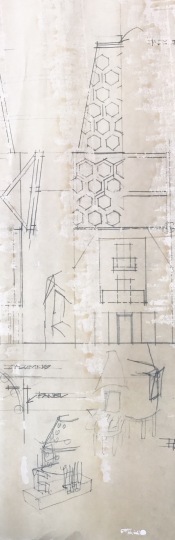
The above Archigram image is mean to soothe even the most anxious architecture student.In fact whenever I get tense or uptight about architecture I pop out, have a cup of tea, and look at a  bit of Archigram. They were a pretty relaxed bunch of dudes. (doods being the operative word). In fact Peter Cook’s recent exhibition at the Bartlett has just closed last week celebrating his 80th. Rumour has it that somewhere in the archive of the 1960s there is a picture of PC in a kind of Emma Peel Avengers style PVC jumpsuit. I would give my back teeth to see that and it would it would make a great paper on taste-making and gender in the architecture of the 1960s. Of course such a paper would have to discuss Reyner Banham’s rants about Jane Fonda in the Barbarella film. There is a it about it here. Maybe those smart-arse and well funded researchers at Princeton should examine this stuff.

Cookie and the other GUYS in Archigram never really got too anxious  as they were all to busy playing footsies with the girls under the table, drinking tea, and smoking huge spliffs. Not surprising that the girls in the back row never really made the club.

Looking at Archigram projects, and following in their anxiety reducing practices,  may be one way to cure anxiety. But Anxiety is one of the most debilitating things that can beset you prior to the design jury or a crit. It’s hard enough being an architecture student. No money, long hours, and the struggle to learn a complex discipline. Pre-design crit anxiety can be crippling. It can certainly stop you from working effectively and it can prevent you from communicating your ideas and what you have done effectively in the actual crit. You are not alone almost every architect or architecture student has had to face this anxiety.

The Looming Deadline 

Of course, it is worse if you are approaching a project deadline or the end of semester. It is worse if you do not think that your tutors, or the client group, or a consultant, is not on your side. It is also worse if you feel that maybe you haven’t done enough work and it is even worse when you are earnestly struggling to build your skills, design confidence and resilience.

I am writing this from a number of perspectives. Firstly, as someone who knows what it is like to be anxious about a studio crit or a meeting. But also as someone who is on the other side as a critic who has seen the anxiety of architects and architecture students. As a young design tutor straight out of my cultish architecture school I was a somewhat fierce and unreasonable critic who developed a reputation for making students cry and jumping on models. Thankfully, after 30 years those people have forgiven me and I now realise how reprehensible and disgusting my earlier behaviour was.

There are of course a number of things you can do to manage the situation and manage your anxiety before that terrifying crit or design jury. Here are my suggestions:

Sympton 1: Thinking the worst

 Your imagination can run wild, you can think that the worst will happen. You will be cut down by other architects, the client or jury members, and you will be humiliated amongst your peers. I suffered from this and it can be debilitating. Don’t replay in your imagination the worst things that people might say to you.

Cure: Remembering most critics are interested and want to help.  

Thinking that the worst can happen is never good. I have been in and seen some pretty bad crits in my life. But, nowadays days these are extremely rare. Most design jurors and critter people in the 21st century are a pretty decent lot. Find out from your tutor who they are and do a bit of research. Usually, they are attending because they are either a convenient friend of your tutor or they have some kind of special expertise that is relevant to the studio.

They will probably not tell you that your work is appalling or rip the prints of the wall or jump on your model. It is unlikely they will belittle you or humiliate you.

They will tell you what they think and usually they try to be honest. Mostly, they will be interested in what you have done.

If you feel anxious before the crit try imaging the sort of interesting questions they might ask you. Make a plan for what you will do before the crit and what you will say. Don’t just turn up and wing it. Be prepared. Making a plan of what you will say and even practicing it in front of a mirror before hand will help you minimise your own anxieties. In other words, imagine them asking you the questions you want them to ask. Imagine the crit going well rehearse what you a going to say using this formula set out in my previous blog.

Symptom 2: Over work anxiety, 

 Anxiety feeds off overwork. Not enough fun or enough rest will fuel it. After my own architecture thesis I went camping on a river and just sat in a camp chair for about ten days and did not move. I was so burnt out from overwork. This can happen to anyone no matter how old you are. I have known student’s who haven’t stopped working hard since high school. At some point they discover they need a break because they are really burnt out.

Working all night will fuel pre-crit anxiety. Not getting enough exercise will make you more anxious. Or just have a rest or go out and play with your friends. There is no point working and working and working and getting so tired. If you are tired before the crit your anxiety will be harder to manage.

Cure: Have fun and get balanced.

If it gets really bad go for a walk. Go to the pub. Go shopping. Go out with friends. Sometime you can overdose, and burnout, on a design project or a studio or even a course. Read this.

Be mindful, try meditating, there are some really good apps you can get that will lead you through some great mindfulness exercises.

Symptom 3: The best friend of Anxiety is procrastination.

I might have said this here before on this blog, but procrastinating, by deferring the activity of design and design gestures, will only make your anxiety worse. Designing is a labour intensive exercise (especially if you are using a computer). Putting it off only means you have to do the same amount of work in less time. Designs are not made and fully formed in the brain and then exactly transferred to the computer or paper or the physical model. If only we could do this life would be so much easier. Designing takes time.

Cure: Work constantly.

Reading, researching, writing little notes, thinking while drinking that batch brew or Aero press coffee, going to the fridge and eating, web surfing and Google searching are all the fabulous ways to defer the actual act of designing. The problem is designing is about either physical or digital drawing and the sooner you start the better. You will be less stressed if you work constantly throughout the studio and avoid procrastination. If you do feel stuck get help or advice from your tutor to get unstuck.

Symptom 4: The other people are always better

 There will always be someone in your studio who seems better, smarter, more creative and more like one of those over-confident alpha-male architects. Thinking this is real recipe for anxiety. You will always be your own worst critic and these other people will always seem better. I mean who needs design tutors or guest critics when you are so good at demolishing your own design thinking and ideas?

Cure: Run your own design race.

It’s best to solve your own problems rather blaming others or being focused on your fellow studio members. Run your own race. Believe me you will actually end up doing better. Focusing and comparing yourself to others is waste of energy. They will always seem better and if you think like this your anxiety will easily be fuelled.

Symptom 5: Critical negativity

Also, don’t compete against yourself. Know when to give yourself a break and when to be critical of your own judgements. Too often I see students tied up in knots and paralysed by their own critical negativity. As designers we need to question. But we don’t need to question every single tiny thing related to a building design. The worse architecture schools on the planet are the ones who promote this kind of claptrap critical negative method.

Cure: Remember there are no right answers

Sometimes it’s often better to design something, anything really, even if you think it might be “wrong”. The alternative is always to be searching for the “right” or correct idea and that is an ideal that doesn’t exist. Or after you have developed an idea for a while in your design its thrown it out and everything else with it. Because it is not correct. I see a lot of this. To develop design confidence and resilience you need practice in developing a design.

Symptom 6: Don’t kick the cat; or anyone else for that matter.

This is a rare, but not uncommon, symptom of anxious students. People and indeed architects under pressure who get extremely anxious sometimes release that pressure by lashing out at their pets or others. Please don’t kick your dog or cat when you get anxious about the upcoming crit. It is also really good idea to not lash out or blame your tutor, or your fellow classmates, for your anxiety. Usually your design tutor is trying their best to guide you and get you through.

Also, speaking from experience, your tutor will not think highly of you if you do this. I am usually relatively understanding if someone lashes out at me when they are under pressure during the studio. There is not a lot I can do when it happens. But, as a tutor it is not pleasant and usually it means that after the studio is finished I don’t really want to have much to do with the lasher-outer type.

Cure: Don’t bottle things up and build ongoing relationships.

Instead of lashing out talk to your tutors and your peers about your fears and anxieties. You might find everyone, tutors included, are just as worried as you are. Try and remember that after the studio has finished the most important thing you can do as an architecture student is to retain and have a continuing relationship with your peers and those who have taught you as an architect. Each studio is an opportunity to build your future professional networks.

Symptom 7: So maybe you haven’t done a lot of work and that’s why you are anxious.

 Yep. You realise there is only two weeks left in the studio and the deadline is looming. You are definitely going down the tubes because you did not do enough work earlier in the semester. You are running out of time. You have been too busy having fun or you haven’t really been thinking about the time. You are not sure how you are going to actually get everything done. Even if you work all day and all night you think that you are going to fail.

Cure: Get help

Symptom 7, along with just about everything symptom above, is best cured by getting help.

Tell your tutor your predicament. Most tutors will be sympathetic. Most tutors want you to pass and even if they recognise that you have done no work they will still help you. But to do that you need to get their help and you need to be honest and realistic about what you need to do. Talk to your friends try to enlist their help as well.

Finally

If of course your anxiety is becoming to much of a burden you may need to get help from a counsellor or your GP. Most universities and architecture schools have avenues and contacts that can help you overcome anxiety. Sometimes the worst thing you can do is to think you can just push through and ride out the anxiety. It’s a lot easier if you always get help and remember that you are not invincible. The most important thing to remember is that you are not the only one to ever feel anxiety prior to a design crit.

It could always be worse imagine if it was Cookie and his crew you had to present to.
What makes a great architecture school? Why its time to dismantle the pedigrees.

So what makes a good architecture school? Everyone seems to have an opinion about it. It’s a complex area. Some architects wonder why the graduates of architecture schools are not technically skilled or seem totally useless. A largely baseless and crude accusation that contributes nothing tot he debate. Any attempt to either consult or change the curricula with the professional bodies outside of university is fraught with petty politics. Architectural academics (and most have a foot in the real world) are totally constrained by a wider regulatory regime that both hampers their ability to create knowledge and then does not fully account for that knowledge when it is created.

My life as an architecture student. 

There is still no research infrastructure to count, yes actually count for, for architectural designs and projects produced in and alongside the academy. This is scandalous and something that the wider profession needs to address. Every time I collaborate on a project or a competition it is not counted in university research metrics. In contrast it me took me ten years (more by the time I graduated) do my architecture degree. This was a combination part-time work, a year working in a sheet metal factory, self-education through reading, feeling the need to prepare for 6 months before I did the next studio and hanging out with my employer the Master smoking cigarettes. When I wasn’t driving the Mater’s car on errands (or stacking it) we often talked, yes actually talked, about architecture.  Thanks to the Whitlam program I was the first in my family to go the university.

Students are forced to pay exorbitant fees and as a result just want to get in and get out. Now more dawdling. No more leisurely processes of self-education. No more long chats about architecture and life, the universe and everything. , any attempt to educate students more deeply beyond the contents of packaged up, templated and accreditated university courses and subject’s is fraught. It’s really different now and some would argue this new environment has corroded our public life.

The contrasting idea is that architecture itself is a comprehensible system, and architecture schools embody a system of education that both shapes and  supports the canons and norms of the discipline.  It’s the Bauhaus (being a prime example of a systematised education) idea of architectural education.

Venice 

I have always suspected that a few people around my provincial town (secretly I am one of them as well) are enamoured with the IAUV and the so-called Venice School of architecture.  A school that was presided over by the provincial “barbarian” Guiseppe Samona. Think a melange of Rossi’s types and Giorgio Grassi’s realism and Gregotti, a deft nod to the theorist Cacciari & historian Tafuri, and the urban realism of Aymonino. For a Melbourne suburban boy Italian architecture is all pretty intoxicating.

Parametricism 2.0 

Of course, schools can be seen to be evil. As recently as last year Schoomee (Patrik Schumacher) was pretty pissed writing that:

This turn away from Parametricism is most conspicuous within the former hotbeds of the movement such as the Architectural Association (AA) in London and Columbia University Graduate School of Architecture, Planning and Preservation (GSAPP) in New York. Another indication is the general backlash against ‘iconic’ architecture in architectural criticism, and the recent proliferation of a frugal Neo-Rationalism. The anti-icon polemic misunderstands that an architecture that is rigorously developed on the basis of radically new, innovative principles becomes conspicuous by default rather than by intention. Both the anti-icon and NeoRationalist camps fail to recognise that the new societal complexity calls for urban and architectural complexity.

I love reading the stuff Schumaker (spelling?) writes its so kerazy and the above quote pretty much says it all and points to the grip that the “pedigreed” and branded schools have on our disciplines. Schools, whose graduates are them hoovered into the intern machines of the star architects Like his own. Perhaps, Schoomey should start his own Schumaccher school.

There are a few glimmers of hope around the place. On the West Coast. The Free Architecture School is being set up by Peter Zellner and it appears to contest the prevailing and pedigreed paradigms of what architecture schools should be like.”

“Many schools of architecture […] now find themselves mired in various forms of academic cult worship: digital traditionalisms, faux-art fetishisms, silly mannerist dead-ends, philosopher-shaman worship, and other neoconservative returns.”

“Several generations of students were robbed of their voices and their right to grow potent individual practices,”

Zellner argued that a post-studio model of architectural teaching, one which is founded on open conversation, student autonomy and critique, “now seems imperative and necessary” to unshackle students and teachers alike from the master–disciple model of teaching..

Peter Zellner is right. A really great architecture school would be self governing: students would be involved in its processes of decision making and production, it would have no pedigree except for what it night produce at a particular moment in time. It would experiment across the territories that only diversity can engender. It would generate open conversations and ideas that would be debated in civil society.  It would be a system that would produce new ideas for the discipline rather than imposing pedagogical strictures or reinforcing pedigrees.

In some ways all of these elements were present, to an extent, at the architecture school I attended. As well as the one I am now at. But we need more than just elements; we need radically different modes of teaching and learning in architecture. To say the least, the neoliberal turn in higher education policy has not really helped architecture.  A great architecture school is a crucible for all of the wild and crazy ways of architects and architecture.


Architects, Branding and Narcissistic Personality Disorder.

Things are in full swing here. The place is full of students and the bicycle park is full by the time I get in everyday. I am “under the pump” as they say and this may be why there were so many typos in the first posting of this. 

Narcissistic Personality Disorder.

As a profession in some ways architects have all the characteristics of Narcissistic Personality Disorder. The common complaints by clients and of course other members of the construction industry are: grandiosity, lack of empathy for others and a need for admiration; a common willingness to be arrogant, self-centred, manipulative, and demanding. This is of course a harsh assessment and many other groups in our industry also suffer from these traits. Especially, Project Managers and contractors !  People with NPD, Narcissistic Personality Disorder often believe they are superior or special. We all know people like this.

Arguably, some of these narcissistic traits are needed to get architecturally designed projects built, in a world that seems not to care about architecture, design or aesthetics. A world that really doesn’t care about design value. It may be because architects go against the normal grain of “cheaper and quicker is better,” and actually care about design, that they are seen by others as being narcissistic.

However, there is one area where I wonder if the self-regard and narcissism of architects is skewed.  This week in the MSD Architectural Practice class we ran a Q&A panel on architects and branding. One theme that came out of this panel  was the fact that architects were great at producing awesome renders and most, although I would say not all, have a pretty good idea about communications design and graphics. Yes, all of those things are taught at architecture school. We are good at building brands for other people like developers. But I think that is the problem. That’s all we architects are good at; we are only good at doing the renders and the graphics for the designs. As a result, we think we a really good at branding because these activities have visual components. But being the narcissistic profession, that we are, we then think this is all you need to do. We too often reflect and bask in the glory of our own technical skills.

Knowing a little about computer generated renders and graphic design does not necessarily mean architects know much about branding. This is an even more pressing issue as branding is now  more complicated in an era of ubiquitous computing, customised advertising, the rise influencers, the proliferation of social media channels. Data analytics of consumer preferences is now a dark art and few architects understand it. The shift to the very short digital film clip as the most common form of communication is smoething that seems to have eluded us.

Branding for architects isn’t just about a few slick images and a funny cute name. Its not something you can do in an afternoon in the office (unlike a blog full of typos).  As Verity Campbell reminded me at our Q&A session architects really need to think about how our representational, images, logos, names and graphics are seen by others. Architects need to bridge the communication gap between ourselves our clients and community.

At the firm level. 

Branding is about  distinction and positioning. What’s the point of every architect in town claiming to do sustainable design. When I searched for sustainable architects in my city I got 684,000 results in less than a second. I couldn’t believe this search result. Whats the point of doing a website that seems more like a hodge-podge of quirky graphics that does your head in when your cursor tries to engage with it. Or loads so slowly you have a aneurysm waiting. At my age aneurysms are a real issue when you are looking at slow moving web sites. All of  this hokey pokey branding schmaltz is like the caricature of the architect with the Corbusian glasses in black with the Comme des Garcon jacket driving to the site meeting in a Citroen.

As noted at our panel architects need to develop marketing and branding techniques that uniquely position themselves. This is a common error. For example when you find blurbs on websites like this. (I have redacted a few things to avoid mutual embarrassment).

and the combined experience of the office ranges from significant major projects in Melbourne, to many small and site specific projects, and international works. Our activity, interests and expertise, ranges from urban design to interiors and furniture – architecture in its broad sense.

We bring design to a broad set of situations and audiences, including peripheral locations, difficult problems and tight budgets. We aim for our work to participate in the widest environment it can; in new forms of communication, in sensitive natural environments, new types of cities, and with ordinary life.

Yip. All things to all people. Everywhere. How can the above be seen as effective branding? Yet, this is the mistake that is commonly made. I am sick of reading about what architects could do: Anything you ask them to do apparently? Or what they are like: creative, smart, experienced etc. etc. Most potential clients probably what to know what architects are doing, what they have done and how they are actually different to the tens of thousands of other sustainable design orientated architects in the universe. Maybe this is why I like the Assemble web site so much as a model.

At the community level

Our professional associations need to get much better at marketing and promoting architecture. Lamb does it and now they kind of own Australia Day. I am actually not sure how many punters are going to get to this “find your architect” AIA page  deep inside what is essentially an industry association website.

The AIA 2017 National conference is called PRAXIS. Holy Sardine Batman ! At least there is a bit of diversity in the speaker line up. Of course, when I think of the word PRAXIS I think of Deleuze & Guattari. But its just lots of architects talking about architecture. At least you get a tax deduction. Maybe the conference needs to include more punters, more real people, more politicians, policy experts, and more decision makers and be seen as means to market what we are as a profession to these broader groups.

In Australia the individual AIA chapters have Twitter accounts, the  National AIA Twitter account seems to have tweets few and far between. The account that has over 23,000 followers but just seems to feature a lot of stuff about the AIA conference and little that would be engaging to the punters, decision-makers or any one else for that matter. It’s a real snooze fest.

There is no obvious involvement through these channels in promoting architecture as anything beyond a kind of slick image marketing brochure. No wonder the punters think we work for the rich Kardashians. There is no deeper engagement, through all of these channels, with the policies and dilemmas of architecture in our time. I know I am biased but Parlour is a much better model of how to do things. At least the Parlour Instagram account doesn’t send you to sleep.

The last upload to the AIA Youtube site was about 2 months ago. Whoops that was the wrong link ! Here is the real AIA website. This doesn’t really appear to be a direct or crafted communications strategy that would link architects to anyone, except for maybe: other architects. No wonder we are too often, and unfairly, regarded as narcissistic out of touch idiots. At least we are fashionably dressed and have nice, although ineffective, websites.


Design Leadership for Architects?

Design Week is almost here in my antipodean city on the edge of the global galactic system of architecture. There are lots of great events, including this one with GT2P, even for those of us with the most cynical and jaded of architectural hearts. There is lots of stuff about how we might value design but not a lot about design leadership specifically. Effective design leadership is really about promoting the value of design in our communities and actually working to increase its value. It should also have an activist component.

We don’t teach design leadership in architecture, landscape architecture or urban design. Leadership studies are broadly a branch of the management and organisational sciences. As a field of knowledge Leadership sits somewhere between management and sociology. Architecture has been so insidiously structured by the mythology of the singular male genius that any objective talk of organisational leadership and its conduct in architecture is usually greeted with silent derision. I know at least one architecture school where that is the case. No prizes for guessing which one (not mine). This approach certainly shuts down any sense of more inclusive notions of leadership. Not only are diverse teams needed in architecture but architects need to understand how to manage these teams. If collaborative models of practice are the future of architecture, as some would suggest, then leadership is an essential component of that.

It is the more inclusive, expansive and indeed realist notions of leadership that we really need to teach in Architetcure and our related disciplines.

Design leadership requires a knowledge of design processes that isn’t simply about waiting around for the big idea. Or having a whole lot of wholesome intentions (like sustainability) that you throw into the mix. Design processes can be learnt by most people and are counter to the view that some people just have “it”. That is to say that there is a secret source (sauce?)  code of creativity that only some people have.

I think both schools and practices (in their career development programs) need to encourage, teach and actively foster, through mentorship, design leadership. I think two areas need to be covered: Knowledge and Implementation skills.

Knowledge

Innovation and Commercialisation

The dark arts of intellectual property creation and management. Start-up processes and venture capital phases need to be understood. There is a whole range of things in the start-up system design leaders should understand. For example, the differences between seed and start-up capital, development capital, dilution of founder’s equity, trademarks and patents are all concepts architects should be familiar with.

Concepts related to innovation systems and policy also need to be apprehended and understood by design leaders in architecture.

Knowledge of the Canon

Design leader in architecture need an extensive knowledge of architectural history, theory typologies and morphologies. Last week in the practice class we asked everyone if they know who Tadao Ando and I was surprised by the number of blank looks. I don’t think this is the fault of teaching architectural historians. But I do think anything we can do to remind young architects that the canon is historical and it comprised by both a physical and digital realm. Trickle down web histories, and the latest meme or viral concept can be really superficial and don’t really cut it as architectural history.

Design Futures 

Design leaders need to understand futures and I don’t just mean cooking up a whacky scheme of for a post icecap melt flooded city or suburb or city flooded. (why do we keep seeing this stuff; can you imagine what a flooded city might really be like?). Our future speculations need to adopt advanced tools of scenario planning and modelling not just spitting out a few renders of domes on the moon with Tesla batteries.

Implementation Skills. 

Design Teams 

Essential for design leaderships is for design leaders to understand the dynamics of team processes. This requires self-reflection on the part of a design leader to be able to manage a diverse team rather than a team created in their own image. Look around the office you are currently working in does everyone look the same, did they go to the same graduate school or come from the same social milieu? The best teams are diverse teams and the best design leaders are the ones who can manage this.

Design Processes 

The better design leaders will be the ones who can manage design processes that are not simply linear and contain within them high degrees of ambiguity. Excellence in design leadership is about being able to create, generate and manage seemingly paradoxical ideas and processes; and doing this in a team. Great design leaders are the one who not just top down decision makers but are able to reconcile bottom up, or emerging design strategies, with strategic, seemingly, top down priorities. Knowing the difference between structured decision-making leading to incremental change and more creative generative approaches is critical. Knowing when to employ processes of creative destruction (and not just at the last fucking minute before the tender is due to go out) and processes that generate radical ideas and solutions in a given context is important.

Design leadership is about timing these different modes of idea generation.

Design Collaboration and Negotiation 

Collaboration and negotiation are basic skills that architects need to develop. It is oh so much easier to adopt a model of design leadership that is top down, transactional and seeks to reward and punish people (usually staff). That is way of managing that is inherently violent. It is violent because it is a process that grants and removes resources at will. The “good’ staff are rewarded and the “bad” staff are punished. It’s a model that seems to permeate architectural office and design studios. Great design leaders have the ability to see the good things in all members and instead of writing of the “bad” ones use their views to generate new insights about a conceptual design or as the design develops.

Irksome things (to me at least)

Design leadership studies and research can bring together and integrates the different sub-disciplines that define our field. It’s a little scary when you look at entire new courses and subjects being devised in architecture schools and there are no subjects or courses on leadership. Of course they are full of all sorts of technical things, construction, digital technology, and the one I really hate: sustainability. How did sustainability studies become reduced to the technical intricacies of architectural science or cranking the handle of the LEED or Green Star ratings. Why isn’t it about shifting the weight of a Carbon system to something completely different in a few short decades?

I hate those all-purpose sustainability mission statements about seeing things holistically, and being “organic” and being nice to Gaia and all it boils down to is a bit of facade design and a few plants thrown onto the facades. This design week event is more like it. If architects were really honest as a  discipline they would rename sustainability studies and call them decarbonising studies or extinction or degradation studies.

Finally Activism. 

Design leadership is about activism. I think this means be explicit about the political in architecture. Good design leadership is about knowing where you stand. It is about knowing what the political tradeoffs are in a given context of patronage and institutional logics. I don’t think we can afford to pretend that architecture is apolitical. It never was in the first place and it’s a pity the parametric technologists don’t get this. Otherwise you are just blowing with the wind and that is not really what design leadership should be about.


Surviving the Design Studio: How should we teach and research Architectural Practice?

Teaching for our subject Architectural Practice at MSD has started this semester. This year we are trialling a series of hour long Q&A sessions. The first panel session was on inclusiveness in the profession; a pretty big subject that deserves an entire subject or seminar series.  It’s a pity I have to teach all the content in Practice the way that I do. Squeezing anything into the syllabus outside of the accepted accreditation requirements or competency standards is always  a problem. Nonetheless, his year at MSD we are going to have panel sessions on fee cutting, branding, cross-disciplinary collaboration, innovation and risk. The extra content we don’t normally  cover. We will probably finish off the semester with a Q&A panel on diversity, intersectionality and career pathways.

By the time we teach everything else that we need to teach in the Practice subject, in order to meet the accreditation requirements, there is not a lot of time left for the really big issues facing the profession. In many respects the accreditation requirements and Australian competency standards seem to reinforce some of the myths that bedevil architectural discourse and culture. As we touched on in last week’s panel, on diversity and inclusiveness, the guidelines appear to reinforce the notion that the only way to Practice is via traditional practice. I call it the Wilkinson-Eyre model of practice. Yet there are many different ways to be an architect. Yet architecture seems imprisoned by the traditional mythologies of masculine and male creative genius, the pedigrees of client patronage, race and class, as well as the binary split between design creativity and business. All of these things seem to reinforce the idea that practice is not a place where discussions around diversity or inequity should take place (there is a lot to cover and this is why I also teach an elective called Design Activism).

In the olden days, there was subject on Specifications. This is now covered as one lecture in our Architectural Practice subject. In the olden days, there were subjects that addressed contract documentation strategies and workflows. We now cover this in practice in one tiny lecture. The same for Contract Management which is now covered in Practice and yet it should probably be a separate subject. These days I think we all benefit if the teaching of Architectural Practice is seen as being more of a contested area. I have no problem with that. A place where debates around the profession and its relationship to various issues can take place.

Architectural Practice is too often an incredibly contested area in the wrong ways. One of the older binaries that seem to pervade it is that one between the real world and academia. It’s always been oh so easy for practitioners to come to the university and look at the work and say the graduates: can’t do this, or they can’t do that. I have seen this happen on numerous occasions during various accreditation panels. Some architectural employers don’t want graduates that have been taught to think but to simply fit into the cogs of that CAD monkey documentation machine. This is a simplistic binary debate, and it’s a pretty easy criticism to utter, and in the end only diminishes architecture as a profession. The real problem is that some voices are too often silenced or not heard when these simplistic aphorisms get trotted out. For example, the graduates who are paid poorly by practices, work long hours and don’t get paid overtime. Or the people of difference who don’t make the so-called grade at Wilkinson Eyre.

It was suggested to me recently that the architecture curricula was simply about teaching design, technology, history and theory. I thought WTF? As an integrated subject Practice, should be both reflective of the debates in contemporary architecture and give young architects their first insights into a range of things. The strategic management of technology for example. Or knowing how to negotiate or consult with a client or a developer or a marginalised community group for another.  Teaching young architects to write business plans so they can find pathways through financial economics in order to not economically exploit others when they come to direct practices themselves (This week our Q&A style panel in is on fee cutting).

Traditionally, Practice has always taught by male architects who by and large seemed to wear suits and seem to know something about money in a kind of worldly sense (I am one of those; but sometimes I don’t wear the suit). As a subject Practice, was and is, for the most part sequestered from design in graduate architecture schools across the world. It is either often forgotten or seen as something that has nothing to do with either design, technology or even history and theory. It is presumed to be a practical subject that somehow teaches architectural students about the “real world.” But this image of the real world is a shibboleth. This is because I know of few architecture schools, where teaching cross-cultural negotiation skills, or stuff like the darker arts of social media branding, or the banalities of cash flow forecasting is thought about. I know of one architecture school, so notoriously attracted and addicted to its own tiny autonomous discourse, that if you mentioned any of this stuff they would stereotype you as a “non-designer” and relegate you a long way down their coveted pecking order of young and emerging star architects.Of course, as we know from other domains of knowledge, that economics. sociology and the management sciences are fields that are valuable to encounter intellectually.

This forgetting of Practice reinforces the worse mythologies of practice itself. The way we practice architecture needs to be dismantled through more effective ethnographic and empirical research using methods dragged in from other domains. Even in the UK field of Construction Management, as a result of an interest in the sociological and management sciences, there has developed over the last 10 years focused research studies on: technology take-up, sustainability, innovation, immigrant labour flows, as well as the inequities of pre-formed racial and gender identities in construction. By contrast in architecture all we seem to do is something called design research (I am still to figure out what that is) a bit of do-gooder sustainability (despite the fact that we are facing extinction as a species) and a whole lot of technical research using robots, 3D printers and Virtual and Augmented reality.

This focus on the technical only seems to reinforce the new image of the young architect as a kind of sneakerboy guru of Rhino or Grasshopper. Someone, I know went to an international robotics in architecture conference to find it was full of hundreds of blokes with less than a handful of woman represented. Even in the sixties, another time of technological obsession in architecture, figures like Archigram and Reyner Banham had a Boys-and-their-Toys fetish about computers, space ships and industrialised building. Not sure if a lot has changed.

For me it is the historians and architectural theorists who are doing the most interesting research in architecture. These areas, as well as research into practice, more often than not, get squeezed in research funding rounds in favour of technology, sustainability and construction. I think the profession at large needs to think more carefully about what it means to practice, beyond the narrow models, pedigrees and mythologies that have pervaded architectural culture for the last million years. Maybe, thats why in all of this it was good to see three (yes, three!) Catalan architects get the 2017 Pritzker Prize. The question of what practice is, who can practice and who does practice should be reflected in both academic and professional development programs, accreditation guidelines, curricula and syllabi.

But to really teach practice I think we need to teach young architects how to chain themselves to the gate of a coal mine. Or how to work directly with colonised groups. Or how to reflect on their own genders and backgrounds. Architecture school is the place for the messy debates that will hopefully dismantle and decolonise architecture’s current subjectivities, pedigrees, rituals of taste-making and mythologies. Architecture school is the place where the politics of global economics confronts the new and emerging forms and structures of architectural practice itself. Most traditional practice courses have avoided building into their framework these perspectives, and sadly in most architectural schools architectural practice seems to get forgotten. These are the issues that should be central to the teaching of practice. In fact, as architects we should all be teaching these things in our firms and in schools of architecture.


Venice Architecture Biennale 2018: In search of Australian Architecture’s global brand.

Today is almost the day that the call for the creative director of the Australian Architecture pavilion at the 2018 Venice Biennale closes.  At least we now have a relatively decent exhibition gallery in the Giardini to exhibit in. The old pavilion, as we all know, was designed  by Philip Cox (kind of channelling Glen Murcutt) and it looked like a little bit of that old timey Darling Harbour style. The pavilion contained a series of long spaces, over two levels, with vaulted metal deck roofing. The new affair by the Melbourne architects DCM is much better as an exhibition space and I visited it in 2015 and saw how it worked for Fiona Hall’s exhibition for the Art Biennale. Of course it is pity that this commission was not a public competition. This was the source of some controversy at the time. But, that is not to deny the fact that DCM have done well; It would have been a nightmare project to have managed, constructed and delivered.

The architecture Biennale at Venice is the  shining and glittering highlight in the calendar of the global system that is architecture these days. From my antipodean perspective, it probably ranks almost as highly as the AA Projects Review exhibition or the opening of the Serpentine Pavilion. It’s as if a  Klingon ship, has picked up quaint little earth in a tractor beam, given it a shake and all the world’s architectural models has fallen of their storage shelves and lodged in Venice. Venice that city of cities where all the other cities of the world and their histories, can be glimpsed  in Venice’s own layers and edges around the lagoon. Venice has always been a place of politics, intrigue and controversy: Just like the Architecture Biennale itself in terms of who is being selected ect.  It  has always been a place where the flows of territorial ambition and power collided and then just as quickly departed. Of course these days, Venice is more like Disneyland in some ways where every tow years the architectural glitterati drink Aperol’s on the Grand Canal and in eat Fiaschetteria Toscana.

All of this exoticism and history and the fact that the worlds biggest architectural trade show is in Venice every two years might be why over time Australian architects have generally gone nuts over the Venice Biennale. There is nothing like swanning around the Vernissage (the opening week of the Biennale) and going to the parties. When I went it was like being in Prahran. Of course, as I discovered you have to know the right sort of people to get invited to the parties with Rem, Sejima or Patrik (Patrick?) or Zaha (god rest her soul). The only party I ever managed to stumble into was one held by the Armenians, in a stripped out Palazzo hulk somewhere behind Campo Santa Margherita, who despite their long association with the Venetian lagoon had run out of beer and Aperol’s by the time I stumbled into the party. At least the Armenians knew how to dance. So going to Venice as an invited exhibitor, and more so as a so-called creative director, is a prestigious gig;  if you don’t get invited to exhibit in the gardens or the Arsenale you can always set something up in one of the numerous Palazzo’s around the town and make it look or seem half decent. All you need is a couple of plasma screens and a bit of money to print a catalogue.

Just the name Venice or Architecture Biennale is enough to make most architects swoon. Which is literally what happened to me as my friends will know at the 2010 Biennale. I drank so much Aperol that I leached all the Potassium out of my system and ended up in the Venice Ospedale (sadly, as all architects know, not the one that Corb wanted to build). My room overlooked the lagoon towards San Michele the cemetery island. For a day I was able to reflect and think about one the great architectural projects of the last century. Aldo Rossi’s Floating Theatre constructed for the 1979-80 Venice Biennale. As I thought I was going to die from a Aperol Spritz induced coma Rossi. I thought about what Rossi had said about his theatre in Venice.

“and what better place for a beacon, a house of light, literally a lighthouse, than by the sea, in a border zone between sea and land, amid beach, rock, sky and clouds?”

Any way I lived to tell the tale about being in the Ospedale. I certainly saved a few bucks because Venice is no place for the small practitioner on a limited travel budget.

I have been to quite a few of Biennale’s and the Australian representation at them is to some degree problematic. I can’t remember if I have said this in a previous blog or not: But, what exactly is Australia’s brand in the global system of architecture? As I touched on last week with the hair thing in this world of Google analytics and SEO’s its amazing that a Google search of Australian architecture reveals mostly Murcutt, Utzon (not really Australian) and maybe a bit of Harry Seidler. I fear there is a lot of Opera House and Murcutt action when people think of Australian Architecture. Even the Wikipedia entry is execrable. Whoever wrote the second sentence of that entry should at the very least be transported back in time to be reeducated in a Maoist collective.

The problematic nature, or lack of a brand or even an identity, around Australia’s global Architectural brand can be seen to some degree in the various curated Biennale that have occurred over the past dozen years or so. My quick take, and Raisbeck ratings  on each one is below.

2006: Micro Macro City Creative Directors Shane Murray and Nigel Bertram.

I thought this was characteristically dry and lacking in any kind of ironic reflection. But in hindsight I think it did depict a kind of realist picture of Australian cities and suburbs. The Models in the exhibition were great. (Raisbeck Rating 8/10)

2008. ABUNDANT Creative Directors Neil Durbach, Vince Frost, Wendy Lewin, Kerstin Thompson and Gary Warner.

After the tight and well planned 2006 gig this was the complete opposite. It’s almost as if the creative directors had to purge the building of the tone of the Micro Macro City exhibition. This as a real free for all it was like every boy and is dog (except of course Raisbeck) got a gig in it.  Annoyingly, the catalogue, if it existed at all, was non-existent by the time I got there. It contained hundreds (140 to be exact) of models all vying to be different. Some of these were really good and some were really bad. The spin around it was that it was a way of establishing the scope and range of Australian Architectural experiment. Sadly, I think it lacked a firm theoretical  basis and just made us look like a nation of idiosyncratic and isolated savants. Having said that it was indeed an exuberant and “abundant” celebration of the pluralism of Australian Architecture and I liked the way the Cox Pavilion was painted green.  (Raisbeck Rating 6.5-7/10)

2010: NOW and WHEN Creative Directors John Gollings and Ivan Rijavec.

This was the one I was involved with a collaborative collective that we called ourselves colony collective. Basically, two crappy laptops and a lot of help from Flood Slicer who set up the multimedia works in the exhibition. This was a take on Australia cities in 2050. Our entry Mould City was intended to be  a kind of  Superstudio or Archizoom take on Australia’s future cities.

Mould-City_Colony-Collective-when.jpg

Mould City Colony Collective 2010 

Disappointingly, in the other architectural ruminations, there were a lot of flooded cities. And I mean a lot of flooded cities. Plus, a few overhead floating type cities. Readers of this blog will probably you know the sequence: One, climate change is real. Two, the icecaps will melt. Three, the cities will flood. Four, lets build floating cities etc etc. Theory and l discourse around Utopian architecture is really lacking in Australia. Nonetheless, Golling’s images of the mines were great and ALL the technology worked. (Raisbeck Rating 7.5-8/10)

2012: Formations Creative Directors Anthony Burke, Gerard Reinmuth, with TOKO concept design

This was the worst one I ever saw it was disjointed and paltry. A total waste of money and resources.The Creative Directors selected six architectural teams working in non-traditional ways and domains from around the nation for the exhibition. The intention was to highlight different modes of practice. In part it did this, but not convincingly. When I got there I couldn’t quite figure out what it was about. It looked scrappy, and as if the creative directors were more interested in being creative directors than actually working to put together a credible exhibition representing, the 6 teams, Australian Architecture. Google it and all you get is pictures of the creative directors in linen jackets and black t-shirts or shirts. I did not really get the football tables outside of the exhibition.  (Raisbeck 4/10)

2014: Augmented Australia: 1914 – 2014 Creative Directors felix._Giles_Anderson+Goad

This one was on when the new pavilion was being constructed. I didn’t really get to visit this one so there is not a lot I can say. There was a call for unbuilt and then augmented projects and I submitted a few but of course; but not being a so-called star architect and given our practice is consigned to the graveyard of small practice oblivion its understandable that any one would want to remodel or Augment on of our old projects. There was  a whole lot of kiosky-appy-cloudy Ipad action;  I am told the technology didn’t quite work on the day (but perhaps I am wrong). I thought it was probably a good idea. (Raisbeck rating 7/10). The project below is the one of ours (Raisbeck and Klempfner circa 1995) that they decided not to “augment.” It certainly could have done with that.

21498cf8-c8da-4da3-afc6-72220bf15c96

Hanoi Office Building Raisbeck and Klempfner 1995

2016: The Pool Creative Directors Amelia Holliday, Isabelle Toland (Aileen Sage) and Michelle Tabet

This was the first one in the new building. I wasn’t sure about this one. I thought maybe it was more of a social history rather than an architectural history. I was also worried that the curators may have forgotten the fact that the public swimming pool has been a colonising instrument space for subjugating Australia along racial and gender lines. I think they perhaps managed to avoid that trap. But I am not sure that the social history of the pool says that much about our architectural culture. (Raisbeck rating 7/10)

Given the above, and my ratings aside. I would argue that a strongly theorised and polemical exhibit is better than some of the above efforts. I know of  few friends who have tried to do this.Only to be knocked back by an overly conservative AIA selection committee. I suspect that is a better than trying to appease everyone or going for concepts that are so saccharine that they really do not add to Australia’s global architectural brand; I mean what si that brand anyway; we really need to shift the brand away from the Utzon-Murcutt-quaint-Boyd and Seidler brand attributes and make our own the contribution to debates and experiments now emerging in the global system that is architecture. I have not really discussed that much about the overall curation of the Biennale. I will leave that for a later blog.

Maybe for the AIA it’s all about getting the sponsorship dollars. That is fair enough to some extent. Janet Holmes a Court has done a great job in that regard. Some countries have the gumption to only exhibit the work of one architect or architectural firm. Other’s tackle ideas that are in themselves controversial. Presenting a seamless and saccharine image, or an overly pluralist one, of what Australian architecture is like doesn’t really cut it for me.   With any luck we might even start to dismantle the innately conservative nexus of Star Architecture, parametricism and Ivy League privilege that bedevils global architecture. On paper at least this year’s curators for the entire Biennale look like they might be able to do that.


Hair Wars: Hair and Australian Architects or why I never made the grade as a star architect.

One of my most popular posts in 2016 was the one about Bjarke Ingels being evil because he had hair. But then I thought what about Australian architects. How much hair do they have? What about their hair? How is Australian Architectural hair portrayed in the media and across social media? As a result, I decided to conduct a few Google experiments. With the research aim to explore how the hair of Australian architects is portrayed on the web. Like all good researchers I needed a hypothesis a methodology and a few methods. My hypothesis is that architects with hair get more hits on social media. My  broad methodology is to focus on notions of identity and how these are constructed within architectural discourse. As for methods a bit of Google Image search combined with a visual analysis. In doing this I referred to some diagrams about male pattern baldness (myself being a prime example).

pattern-hair-loss

Google Search: Australian Architects (searched 170217 1.31pm

  1. Glenn Murcutt
  2. Jorn Utzon
  3. Robin Boyd
  4. Harry Seidler
  5. Roy Grounds
  6. Nonda Katsalidis
  7. Walter Burley Griffin
  8. Francis Greenaway
  9. Philip Cox

It was a relief to me as they pretty much all had hair undergoing various stages of Male Pattern Baldness. Numbers 5 and Numbers 6 seemed to have the most hair. It goes without saying that its shockingly amazing that even Google doesnt include female Australian architects when you do this kind of search.

Google search: Top 10 Australian Architects (searched 170217 1.40pm)

  1. Glenn Murcutt
  2. Sean Godsell
  3. Philip Cox
  4. Robin Boyd
  5. Harry Seidler
  6. Jorn Utzon
  7. Nick Murcutt
  8. frederik Romberg
  9. Roy Grounds
  10. Edmund Blacket

and with this search something weird  happened. Suddenly an insurgent with lots of hair jumped up to second place on the list.

I then decided to search just in Google Images  (searched 170217 2.30pm) rather than Google.

Google Image search: Best Australian Architects (searched 170217 3.00pm)

In this search you get a lot of buildings but of course only one Australian architect features and that is Peter Stutchbury who admittedly has a pretty good ahead of hair (as does his comrade Richard Leplastrier)

leplastrier-and-stutchbury

These are of course Sydney architects. Before I write any more I need to make a disclaimer which is this: At my tribal architecture school in the 80s one of the first things we learnt was to hate, and I mean really HATE, Sydney architects. Despite my biases a kind of Roland Barthes semiotic analysis seems appropriate here. There is certainly no sign of Brylcreem or Hair  Dye in this image. These architects are in some ways proto-hipsters. These men appear to be the very negative of the urbane, metropolitan, Don Draper suited 50s and 60s architect like Gary Cooper in the Fountainhead or indeed some of the architects in the above lists like Robin Boyd, Harry Seidler or the seemingly avuncular Roy Grounds.

Nup these guys are wild architects with all that hair: Raw, mountain men, lumberjack architects, with natural poetic instincts and urges, the very antithesis of the cosmopolitan architect; they appear to be flaunting an organic and seemingly natural sexuality and masculinity. Satyrs in the woodland with set squares. Its all a bit too Norsca Soap like for me, and even the work of these architects is kind of entwined with the myths of Scandanavia and the scarves, for some unknown reason, start to remind me of the columns in Alvar Aalto’s Villa Maireia. 

498072

When he was younger Stutchbury, who was born in 1954, looked like this (what is he looking at?). I  was surprised to find this image so easily on the web.

imgres-1

Stutchbury 

Untitled.jpg

Raisbeck 

I had hair as well when I was young as you can see from the above comparative photo of me in the 70s at my outer suburban high school. So its interesting to wonder why our own practice never got up and running. I mean I had long hair as well. But actually the reason is probably very obvious. Firstly, I lost my hair and I was also confused about the semiotic identity I wanted to portray as an architect. This is fairly obvious in this picture of me below from architecture school in the mid to late 80s. Little wonder I never made the top 10 Google list.

raisbeck_2

I was already loosing my hair then. Plus, I had obvious aligned my self with the cosmopolitan urban intellectual types rather than the organic FLW loving mountain men. But the tie was all wrong. No wonder I never got into the club. At night I wonder if our practice had done better if I had retained my hair and somehow gone the long hair silver mountain man foxy route. Or worn a straighter tie.

As my friends will now I have kind of re-invented myself a few times now. And as I noted last time our wrote about this kind of stuff in the Bjarke blog: The construction of the architectural identity should be regarded as being problematic and contested rather than being seen as a singular, holistic and a stable domain. As architects in this age of, oh so awful, celebrity we need to foster debates around the real laws, and dilemmas of architectural design our cities.

It perhaps goes without saying, but it keeps needing to be said, that the identities that we privilege in architectural discourse need to be more inclusive of difference. The recognition of collaborative practice is one way forward. But in the swamplands of social media a constant critique and dismantling of the rhetorical images that are presented to us is essential and necessary. Otherwise, the rhetorical idealisation of the architectural identity will continue to corrupt our discipline and architectural education. It’s time for the the cult of architectural celebrity to die. The mountain men architects like to think they are poets but they are really just celebrities.

Its been crazy here as I prepare for the students and substantially revamp my Architectural Practice course which starts in two weeks. Notably, I have prerecorded 9 lectures and have another 9 to do. It will be an interesting experiment in online teaching models. This will give me more time to run an actual tutorial in the subject and organise the guest lectures. This year we will also have a number of Q&A style panel sessions which we will advertise here and elsewhere. 

Surviving the Design Studio: Architectural Practice as a Design Knowledge Ecosystem.

For some practicing architects, there is the prevalent fantasy that they are valued for their knowledge. In this utopian world architects, with their unique generalist knowledge alongside an ability to drill down and easily grasp disciplinary detail, are employed just like management consultants. In this scenario, all the practicing architect has to do, rather than slaving over CAD drawings, is to sit back and relax and dispense valuable knowledge to the clients. In fact, in this oh so wonderful scenario, architects get paid lots of money for it. But maybe this is dream, is the dream of a discipline slowly losing its currency, moribund by the fact that architects are hung up by the building delivery paradigm.

The best way to get anywhere near this dream is to operate an architectural practice as a Design Knowledge Ecosystem or DKE.

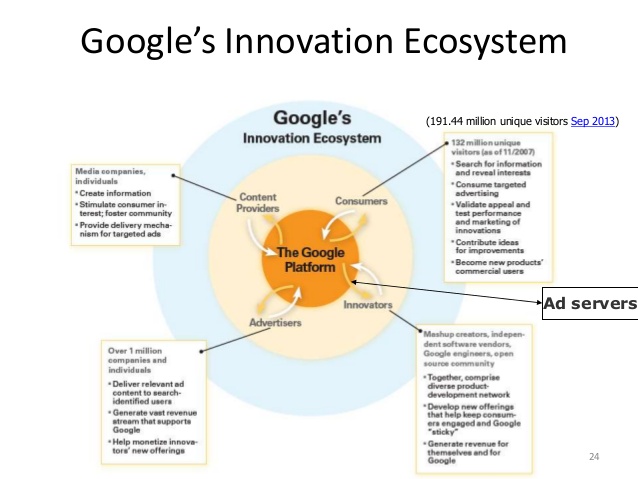
Ecosystems as a model, and a theoretical view, of practice are well known and prevalent in the world of big software development. For example, Google’s ecosystem has been described in the following diagram from HBRgoogle-designed-for-innovation-24-638

Some business commentators have even argued that Apple is no longer a hardware or a software company but an ecosystem. In construction management Chris Harty and Jennifer Whyte discuss what they call ecologies of practice. One of my favourite sociologists is the Bronfenbrenner who has developed Ecological Systems Theory. Bronfenbrenner’s theory contributes to our understanding of individuals in organisational contexts. Check it out if you are interested.

Thinking of the practice as an ecosystem of design knowledge is a much better way to conceive of and create new architectural theory, new modes of architectural education, and practice management. So what does the above mean for the practicing architect? For me organising a practice as an ecosystem of design knowledge implies the following:

It’s all about the idea and not the building

 A practice needs to be organised around the generation of knowledge. In other words ideas. The design of buildings are a by-product of these ideas. For a start this means that the practice must embrace research, research and development and even in some cases strive to produce innovative intellectual property. Dare I say it, Intellectual Property that might even be commercialised. This will mean that architects need to better understand and even be taught the dark arts of entrepreneurial pathways, innovation systems and associate policy contexts.

What is important for practices is not so much the creation or delivery of buildings, or representations of those buildings for that matter, but the creation of design knowledge. Managing the Design Knowledge Ecosystem is about constantly creating new ideas and managing a system that is in flux. Knowledge ecosystems can take on a life of their own and architects need to be comfortable with the ambiguity this can create.

Leadership 

Within practices new decision-making process and modes of leadership will be required. In the past, far too often knowledge was centred on a single designer or figure within the practice. Too often this knowledge was by its nature was tacit and for the most part hidden. Knowledge transparency is the key to creating better designs; designs that have been subject to rigorous process of design testing and re-testing. In the future leadership in the best practices will be those that are able to harness in an inclusive way all the members of a diverse team. The best leaders will be those with an intimate knowledge of design processes and different modes of designing. These leaders will understand that

Diversity

The purpose of having a diverse team within a practice is not simply about giving people opportunity. Although that is really important. Practices that recruit in their own image or through existing intern networks (really, how many interns from Columbia or the AA can you get?) may miss the opportunity to create teams that spit out a range of ideas and perspectives. The Management Consultants are the same and possibly worse. Worse because consulting is an industry that constantly espouses its creativity. But, whenever I get in a room for management consultants I usually shrivel up from the stench of conformist boredom (harsh I know). Diverse teams, is about having team members with contradictory and diverse perceptual, and conceptual thinking skills. It’s also about having diverse age groups and backgrounds. Tell that tot he management consultants.  To put it cruelly who needs a team entirely composed of “big Picture” people or only the under 30s.

Boundaries

Building a robust knowledge ecosystem, means not limiting information to the closed boundaries of the firm. In the design knowledge ecosystem, clients, consultants, product suppliers, sub-contractors, manufacturers and yes even academics may form a part of the way a firm gathers, produces and sifts through design knowledge. This is not dissimilar to what the software developers do.

Hybrid practices

One of the problems of the current system of architectural production is that the focus on the built object has been aligned with the digitisation of design processes and workflows. And whilst the delivered object is physical, hopes for its efficient realisation has increasingly led to the myth that this realisation is entirely reliant on the virtual processes. In the design knowledge ecosystem is an immanent system where both digital objects and practices are seen to be equal with the physical. As Harty and Whyte designate the real practices of the firm are hybrid practices.

The tyranny of the commission

I suspect that for some architects the idea of a Design Knowledge Ecosystem goes against everything they were taught at architecture school. At architecture school, many of us were inculcated with the idea that architecture was ONLY about designing buildings. I think a pedagogical approach focused on building design is far too narrow an objective. This unduly puts the focus onto gaining, and then delivering, an elusive built commission. This leads to the physical object, or building, rather than the knowledge or ideas embedded in that object, being debated. Don’t get me wrong as I am the first to argue that architecture’s presence, as well as architectural aesthetics, is an important component of architectural debate (As I say in the studio, “is if it looks good then it is good”). But what interest me more than anything else is the link between architectural aesthetics and ideas. It is the ideas that architects create through design knowledge ecosystems that gives rise to the ideas that are of most interest to me. Not necessarily the completed building itself.

However, the crude emphasis on the built and completed object has helped to create a global system of architecture that is overly bound to educational pedigrees, the clustering of architectural brands around star architects, a discriminatory intern system and worst of all a clustering of theory around crude ideologies focused on the latest delivery technology. I thought we had gotten rid of those, banal notions, of a historical zeitgeist driven by technology in our discipline and discourse.  Since when was architecture just, and only, about technology: in particular delivery technologies like CAD, BIM, the gymnastics of coding and CNC fabrication? Of course the contractors and the Project Managers will flip out when they hear it’s not about the building. But maybe that’s the point of the exercise.

So, next time someone tries to tell you it’s all about: getting actual stuff built, the big brand star architect or some new technology run for the exit. It’s time for architects to stop being content with both a local and global system of practice that is entirely inflexible and increasingly redundant.

Surviving the Design Studio: A quick form guide for the Shepparton Art Museum competition.

I think architectural competitions are awesome. A well run architectural competition generates debate, promotes architects and architecture and ensures that cronyism, fee cutting and so-called value management doesn’t diminish the public realm. When it comes to procurement it is usually the Project Management types who get it all wrong and not the architects. Yup, it is often the in-charge Project Managers who have little concern for, or knowledge of, architectural design. The killer thing is the Project Managers love to blame the architects for the problems they have created in the first place.

Greater Shepparton City Council. should be applauded for having the courage to run an architectural competition for the new Shepparton Art Museum. Architectural competitions are a excellent way to get the best outcomes, both in terms of time and cost and meeting the requirements of a complex program. Its great to see architecture supported in this fashion. In this case it is a complex cultural program and interestingly the business case for it is readily accessible if you are interested. It’s great to see and contrasts with the the usual behind closed doors machinations of Project Managers and bureaucrats enmeshed in established networks of patronage (and dare I say privilege).

 The problems of criticism 

Since starting this blog I have been hesitant to allow my harsher critical intelligence to run riot. Architectural criticism is fraught with hazards and pitfalls. The central problem is that some architects are notoriously thin-skinned and any vaguely or faintly critical discussion of their work can lead to bad voodoo. A lot of what passes as published criticism, and architectural discourse, on the web is really just about saying nice things about a particular architectural project. Or worse still stating the obvious with little interpretation. A lot of it is middle brow sop avoiding the hard questions and failing to pursue the contradictions and complexities of architecture in a wealthy nation like Australia.

I also fear that critical theory in relation to architecture is a little dangerous. Too much critical theory and you can get into trouble. I think this is because I witnessed the “Theory Wars” at my architecture school in the early 90s when the practicing architects took on the theory mavens. Theory is certainly dangerous of course, and unlike Italian, Dutch, or French Architecture, not valued particularly highly in Australian architectural culture. I can just hear those voices now saying: “cut the bullshit and who needs theory when we get stuff built.” I remember once when I was a chair of on a AIA awards jury I was told by an older and respected architect: “if you don’t give so and so the award you might as well pack your bags and leave town.”  The privilege of practice doesn’t necessarily mandate the particular theoretical view of the practitioner. Why should it and why shouldn’t such views be contested and debated? I think we need critical theory more than ever now. In recent times I fear that the practice and development of theory in architecture schools has been, with a few exceptions, almost completely erased. Much easier to grab and robot and dance with a 3D printer. Who needs theory when you have technology. Who needs architecture for that matter?

As a much younger person I was also involved in a radio program on community radio. Every week we reviewed a building and gave it a score out of 10. A few buildings were so bad I used to call them dogs and I may even have made barking noises a few times on air. It is little wonder I always struggled to find work and why I never ended up crawling up the ladder to being an associate somewhere. Of course I was useless as well, as I was always spilling Rotring ink, or dropping things, or crashing the directors cars, or trying to gatecrash lunches at the Kelvin club with the AIA President or barfing up at the AIA awards. No wonder I was relegated to the back of the office under the dyeline machine.

These days I wonder if anyone cares whenever I write about anything about buildings at all. When I write stuff about Bjarke’s hair, or Alien Project Managers, or the problems with planners, the blog stats go through the roof. But nonetheless, despite these impediments, I still feel the need to try and here is my quick form guide to the Shepparton Art Gallery entries. In no particular order here is my, oh so gentle, take on the Shepparton shortlisted schemes.

DCM

denton_corker_marshall_pty_ltd_page_1

This scheme has a pretty cool roof deck. The planning and circulation looks like it would easily cater to a range of different exhibition configurations. The volumes of the central galleria would be cool. Maybe its a bit too much like a gallery; but that is probably the point. But,  the thing I like the most about this one is the northern “plate” façade and the hill or mound leading up to that. Working together these would be a pretty good articulation and expression of public space. I could just see myself lying on the hill drunk on Rose watching a few projections. If it is detailed and constructed well (and it think it would need to be to carry it off) the northern façade or plate could be fantastic.

Lyons

lyons_page_1

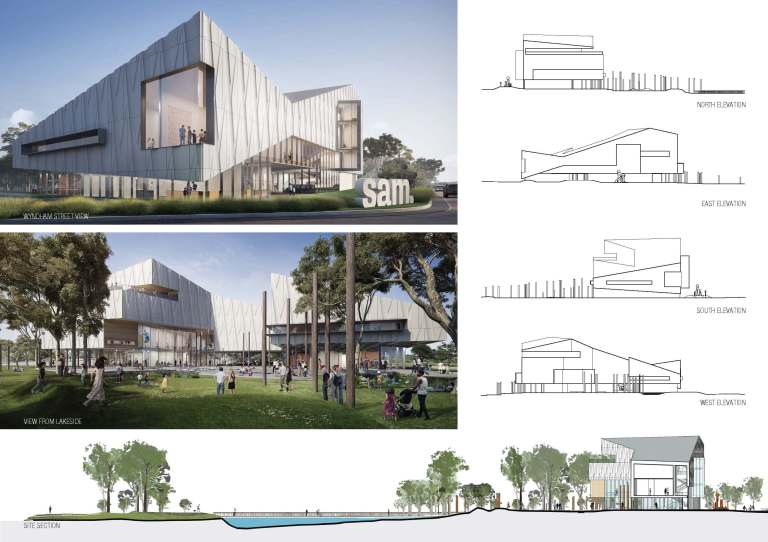
A lot of fun with some inverted wedge shapes (wedgies?), deftly playing up on contours of these volumes; in conjunction with the diamond shaped façade, this would give the Wyndham street view a great visual dynamic as you approach the gallery. Lyons really are great exponents of dynamic façade design and detailing. The volumetric shapes allow for the building to have a series of well articulated and diverse gallery spaces opening out to the lake. I like the ceiling of the Kaiela gallery. The galleries are generously and the central square would be great place for the kids of Shepparton to play up in.

KTA architects

kerstin_thompson_architects_page_1

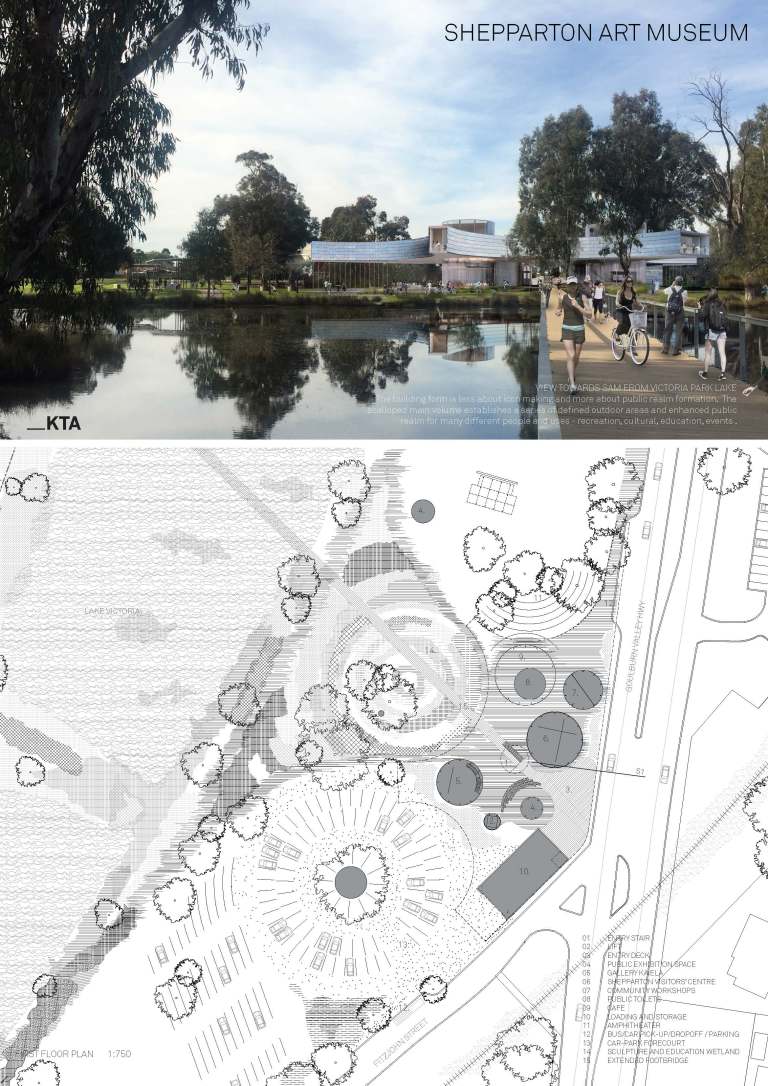
To be honest I actually like this one the best (is it ok if I say that?). I think this one pays more respect to the idea of country. I think it is because of the way that it attempts to drag the adjacent wetland and landscape into the building, and like the DCM scheme, I am a sucker for rooftops you can get onto. The space planning of the galleries look a bit constrained but I think the idea of a flowing circulation space and the sheltering canopy would be great backdrops for art. Being able to walk through it after hours is exactly what the punters need in Shepparton.

JWA

john_wardle_architects_page_1

I work in a JWA building so maybe I am positively biased. In contrast to the materials in the Lyons scheme what distinguishes this design is the use of timber both inside and outside. The vertical circulation through the building and the arrangement of different rooms and spaces is functional and extremely well considered. There are some pretty cool bits that would work well: The circular aperture over the entrance gallery. The large outward facing window to the amenities area. As well as the surreal red canopy over the roof terrace (which presumably can be changed and is intended to change over time). There is a lot of architecture and architectural detail in this proposal.

MVS

mvs_architects_page_1

Of all the schemes I think this one is probably the most subtle in terms of its concept.This is a more conceptually ambiguous proposal, than the other proposals, and perhaps that is a good thing. However, this ambiguity makes it harder to describe in a few words. At first glance it looks deceptively simple. A separate block and a courtyard block. There is no bluster or obvious kick in the head big idea.  A distortion and break up of a traditional art gallery or museum typology. In the renders and the conceptual diagram it looks like the concept is structured around disruption and play between a forested landscape (country), a manicured landscape and the wetlands. A slightly different take on the themes in the KTA scheme. The kinda lumpy ceiling of the entry gallery looks like fun.The facade is also apparently ambiguous with hues of orange, yellow, pink and violet against a mesh-like pattern and material.

State of Play? 

It’s a pretty good snapshot of the current state of play of Australian architecture. In light of the above I have tried to keep my remarks generous and resist the urge to let my critical faculties run wild. You can make up your own minds. My comments are based on the renders and plans to be found here. I would encourage all of you, especially students of architecture, to study and think about these submissions as these projects represent some of our best.

As with all good competitions you can vote on which one you like best. You can also do that here.


Strategy and Design Thinking: Why architects need strategic thinking.

This blog explores the nexus between architectural design and strategy. I am thinking there will be more blogs on this subject to follow over the year. 

Most architectural practices seem to lurch from crisis to crisis. In Australia most architects are small practitioners, juggling family commitments, trying desperately to maintain work life balance and at the same time running a small business that produces bespoke projects that require innovation, high levels of risk management, advanced negotiation skills not to mention networking and marketing skills. Architects, in between juggling the school drop off or saving for their own mortgages, work hard to add value to their clients, the built environment and society at large. Of course, its much easier, as it is for some in the building industry, to take the low road of cheaper, better faster and easier when it comes to delivering projects. If its cheap and nasty it must be good, right?

Having a strategy, and embedding strategic thinking into practice, a good way to help guide and resolve the dilemmas of practice. A good way to combat the cheap and nasty faction. Recently it was suggested to me by an architect that architects need not learn the finer arts of strategy. It was put to me that some architects never learn it and that it doesn’t really matter. I was pretty surprised by this as we were taught at Business School, regardless of what you think of business schools or biz school education, that strategic management and thinking was the highest form of managerial action.

In classical management theory the classical definitions of strategy are intertwined with notions of competition, military thought and the notion of winning. Mintzberg argued that strategic thinking was a central component of creating innovation and was by its nature intuitive, creative and divergent.  Strategic thinking as defined by the managerial theorist Mintzberg argues that strategic thinking is:

“about synthesis. It involves intuition and creativity. The outcome…is an integrated perspective of the enterprise, a not-too-precisely articulated vision of direction”

Michael Porter another management theorist argued that:

“Competitive strategy involves positioning a business to maximize the value of the capabilities that distinguish it from its competitors.”

Of course strategy as a field of thought has moved on since the work of Mintzberg and Porter. This has happened because technology has morphed and remorphed and the interconnected complexities of the global system have seemingly increased. In recent times the discourse of strategic management has reflected this. In strategic management theory and research questions abound: Is strategy formulation something that emerges or is it something that can be designed top down? How can strategy help our institutions with concepts of turbulence and uncertainty? As noted in a recent editorial in the Strategic Management Journal strategy may cover: organisational capabilities, interfirm relationships, knowledge creation and diffusion, innovation, organisational learning, behavioural strategy, technology management, and of course corporate social responsibility.

For architects having an understanding of strategy and strategic thinking is vital. In fact I would argue that it is vital for future architects to study strategy at architecture school, perhaps in the design studio.  To suggest that strategic thinking is not a part of architectural education or architects expertise suggests that architecture is simply a bundle of technically orientated skills and processes. A bundle of repetitive actions that require little thought. Actions that can be transferable and imparted to others. This suggests a craft based notion of architecture where skills and knowledge are passed down from so-called master to apprentice. I am not so sure about the craft myths that seem to permeate architecture. The craft myth is hard to shake even when highly advanced design and construction methods are used. The craft metaphor is probably a little bit too formulaic as a concept of architectural knowledge for my liking.

In Australia the competency standards describe the competencies and skills that architects are expected to know. These standards are used in accreditation processes to determine if a particular person is capable of being an architect; or an architecture school is teaching the correct skills or competencies. Interestingly, the standards say little about the need for strategic thinking.  They mostly describe what architects do rather than the thinking or conceptual skills they require. They are activity and process based. The standards are really lacking when it comes to issues around concepts of strategy, foresight, risk, project management and financial skills. The weight of the standards are focused on design and documentation. Viewed in detail much less emphasis is given to practice management and project delivery. I mean who needs that stuff? All we need as architects are the skills inherent to the traditional practice life cycle: Sketch design, design development, contract documentation, contract administration ect etc. In fact all we need to know about is Sketch Design. No matter that this lifecycle is increasingly under pressure and fragmented and as result a result of the industries lack of diversity, fee competition, and dis-intermediation.

Strategic thinking and planning has a number of advantages even for those architects lurching from the client to the consultants between picking up the kids from school. Strategic thinking sets a direction, even for the small firm beyond the day to day. A kind of thinking that helps to guide resource allocation when difficult decisions or trade-offs need to be made. It determines how your firm might be different, and I mean really different, to all of the other firms out there. Understanding strategic discourse can help the architect understand clients as they make strategic decisions regarding the future. If the management consultants and gurus can do it, why not architects? We are a lot smarter and more diverse than those guys.

An appreciation of strategic thinking helps to get architects out of the cycle of reacting from practice crisis to practice crisis or seeing architectural design as simplistic, step by step, and linear process of sequential tasks. Seeing design as a narrow technical specialisation is a huge mistake. Strategic thinking is inextricably and broadly linked to design and should be regarded as the highest form of design thinking.

It’s all quiet on the front at my grad school of architecture. A few summer studios are running and there is till 5 weeks to go before classes start. Nonetheless, next week, in the lull I am pre-recording a whole lot of online lectures!