#Freespace: The 16th Venice Architecture Biennale

For regular readers of this blog, I am sorry for going AWOL for a few weeks. This is the biggest break from my weekly blogging that I have had since I started this endeavour. Of course, I feel a little guilty. But hey, this blog is not always about the Google stats, if it ever was. For the past few weeks, I have been in Italy and managed to visit the Architecture Biennale. So, dear blog reader the next few blogs will focus on the 2018 Biennale. So dear readers, you can now say, as they say in the Chucky Movie he’s back. Typos and all.
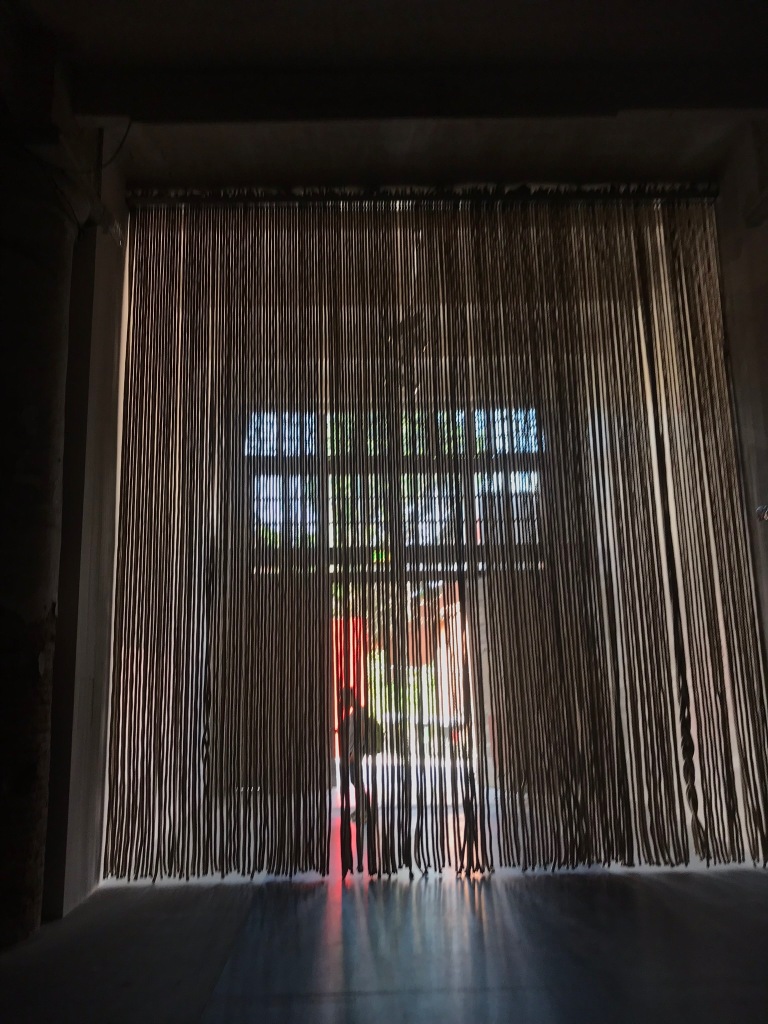
IMG_0001

Freespace

Freespace is the theme for the 2018 Architecture Biennale, and it has been curated by two Irish architects, Yvonne Farrell and Shelley McNamara. It is thought-provoking and well curated, and this is the best Biennale I have seen. They have done a great job. And for the most jaded of architectural hacks such as myself, looking at it through a haze of Cocchi Americano spritz, the curators have presented their theme as a comprehensive vision (Aperol is no longer my drink of choice on the lagoon). Its a vision of what architecture can aspire to be. Compared to past Biennale’s, it is not as muddled as Chipperfield’s theme of “Common Ground” or as ambiguous as Sejima’s “People Meet in Architecture” of 2010. This Biennale, unlike previous versions, has its very own manifesto written around the notion of Freespace.

The Manifesto

Yvonne Farrell and Shelley McNamara are graduates of University College Dublin and their practice is called Grafton architects .  The Freespace manifesto has six points. You can read the entire manifesto here. Here are a two manifesto points for your edification.

FREESPACE can be a space for opportunity, a democratic space, un-programmed and free for uses not yet conceived. There is an exchange between people and buildings that happens, even if not intended or designed, so buildings themselves find ways of sharing and engaging with people over time, long after the architect has left the scene. Architecture has an active as well as a passive life.

FREESPACE encompasses freedom to imagine, the free space of time and memory, binding past, present and future together, building on inherited cultural layers, weaving the archaic with the contemporary.

You can see all the selected architects here

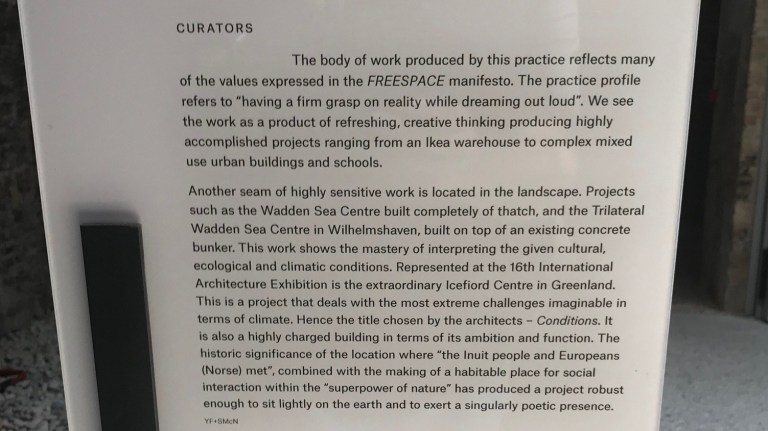
These are noble aspirations, and the manifesto helps to keep everything together. I think that Farrell and McNamara have curated a Biennale that is in keeping with their manifesto. Of course, the theme must allow enough room for broad interpretation and yet lend itself to specificity. Farrell and McNamara, and the architects, have done this admirably, and one of the great joys of this Biennale is the effort that has gone into the interpretive signage of each of the 71 or exhibitors in the Venice Giardini and the Corderie within the Venetian Arsenale; the impregnable complex of shipyards that was the epicentre of the Venetian Republic’s power. For each exhibitor, Farrell and McNamara provide for the visitor a piece as to why each was chosen and how their work relates to the overall theme. These little blurbs are concise, well written, refer back to the Freespace manifesto and are a pleasure to read.
IMG_5843

Frampton

And it might seem foolhardy to find a stable point in the plethora of approaches selected and presented at this Biennale. Nevertheless, this Biennale evokes Frampton’s 1983 essay, Towards a Critical Regionalism: Six Points for an Architecture of Resistance. In it Frampton argued that optimising technologies had delimited the ability of architects to produce significant urban form.⁠ The curators, like Frampton, strenuously advocate for the legitimacy of localised architectural cultures and a discourse resistant to processes of universalisation. The work of Critical Regionalism itself was to, “mediate the impact of universal civilisation with elements derived indirectly from the peculiarities of a particular place.⁠” Much of what the curators have selected in this Biennale accord with this sentiment. So much so they awarded Frampton a Golden Lion.
img_0058.jpg

A Computer #FreeSpace Zone

Best of all this is a Biennale that is very much a computer free zone. Yep. Let me just say that again. This is a biennale that is very much a computer free zone. Yes, there are lots of exquisite laser-cut models, there are obviously computer-generated drawings and diagrams. But for many of these architects, their patrons, and ordinary punters this is an exhibition that is about a kind of bottom up-architecture. There is no bombast or hyperbole related to the latest computer technologies to solve all of our problems. By and large, most exhibitors have provided representations of their own work, rather than pursuing dreary conceptual pieces based on abstract ideas. One might ask Farrell and McNamara, if they think computer hyperbole is diametrically opposed to the aspirations of Freespace?

Of course, between these two polarities–the curator’s against a universal society and the absence of in your face computing–there are other pathologies at play that probably cannot be covered in a blog like this.
img_0047.jpg

A schlock free zone

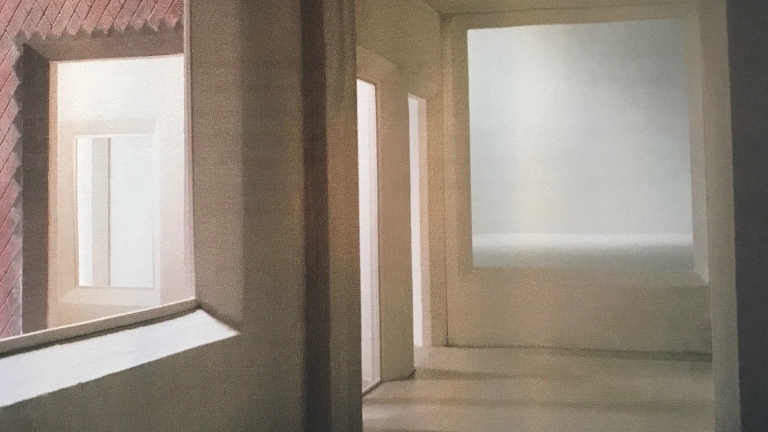
This is a Biennale refreshingly free of abstract schlocky volumes, cheap Eisenman-like syntactics and thankfully para-mucking-metrics. A few installations are overly conceptual, and they fall pretty flat. There is only so much you can do with gauze curtains and multi-media. This is a biennale depicting an architecture still based in the techniques of drawing, model making, section (remember those) and the plan. Yes, the plan, the plan as a working method, before it became an overly coagulated El Lissizky composition; drawn over and over and over again with line sequences adjusted a little bit here and there; lines never expressive enough to break out of the constraints of fluid capital.

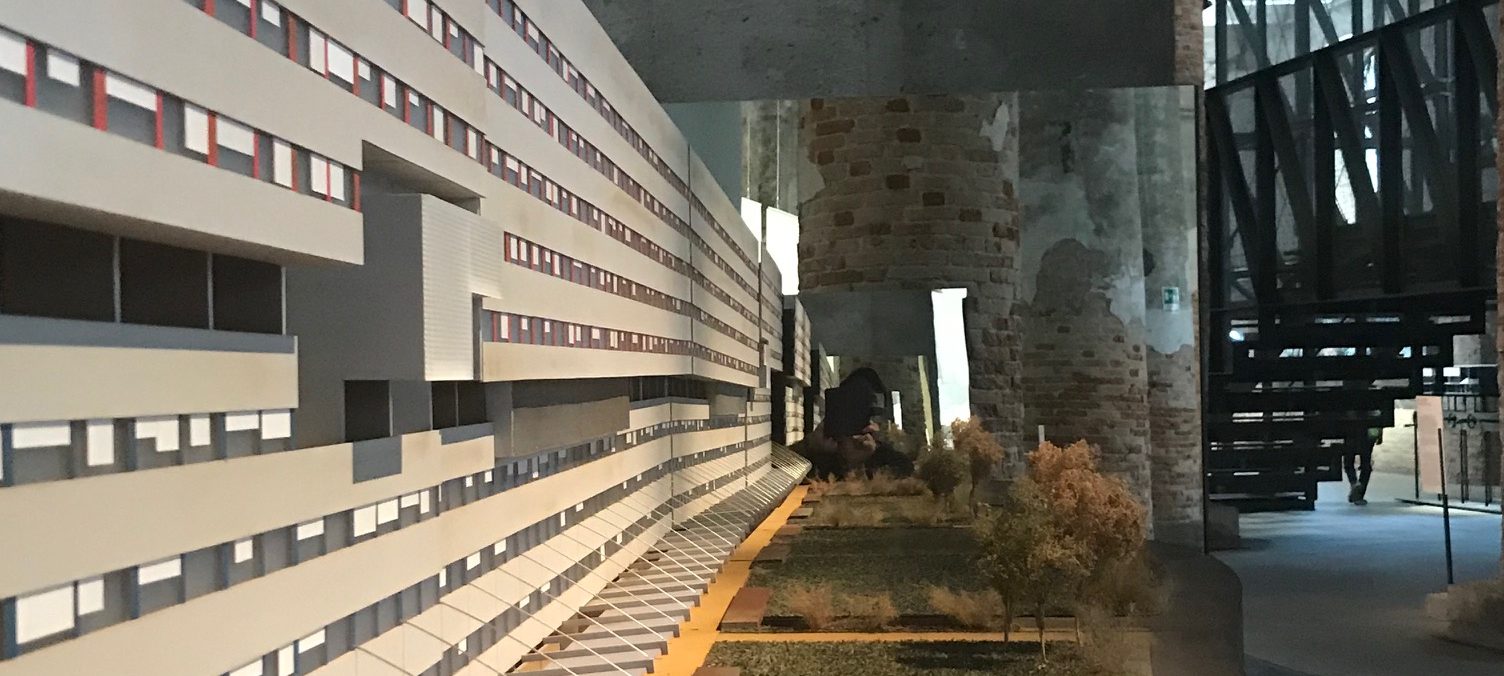
This is a Biennale exhibition of models, materiality, construction and spatial context. An architecture cognisant of regional differences, cultural layers and as the curators say in their manifesto.

FREESPACE encompasses freedom to imagine, the free space of time and memory, binding past, present and future together, building on inherited cultural layers, weaving the archaic with the contemporary.

Highlights

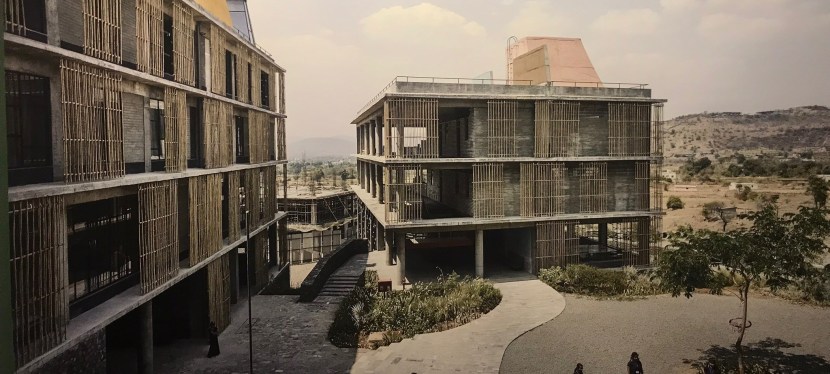
This is very much a Biennale that exhibit’s work that is shaped by propositions and experiments of the European city. The stats tend to suggest this: 46 of the firms represented are from Europe, 11 from across Asia, 5 from South America. Peter Rich from South Africa. Notably, the Trumpian republic only has 5. In theory, this Eurocentric focus and pursuit of Frampton’s credo is paradoxically the limitation of this Biennale. In accord with the Freespace manifesto, much of the work of the firms in the Arsenale is focused on exploring layers, community, culture, memory and the morphologies of the European city. Yes, the curators have selected some non-European entries from India, China and South Americas. But overall, the wan light of the iniquitous slum-cities now sprawling across the globe are missing at this Biennale. This is arguably an architecture formed in a Eurocentric bubble, and one wonders if Freespace is radical or confrontational enough to fill the gap. Perhaps in the future, some historians will decide that Betsky’s 2008 Biennale was the last gasp of American architecture.

Nonetheless, the result is refreshing as this is by and large it’s a star architect, and parametric free zone, although beautiful, charming and talkative Bjarke is there with a dreary flooded scheme of New York replete, in a room with plasma screens which have a cheesy blue bubble water that rising up on each screen. It reminded me of the Bubblecup franchise (I guess that’s what happens when you leave Europe and go to New York). Nothing like converting global warming and rising sea levels, to a graphics device on a plasma screen to help avert the actual horrors of climate justice.

Ozzie, Ozzie, Ozzie

img_0068.jpg

And of course what about the Ozzie’s? What about the Ozzie, Ozzie, Ozzie, Oi, Oi, Oi architects. Well, there are two plucky little Australian firms selected by the curators in the Asrsenale. John Wardle and Room 11. Wardle makes it into the Arsenale with a giant kind of conceptual spotted gum (if that was the species) piece, sadly let down by an overwrought plastic red thing with a mirror at the end. I can’t even begin to tell you what it reminds me of. It would have been better to see some of the practice’s work. As for Room 11, from Tasmania, I think I have written about them elsewhere.
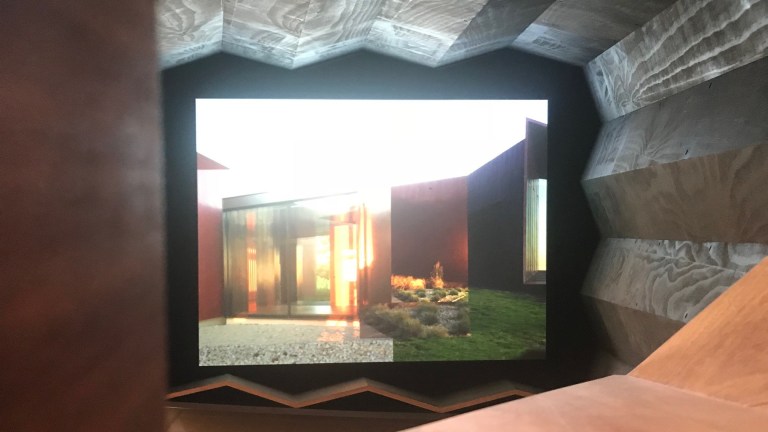
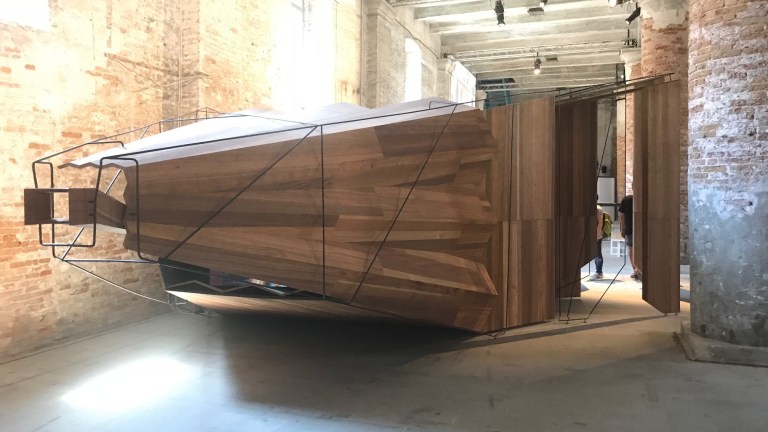
img_5840.jpgIMG_5837IMG_5840

Caccia Dominioni

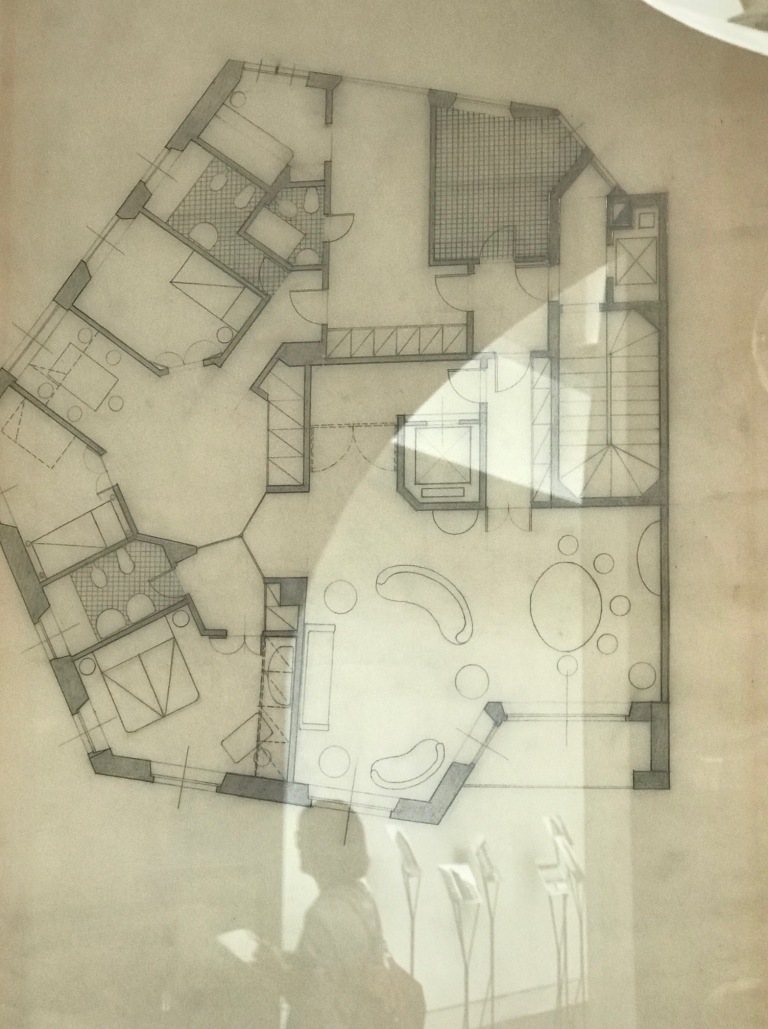
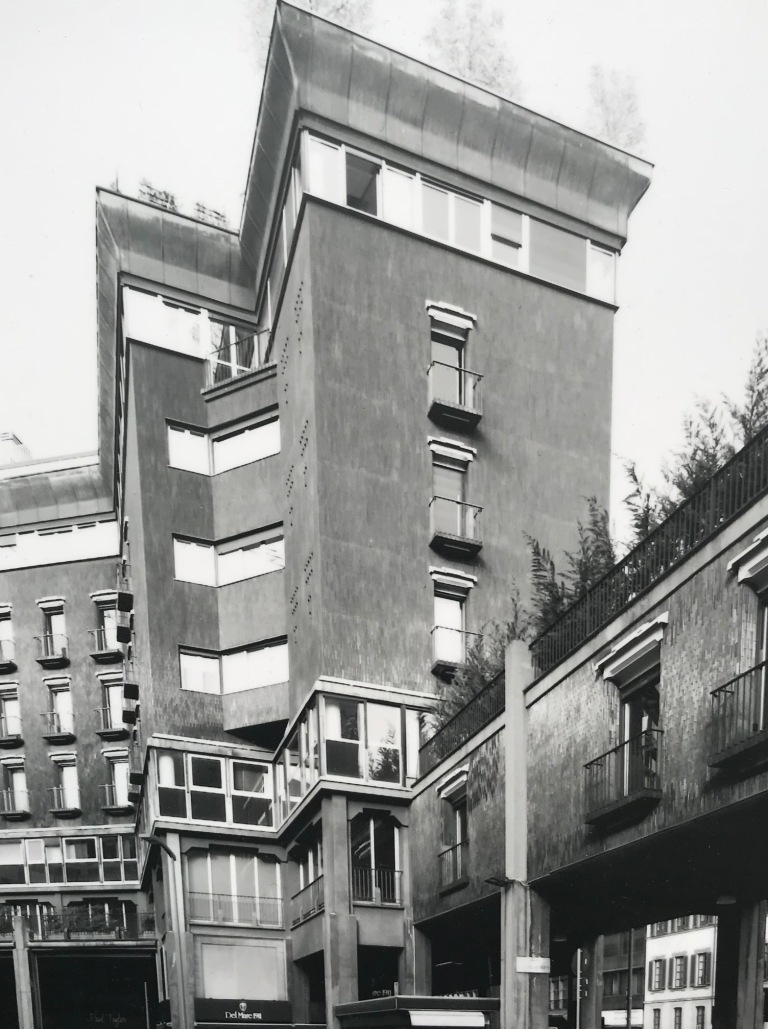
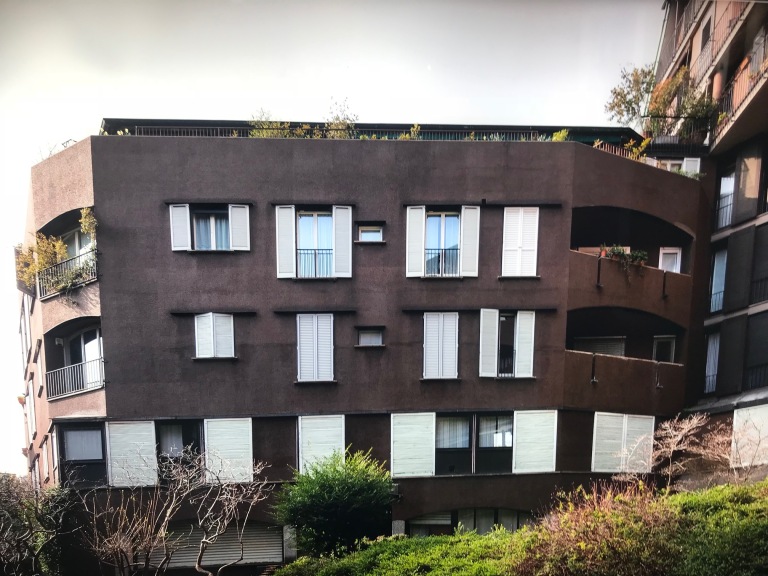
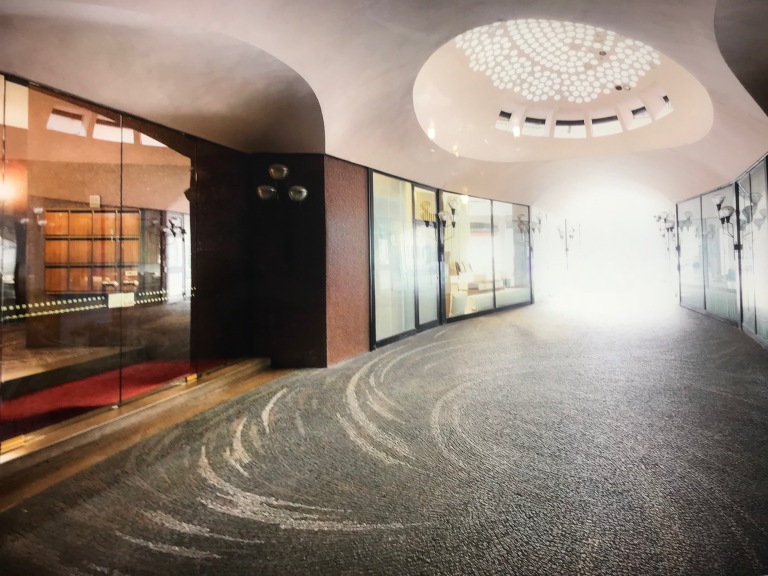
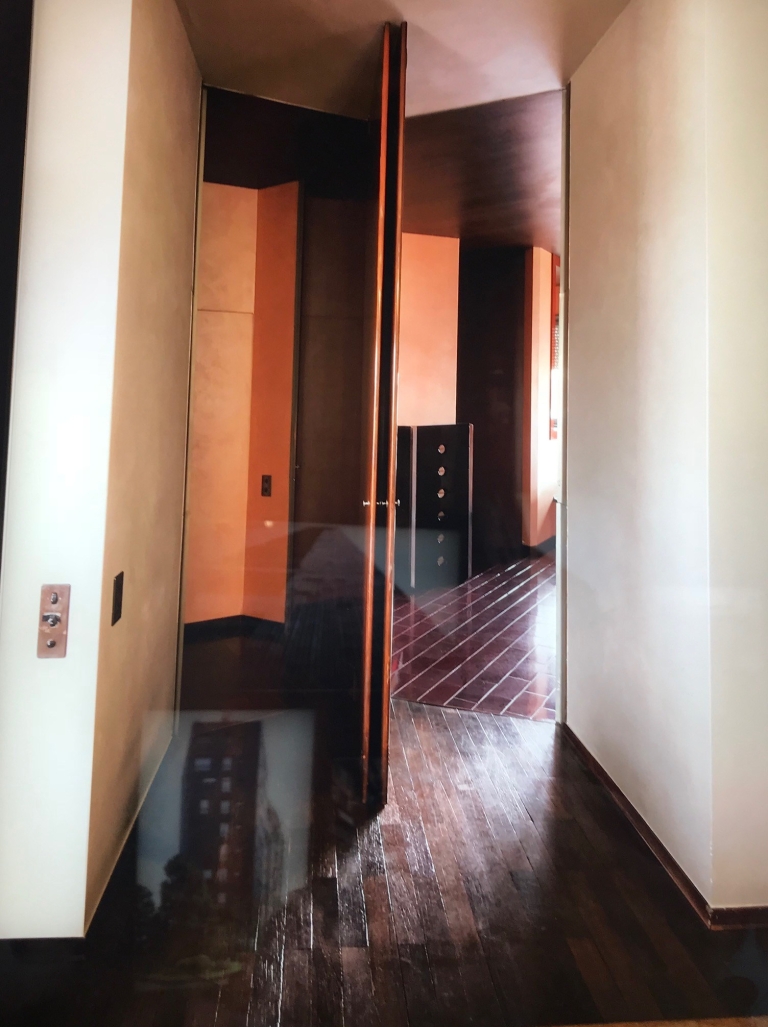
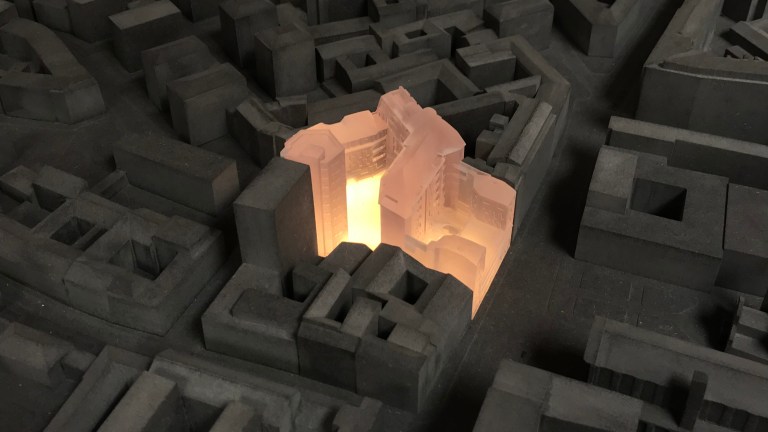
One of the revelations for me was the presentation of the work of the late Milanese architect Caccia Dominioni curated by Cino Zucchi. Dominioni worked to create magnificent apartments for the Milanese bourgeois.
img_59131.jpg

IMG_5918

IMG_5932IMG_5922IMG_5928IMG_5926IMG_5930

When I see this work I think it indicates a rigorous working method committed to a project that inscribes the lives and habits of a people into the plan. His work is a far cry from the Jim Jims and melamine soaked interiors, featurist luxuries, and cheap scrims in the apartment plans of Australian cities.

In coming weeks I will discuss the Sean Godsell’s contribution at the Holy See, Repair the Australian Pavilion and maybe even the MADA wall. In the meantime don’t forget to help Architeam fund the RASP project. 

Boom times but Australian Architects still facing Mutually Assured Destruction

Shaun Carter’s recent piece on architects fees and money is something I think everyone should read. You can find the full article here at ArchitetcureAU.  Shaun is a past president of the NSW Institute of Architects Chapter.  I thought it would be worth commenting on some of the questions and issues that he raises. Everyone architect in the country should read this article.

The old joke 

He starts with an old blokey architects joke.

Did you hear the one about the architect who won the lottery? They kept on working until they were broke. This was my introduction to architecture. I thought it was a joke. Now I’m not so sure.

This was a fine joke thirty years ago. It has a little bit of the boom-bust mentality about it. Plus a tone of altruism. In other words, architects get money and then spend it on architecture. They get money and spend it on design hours. They do this because of a love and passion for architecture and society.  But as a joke it implies architects always go back to zero, or square one, when they go broke.

The usual catastrophe 

images-1

However, while the joke might contain some sublte truths, the problem is as that architects don’t just go broke to the point of zero dollars. They go negative, and the financial and emotional toll on themselves their families and their profession is enormous. No adequate superannuation, no assets no worth in their small businesses when they retire, its worse I guess for employee architects who are inadequately prepared for their later years. Working from contract to contract, below award wages, no paid overtime, moving from poorly managed firm to poorly managed firm isn’t really a recipe once you are past 50 or 60 for a comfortable grey life.

Exploiting the talent

Last week a graduate came to me and said he had been offered a casual job at 17 bucks on a kind of “training” basis. Anyone reading this can look up the award. Sometimes I wonder if one of the best things that could happen to the profession is that the Fair Work commission starts to prosecute architectural employers for not paying award rates. Under the award, a graduate architect on a casual rate should get $31.09 an hour and if full time or part-time. $24.87.

The Scourge of Fee Cutting 

However, as Shaun says the real problem is price competition and fee cutting:

I talk to architects all the time and in almost every conversation hear stories of outrageously low fees and cutthroat fee gazundering. Economics 101 taught me that when a good or a service is in high demand and the supply is limited, the cost goes up. So why is it, then, in this boom time for architects, that we have managed to slash our fees in a desperate race to the bottom? He then goes on to say: If we are to achieve major reforms and be respected as a profession, we need to be not only financially viable, but financially successful. Otherwise, how are we to achieve gender equality? How do we stop our practices becoming sweatshops of juniors working long and late hours?

Shaun Carter proposes four areas where he feels that architects need to change. These are architects, clients, regulation and cheap overseas labour (WTF?).

Idolising the creepy architects

download-1

Shaun argues that architects need to be better at business and that being poor at it is “just plain dumb.” I agree with this but to change this architects really need to shift their culture around. As architects, we have to stop idolising and revering “bad boy” designers. These guys are mostly creeps and yet they are the ones that get all the symbolic capital in our profession. Plus they know nothing about business or management. Or for that matter anything really. But hey does it matter when you get all the street cred.

Sludge 

download-3

However, he argues that architects need to collectively bargain minimum rates of fees and architects need a “strict ethical and moral code to prevent rogue architects from damaging our profession.” Fair enough, but try telling that to the AIA which as an organisation appears to have governance and decision making processes that are slow bureaucratic and easily hi-jacked by ego-driven personalities. Witness the recent hoohaa around the AACA vs. the AIA. Hence reaching any consensus that might translate into policy or advocacy approaches for architects is like wading through sludge.

Going for the Mandate 

Carter calls for minimum fee guidelines for the entire profession. He argues that governments should then follow these guides as well. However, I am not entirely sure how this might work in practice, and I am concerned in legal terms it might be seen as being anti-competitive. But hey if you are starting a practice, it would be great to get an idea of what you should be charging. I think one thing that all of our professional groups and associations could get behind is the idea (suggested to me by Vanessa Bird previous president of the Victorian Chapter). This is the idea that it should be mandated that every building project in Australia, over a certain amount, should have an architect. I am not sure how this kind of regulation would work in detail. But as Shaun Carter argues:

Regulation has been a dirty word these past 30 years of neoliberal and trickle-down economics. What we know of this period is that the failed economic model has advantaged the few at the expense of the many. Economic literature has thoroughly documented the failure of loose and limited regulation and the way this has run down professions and reputations.

Mutually Assured Destruction

download-2

Shaun’s third notion for saving the profession from the “existential cliff” and “Mutually Assured Destruction” as he calls it is to limit university places in architecture degrees linking this to the outsourcing of architectural work offshore. As he says:

“If the profession is going to send our future architects’ jobs offshore, then let’s stop the cruel practice of offering them meaningful employment with one hand and ripping it from them with the other.”

He then goes on to say:

Perhaps the most controversial reason for the erosion of fees is firms employing cheap overseas labour to undercut the market. I believe that this is the emperor’s new clothes of business school management. It drives down fee expectations that will be difficult to claw back, while limiting employment opportunities for our young architects because their jobs are being sent overseas, all at a time when we are enrolling and graduating architects at record rates.

Protectionism?

I am not sure about this line of argument because it starts to sound a little “protectionist” and raising the spectre of “cheap overseas labour” suggests stereotyped images of what that labour looks like. Think, call centres full of Revit CAD monkeys in large second-order centres full in South, South East or North Asia. Nonetheless, I certainly dont think that Shaun Carter is intending to cross the lines into Trump Tariff and Immigration territory. But really what is being suggested here does raise questions about some of the current dynamics in practice. This includes the globalisation of competition between architects and the commodification of architectural services with the rise of new technologies. Despite all the BIM hoopla are we really ahead of the technology game?

Too many at Architecture School? 

As for the numbers of architecture students in the Universities and how many graduates are produced in Australia I might leave that to a later blog. But needless to say in 2015, the universities made $225 million bucks out of architecture (Check that out here). I also doubt that very much of that goes back into research of direct benefit to the profession. On the plus side, the Architecture Schools do support the professions with lots of sessional teaching contracts. However, is that enough given how much money the Universities are making out of architecture? For Australian Universities, Architecture Schools are a valuable cash cow. However, Architecture Schools are by no means the largest of their international education cash cows. The universities also love architects, and they love architecture schools because it all adds to their branding, reputation status and symbolic capital.

However, I don’t see many of the 18 schools of Architecture joining these debates about the value of the profession and its worth. Most architecture schools and faculties are struggling to manage the strictures imposed on them by central university executives who think that having an architecture school, in the portfolio, is a bit valuable and kind of quaint. If that is the case, maybe those same executives can give architecture some more research money.

We are family

To overcome the malaise that architects find themselves in the architecture schools, the professional associations, and the AACA need to lobby for the worth of architecture collectively. A fragmented and ungovernable architectural community will not solve the problems architects face. As Shaun Carter argues fee cutting is a recipe for Mutually Assured Destruction.

I am almost on annual leave between semesters. In the next few weeks expect to see a few more relaxed beach blogs and tweets from Italy and the Biennale. If you want to know more about our RASP research project you can find it here

ArchiTeam Funding Research for Architects in Small Practice.

Small architectural practice is one of the hardest things you do in life. Sometimes it feels like the rewards are few and far between. Even the most modest house or house renovation can take years to design and see built. Small practices contribute much to Australian cities, small practices believe in design, the elegance of details and, more often than not, the hopes of local communities. The influence and impact of small practice is everywhere in our cities and suburbs. In our cities, small practice architects are an integral part of heritage and planning debates, the business of architectural education as well as the construction and property industry. However, small architects have not been served well by existing avenues of research funding in the field.

RAsP invite

The RASP launch is just before the MSDx exhibition which will give you a great idea of the range and depth of the many fabulous design studios at MSD.

The voice of the architect

In small projects, no matter what they are it is often the voice of the architect who stands up for planning and regulatory approval, common sense and sustainability. It is the architect who pushes back against the excesses of those only concerned with crude measures of time and cost. A generosity of spirit has always been an attribute of small practice. As a result, most architects at the end of their careers have accumulated those lines and wrinkles that only the careworn seem to gather.

The voices of architects both individually and collectively are often unheard or dismissed. Mostly these perceptions come from a distracted public unversed in design and more powerful lobby groups. Architects themselves worry and wring their hands about this and wonder how it could be better. We need research to combat all of this.

In conjunction with ArchiTeam and MSD, we are hoping to crowdfund a research project that examines the value that architects add to the property. It is unlikely that this project would gain funding in any other way. We are hoping to get around $25,000 for the project.
This initiative is a unique approach to research funding for small practices, and ArchiTeam is hoping to create an ongoing research fund for small practice. ArchiTeam have branded this initiative as RASP an acronym for Research for Architects in Small Practice. Building a research fund of this kind will send a strong message that small practice based architects need to be acknowledged and counted for in the design of our future cities.

The proposal

The research project aims to measure if architect-designed houses and house renovations improve capital gains in the Melbourne inner city housing market. The precise wording of the research question is “Do architect designed renovations improve capital gains in the Melbourne residential property market?”

In concise terms, the research will involve a descriptive, comparative quantitative analysis of two data pools. One pool will be based on sale data from architect-designed houses, and the other will contain sale data from non-architect designed houses. The data from each of these pools will be aggregated, analysed and compared. Descriptive statistics, as well as correlation and regression analysis, will be employed to compare the two pools. Email me if you have any questions about how we will do it. A research contract is in place the crowdfunding amount will go into a fund administered by MSD and ArchiTeam cooperative. The money will principally fund research associate time and data costs.

ArchiTeam 

For regular blog readers who do not know ArchiTeam was founded in 1991. ArchiTeam Cooperative is a membership association for Australian architects working in small, medium and emerging practices. ArchiTeam is democratically run by members, for members. Every member is encouraged to play an active part in shaping the organisation. With over 800+ members, it is the leading dedicated voice of Australia’s small architectural practices. This research proposal is unique and specific to the profession of architecture and small practices. It positions ArchiTeam as both a sponsor and a leader in applied architectural research in Australia.

You are welcome to come along to our celebratory launch night and the details are below. Justin Madden of Arup, Rosemary Ross of ArchiTeam and myself will be speaking. The RASP crowdfunding button will then go live !

RAsP invite

The RASP launch is just before the MSDx exhibition which will give you a great idea of the range and depth of the many fabulous design studios at MSD. Hundreds of projects will be displayed throughout the building during the exhibition, from 22 June to 6 July. If read this blog and see me there come and say hello.


Big Data and Architects Part 2: Getting ready for Hackable urbanism

This week I have been visiting quite a few crits and jury sessions at my graduate architecture school. After last week’s post every time the students saw me coming they appeared to panic. Nonetheless, I sat in the back of most of the crits and listened. It was great.

The experience, of looking at countless analytical diagrams, did make me think about the impact of big data on urban strategy and urban design techniques. Then I bumped into the poster near the lifts. It’s great the AA is coming for a summer break to MSD, our winter break, and our MSD grad school is having lots of great speakers. All the details are here, and I would encourage people to go along.

Sadly, I won’t be around to indulge in this fest as I will be in the northern hemisphere hanging out with what’s left of the Architecture Biennale after its Vernissage partay trashing. Even so, the poster got me thinking about architects and the technology thing yet again. As regular readers of this blog know I am over the whole parametric hoo-ha. Maybe it’s just the culture that goes with parametrics in architecture that I dislike.

However, what concerns me is that with all the obsession with new gadgets and technologies architects have arguably relegated the logistics of informatics to a forgotten territory. The new architect-as-maker paradigm has turned design aesthetics into a construction supply chain wet dream; a meta-narrative of commercial innovation; a fantasy that we architects can be like subbies (sub-contractors) and tradies.  An architectural focus on the technology of gimmicks, the making stuff, is one thing but what about data analytics? (My previous post on big data and practice can be found here).

Technology management and strategy is not something that is taught at architecture school, and I am wondering how the design studio and architects in general will, and should respond to the mass of data and information now coming down the pipeline. So to help, and to prove I am not a complete IT atavistic type here are a few clues to help you get your head around so-called big data.

Redundant Instruments

In engineering and manufacturing, policy types are starting to talk Industry 4.0. However, for architects hunkered down in the maker-space construction supply chains it’s like we are doing all the bits but not the strategy that goes with it. However, the broader question should be: Are all the old polarities of architectural and urban design technique relevant? Typology, functional zoning, densification, “activation” and the like. A lot of the architect’s toolkit of urban analytics appears to be related to the Smithson’s notions of diagramming, and while I would be the first to point to the importance of these legacies, the new digital technologies are swamping these approaches and techniques of urban analysis.

smithson-golden-lane.jpg

However, cities are no longer the economic engines of American industry or post-war reconstruction. It was these types of post-1945 cities that the Smithson’s and the other post CIAM architects employed their toolkit of pencils, butter paper sketches, ideograms and collages to analyse.

With the rise of policy concepts like Industry 4.0 and the so-called internet-of-things (which always makes me think of this) architects and urbanist are now facing a different set of conditions.

Data analytics is a design issue

gcp-map-2.jpg

How do architects design with data? Even the interns at Hadid’s are beginning to experiment with the Internet of things in workplace design. A few people have started to discuss the idea of data augmented design. However, most of the current work in this field appears to be focused on transport planning and logistics.

Perhaps the first step for architects is to begin to understand the basics of IT infrastructure. Hey, where does all that data go? As physical entities, Data Warehousing appears to exist on the periphery and in the cracks of cities. Where does all that go and who is responsible for data security. In the wake of Cambridge Analytica how is public and urban data captured, stored, secured and surveilled? What are the physical interfaces between this hidden ecology and the servers that it all resides in?

https_blueprint-api-production.s3.amazonaws.comuploadscardimage736957b3740dd8-c006-47b1-8136-8a4346f9cff8

 As Lev Manovich and Agustin Indaco, argue analysing social media posts can yield much information about the built environment.

Data is big really big

That’s why it is called big data. With the onslaught of digitisation, every action generates and spits out data. There is social media of course but once the Internet of Things kicks in it will probably get bigger. Plus it is not just about physical objects spitting out information. There is all the data collected from social media and google apps.

AURIN which is a data provider to researchers have over Over 3500 datasets from 98 sources cover disciplines including demography, property and housing, transport, health, energy and water.

Agency and the Hackable city

It’s pretty easy to mouth off about It’s pretty easy to leave it to the experts. However, in doing so architects risk losing ground unless we can integrate our ways of spatial thinking with these  The size and scale of new data sets and the skills needed to analyse these sets is not something architects should avoid if they are to be serious about tackling the urban design of future cities and settlements.

The hackable city project in the Netherlands posits that there are opportunities for

“platforms offer for modes of collaborative city making that empower (hyper)local stakeholders in an open and democratic society.”

Such sentiments may sound naïve, but they a are better than blind ignorance of the network of platforms that now consume and shape our cities.

Big Data is about decision making

Tools like SPSS and Matlab are ways architects can start to develop some of these things.  But, hey we don’t even do excel at architecture school. Moreover, our idea of research methods is stuff about “creativity” and “design as research”. But maybe what we need are skills in topics including decision-making under uncertainty, optimal location allocation of resources, decision trees, linear programming, Monte Carlo simulations. Not to mention, linear and nonlinear regression, parametric classification techniques and model selection. Then there are methods like Neural Networks and AHP (you can read my paper on AHP here).

Predictive analytics

A lot of the work on predictive analytics in architecture and urban design appears to be centred on transport planning, pedestrian networks and agent and swarm-based modelling. Another development is the push for what has been called citizen design science. This is the idea that new technologies and data can be employed to help citizens to provide input and feedback into urban design and planning processes. I kind of like the idea of “crowdsourcing” opinions. I also wonder how that might work in the context of informal settlements. Predictive analytics would also be of benefit to Post Occupancy Evaluation techniques which architects are now increasingly returning to understand what the heck they are doing.

In understanding the dynamics of urban flexibility and reconstruction the idea of the hackable city and the idea of citizens agency. Such techniques might help architects and planners to abandon the old notions of analysis based on functional zoning and urban circulation.

 Data Visualisation

peter-alison-smithson-upper-lawn-pavilion-xoio-lasse-rode-13.jpg

Data Visualisation is where architects can go a bit crazy and really excel (excuse the pun).  We all love a good diagram. Data visualisation is not about going down to the VR lab and hanging out in a VR hospital word or classroom to see what it is like. Is VR and AR really where it’s at for the future of architectural design? I think other technologies for gathering user data will be more critical than gimmicks.

In fact, I would rather hang out in a VR network diagram or graph. Data Visualisation would be like the Smithson’s diagrams on steroids. No, actually it would be more like meeting Alison and Peter Smithson in their little home the Upper Lawn Pavilion and giving them a few lines of coke and then seeing what happens on the butter paper.

Surviving the Design Studio: Coping with the 10 worst design critics

My Instagram feed has been full of my best ex-students and favourite colleagues having a great time in Venice and Northern Italy. Some have even taken their smaller kids. There were lots of images of Scarpa, and many of the glittering ruins built on the mud flats of the lagoon plus the dreary architectural follies of the Biennale.

img_7844.jpg

All washed up 

Then I thought of these ex-students and thought of the old comic times of the Raisbeck studio teaching days. I got a bit nostalgic. It got me thinking how much I miss design studios and the end of semester crits. No one wants the washed-up self-deprecating professional practice lecturer in a crit these days. Probably best to leave those crits to the shoppy fabricators, grasshopper gropers, history aesthetes, save the world (but never protest) sustainability types, robot boys and anyone with a pedigreed north American or pedigreed degree. Have I offended anyone?

Everything is now so fragmented and specialised. There is nothing wrong with getting the specialists in providing the architects are there as well. But I worry this approach is breeding the end of the design studio. The university managers and money men would love that. Thank god we can still have actual architects from small practices teaching and involved in our schools. Small practitioners can think across, and into the fragmented fields of specialisation.

Of course, I am actually more nostalgic than bitter about the old Raisbeck studio days. Maybe I should put together my all-time best studio team in another blog.

Design crit anxiety

The juries and design crits at my graduate school are coming up, So I thought some of you might need some help. But first a warning: Don’t read this if you are already anxious about standing in front if a design jury.

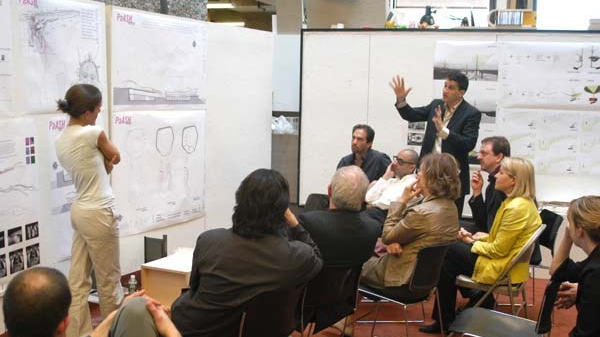
Architecture students are by and large terrified of design juries. They have every right to be afraid. For an architecture student, the power balance is unequal. Perhaps it is this unequal power balance embedded in studio culture that permeates through the profession’s culture. For the most part, this fear is a result of the emotional investment and work that an individual invests in the project before the presentation. Also, the investment in a project is often individual and unique and it is also easy to think the worst is about to happen. That the jury members will, in the presentation, focus on the weakest points in your design or worse still find faults in your design that you did not even know existed.

English as your second language 

English tends to be the international language of juries. So, if English is not your first language, then it is more difficult. It can feel daunting. Most jurors, but not all, will be sympathetic to your language skills. After all, if you have designed your project well and presented your work effectively it will be ok. Everything will be there on the wall or the screen, and you don’t have to say that much.

Most jurors will genuinely want to explore your thinking. They will want to know about your design ideas, how you responded to the design brief, the context and the ideas set by the studio tutors. Regardless of your language skills they will want to engage in a two-way conversation with you. They will suggest things that you might have done or done differently. Use it as an opportunity to learn.

Good advice

Good jurors will listen to what you and the other jury members say, and help to promote the conversation. The depth and range of this conversation will enable the juror to understand your project and where you are positioned in your journey towards being an architect. Better jurors will gently shape this narrative to get to the point of considering if your project contributes to new design knowledge or not.

But jury presentations require practice and if you haven’t had much practice then, of course, its a worry. To overcome this you should practice your talk beforehand. You really need to do this, and the jurors will appreciate your care and thoughtfulness if you do this. The above approach presumes there is an equal balance of power, or at least approaching it, between the design juror and the person presenting.

Some jurors and design critics are not nice at all 

But you need to be aware that not all jurors are nice. Jury standards across the schools and the profession vary. Architecture in the past has been a professional cultural built on a legacy of discrimination, racism and taste-making snobbery. There are still pockets of these practices in architecture. The design jury can sometimes be the place where these things come to the fore. So below is a heads up on some of the jury types you might find when you present. Plus a few tips on how to deal with them.

Ten types of jurors and design critic (in no particular order).

1. The Peacock: Very common. Sadly some design jurors like to be smarty pants and love to use deficiencies in a project to promote their own specialist knowledge, interests and architectural fetishes. This one is quite common. You often get the impression that these jurors jurysplain. This is the equivalent of mansplaining, and in their vanity, they just want to impress you with their superior knowledge (usually flawed or incomplete), architectural or star status or latest awfull project they may have just finished.

pexels-photo-409828.jpeg
Photo by Juhasz Imre on Pexels.com

Counter: Tell them and stick to what you know about your project. Smile and nod and agree. Try and find the connections between your project and their interests. Under no circumstances pretend to be an expert in their peacock areas of knowledge.

2. The contrary dickheads: Common. These are the jurors who love nothing more than being contrary. Think Tony Abbott. To them the logic of your design thought and how it contributes new design knowledge means nothing. These jurors will use an opposite argument at every step of the way to counter what you or other jurors might say. Usually, they are playing to an audience. For example, if the other jurors like something this type will say the opposite. If you say something, they will say make an opposite and opposing claim. The Contrary dickhead usually leads to a discussion between jury members with you on the sidelines. Counter: If you are confident counter with contrary positions on there contrary. That usually confuses them. Or try and ask a few questions and ask them what they really think.

3.The plansplainer: Common. I hated doing plans when I was an architecture student. I was more interested in ideas, volumes and theories of architectural meaning (on reflection I really had no idea what I was doing when it came to plans. The plansplainer will start looking at your plans and picking them apart. Door swings, toilets, bathrooms, kitchens bedrooms, storage areas and of course those big slabs of space you stupidly filled with tables and chairs from the CAD library. They will often go onto question your pragmatics.

Counter: Get right into the plan detail with them. Pray you actually have some detail there talk to them about sizes and measurements of the spaces in your plan. Don’t worry you will never get it right with the plansplainers. For the most part, they are pedants who have no real interest in architectural ideas.

4.The rock and roller: Endangered. A few isolated individuals exist. Think Woflie P and the recently departed Will Alsop. These are a variant on the self-confident star architect. These types are becoming increasingly rare as they get older. They just want to be entertained. They have no discernible ideology to pursue except “let’s all get down and party.”

download

Counter: Go with the flow. Talk about your design as if it’s going to be the best drug-fuelled disco party space ever. Tell them something about contemporary popular culture they are unlikely to know about. Mention rappers or the latest Insta influencer.

5.The Big Picture Critic (BPC): Common enough. These types will usually attack the logic of your conceptual approach. It is typically posed by those who have had a more “academic” training in the pedigreed schools. This attack typically will come in two forms. Firstly, the way you have conceptualised your design in a way that is too limited. Your design’s frame of reference, its big picture, is not quite right. Basically, you have forgotten something, or you have not had the right frame of reference, or the logic of concept is flawed. In other words and typically, you did not address a broader urban context. Secondly, there is some fundamental flaw in the conceptual framing of your concept that means your entire concept should be reconfigured.

Counter: this is a tough attack to counter. Especially if you have spent the design process on the computer or rushed together a basic brief and spatial program and never considered anything outside of the boundaries of your site. This attack ends badly if your design does not have conceptual apparatus built into it. Best to consider what you would say about these kinds of questions before the design crit. One way out is to talk about the ideas you embedded into the design. Let us hope you have more than two. This will appease the BPC even if they continue to argue about conceptual configuration.

6.The Headkicker: Rare and increasingly becoming an endangered species. As our former Prime Minister Paul Keating used to say “see a head” kick it. This is the one that is hardest to defend against. It is usually a disaster when one of these types appear in the jury room. Probably best to stay calm and go along with it. Don’t panic as soon as this type smells panic they go for the jugular even more. Thanks to lousy role modelling via the people who taught me I have been witness to the darker arts of this style of jury criticism. These darker jury and design crit arts and tactics should never be used by anyone. This is why I am not going to give you an exact list of what they are.

Counter: There is not a lot you can do. If you can cry. Or seem like you are about to cry that can work. Or at the least just look crestfallen. This only works if your studio leaders have some sympathy for you and they understand that when someone cries in the public space of the design crit something has gone seriously wrong with their teaching.

7.The Silent Head-Kicker: Relatively Common. Still a common occurrence I am afraid. These jurors will never tell what they really think. You will get the feeling that whatever you have done is not quite right. Some architects run their design studios like this (both within and outside of the schools). The crit itself can be painfully long without anyone saying anything. The design critics won’t say much, but your natural tendency will be to say too much to fill the gap of the silence. Don’t try and fill a silence with unnecessary words you might end up saying something that sabotages your design argument (if you have one). In talking to fill a void, you may dig your own grave. If there is a silence just go with it. After all, it is burning up time, and no one is attacking you.

Counter: Respond to their questions but also try and draw them out as to want they really think. Also, direct your remarks to the entire jury even if one of them is silent. This doesn’t necessarily mean their opinion won’t hold some weight later. I hate it when I am on a jury, and a student directs there remarks to the person (like the local starchitect) they think has the most power in the room. When I see that happening I think is one of the few occasions that I will go for the jugular. Remember you need to involve all jurors in the conversation.

8.The Koala: Relatively common these days. I kind of like the Koalas. But they can be unpredictable and a tad pedantic. Sleepy with not much to say. Mostly dopey. So they just assert things. Usually, warm and fuzzy things. But sometimes they will assert incorrect and stupid interpretations. Mostly the questions are superficial. But poke the bear too much, and they can turn nasty. Or show them something intellectually challenging and they will come out with statements that will really drive you crazy because they are out of their depth and don’t really get it.

img_42001.jpg

Counter: Listen and be patient. Try and affirm their questions to get tot here warm and fuzzy core. This juror is never the brightest. Address their pathetic concerns in detail. If they say anything to presumptive or outrageous, you will have to call them out on it. But be warned you may not have enough time to counter their lack of knowledge.

9.The love-your-work-critic: Rare. Just go with the flow with it lap it up and don’t believe all of it. The more you tell them how you thought about your work, the more they will love it. It’s often hard to know what prompts this response from a juror. Sometimes it might be set-up, e.g. a good cop-bad cop situation. Again there are some things about the darker arts of jury criticism I cannot reveal.

Counter: Self-effacement and modesty is always good. Thank the juror or juries for their encouragement and try and figure out what they like about it. Tell them what you would do differently next time. When they jury loves your work, and you tell them that they will want to give you more marks for being insightful. Communication self-reflection and insight into your project and processes will always get you more marks. But, make sure the love-your-work jurors are not just saying it because of how you look or has anything to do with your fashion sense. Check in you with your tutor later and see what they say about it. Afteerwards avoid any #metoo situations.

10. The Mind Messing Psycho (MMP). Extremely rare but not yet endangered. As with the general population a small number of jurors fall into this category. This type will want to get into your head and mess with it. To do this they will ask you all sorts of questions about how you think? These questions will not just be about how you thought about the work. But things like how do you feel when you walk down the street……? Or do you like ice cream….? In other words they will ask you questions that elicit answers bordering on personal emotions.

The MMP then uses this information against you. For example, “you say you like ice cream but there is no ice cream vendor in your scheme?” They might even ask you questions like, “have you been happy in the studio” or makes statements like “you look like a nice person.” In short the line of questions blurs the line between the personal and the public narrative around your project. In some cases, the MMP is asking these questions in order to assert the repower over you within the jury room and perhaps even outside of it. These types thrive on unequal power exchanges. In no circumstances talk or make contact with these juror types after the crit

images.jpg

Counter: Block their questions and don’t give too much away about your personal life or individual feelings. Keep your answers, and the project focused on the situation.

Humility 

The design crit conversation should foremostly be about ideas and bringing those ideas into the light of day. Even though you may feel powerless or that others have power over you this is the kind of conversation you should strive for. A conversation about ideas and the best design jurors will seek out and want to hear about your best ideas. In fact, I would go so far to say that the best critics are the ones who will listen to your ideas with a sense of humility. Humility is probably an attribute we could do with more of in the profession.

And as I write my plane is diving into Sydney and I can blame that. Put me on a trip and you get an over-oxygenated plane blog.

Weasel word hashtags for Architects and Urbanists

Architects always seem to get quite a bit of criticism for adopting strange, eccentric and or opaque language. Recently a friend told me that he heard a Project Manager say that “everything architects write is shit,” I am not entirely sure but maybe that PM had been reading this blog. Especially this extremely popular blog post.

Weasel words defined

This prompted me to think about this and the pressures on architects to employ weasel words to get work. A few years back Paul Keating’s speechwriter Don Watson identified and wrote a book about same weasel words amongst corporates types and the political class. In his introduction he wrote:

Weasel words are the words of the powerful, the treacherous and the unfaithful, spies, assassins and thieves. Bureaucrats and ideologues love them. Tyrants cannot do without them.

To speak the words the powerful speak is to obey them, or at least to give up all outward signs of freedom. Stalin was not the first tyrant to be so feared that those around him preferred to imitate even his malapropisms than give him any reason to think they were not in awe of his authority.

The same mimicry can be expected wherever the official language is a kind of code that we must at least appear to understand, or be excluded. It happens in democracies, and in businesses and government departments. Today it is found everywhere the language of the information age is (compulsorily) spoken; everywhere the management revolution has been; everywhere marketing goes. This is language without possibility. It cannot convey humour, fancy, feelings, nuance or the varieties of experience. It is cut off and cuts us off from provenance – it has no past.

The public language of architects 

Certainly, the same kind of miasma exists in the public life of architecture. Its true for construction and the related disciplines and I am breathing this stuff in all the time in marketised academia. Who is the worst I wonder? The development industry, the real estate industry or the contractors. Architects should know better to avoid the butchering of language, and overuse of signifiers cut adrift from any real architectural theory. For architects weasel words often accompany weasel images.

My point is not that architects do not need a dose of “plain English” speaking.  They already do that. For example, a quick scour of a few architects websites revealed words like client focus, inspiration, evolving, inclusive, distinctive, responsive, quality and of course context. Architects are all these things. But I  hope that in and across all the architectural websites and hashtags there might be a little more clarity, nuance and resistance.

How you talk about projects, like urban design or architecture is just as important as how you might represent them. In recent years with the rise and rise of social media, it seems like every second, Facebook post, Twitter byte, Insta Story or Linked-In post is pushing a new positive and inspiring line about the urban and architectural world. Written in a way that attempts to grab you distract and then grab your mind for a few seconds in the attention economy. Consequently. It seems with the rise of social media we have seen a corresponding surge of weasel words and slogans. With the demise of theory and history and any subject that might help architecture students analyse these words.
Are architects flying into a vortex of dumb and dumber? So here is my own list of Weasel words specific to architects and urbanists. So what is an urbanist anyway? When you hear someone say one of these words or phrases its best that the alarms go off in your head and you drill down into the detail.
The following is a warning and an alert as to what these words might really mean. So here is my list of weasel hashtags. For each #weaselword I added the word architecture or city to and did a Google image search to see what would happen.

#Low-Carbon

Usually followed by words like Architecture, Urbanism, City, City Transition Holy fuck you can add low-carbon as a descriptor to just about anything. Maybe it doesn’t really matter if haven’t actually done a Carbon Audit or you emissions are through the roof.

download-7

The low clouds are not carbon emissions

#Sustainable

This one has really been overused. We should stop using this word and think of something better. This one is also like Low Carbon. But whereas Low Carbon sounds a bit more techy and quantitative, this one just sounds like mush. But hey sustainable architecture is this in image search.

download-8

Naturally 6 stars for this one

#Smart Cities  

What this really means is the opposite. It means dumb cities. Dumb cities with awful curtain walls, mixed-use retail and glassy-eyed towers in the portfolios of middle manager real estate types. The Google image search threw up this.

1200px-Smart_City

Just oozing smarts

#Parametric

Ok, I know regular readers of the blog will be accustomed to my hatred of the cult of parametricism. But I could resist. It’s like a label you can use to pretend you have done architecture. Googling Parametric studio gets you 9,960,000 results. When I Google image searched Parametric architecture I got this:

download-10

Not so far down the parametric image food chain you start getting timber stuff like this. 

images-1

Wow !!

#Liveable

#Liveable = Melbourne. Yes, equals full stop. Melbourne is the world’s most liveable city.   What else could it possibly mean? When I Google image searched Liveable I just got Melbourne:

1.09.A-v02r01-PhotoLarge.jpg

It’s a great place to sleep out if you are homeless.

#Visionary

This one means usually means we are going to build a massive tower on top of a tiny little historic building. When I Google image searched Visionary architecture I got this:

Screen Shot 2013-10-21 at 12.1924603.png.1924605

Those crazy architects !

#Resilient

It should mean when the climate change catastrophe comes how will our community recover. Or it might mean how we can recover from any kind of volatility. But when I Google image searched resilient architecture I got this:

kpf-red-hook-houses-1

How could that design not be resilient? 

#Innovative

Usually means “we are going to try and do something different that our middle-brow time and cost outcome clients will not like.” Can also be used to explain, to the uninitiated, why the scheme is a completely under designed ad-hoc dog’s breakfast disaster. When I Google image searched innovative architecture I got this:

download-11

Innovative and blurry. 

Finally

So let’s hear it for those architects and urbanists who bother to think about the words and images they make and send out into the media streams. Let’s applaud those architects who refuse to adopt the official languages of information tyranny and capital. Architectural practice of worth will always pursue architecture as a minor literature in the hope that it can still be a gathering point of critical resistance.

Rising and Falling Stars: Australian vs. Global architectural firms

This last week or so at my graduate school of architecture the students were lining up for selfies with Bjarke when he came as a part of the Beulah International competition. It was quite a commotion. Initially, I wanted to puke, there was a lot of black, and I mean a lot. Black tees, black jackets and black horn-rimmed glasses. Everyone looked liked gangsters on a Eurovision set. Most people who read this blog know how jealous I am of Bjarke’s hairstyle.

After my initial revulsion, I calmed down and realised that Bjarke was here for the Beulah International competition to design a mixed-use high rise complex on Southbank in my City of Melbourne. For Beulah quite a few of the local firms got together with the stars.

Beulah Competition: The Local-Star Match-Ups 

  • Bjarke Ingels Group with Fender Katsalidis Architects
  • Coop Himmelblau with Architectus
  • Mad Architects with Elenberg Fraser
  • MVRDV with Woods Bagot
  • Office for Metropolitan Architecture (OMA) with Conrad Gargett
  • UN Studio with Cox Architecture

In December the South Australian government announced the shortlist for the Adelaide Contemporary Art gallery. This list was as follows:

  • Adjaye Associates (UK) and BVN with Steensen Varming, McGregor Coxall, Barbara Flynn and Yvonne Koolmatrie
  • Bjarke Ingels Group (Denmark) and JPE Design Studio with United Natures, Arketype and BuildSurv
  • David Chipperfield Architects (UK) and SJB Architects with Jane Irwin Landscape Architecture and Arup
  • Diller Scofidio and Renfro (USA) and Woods Bagot with Oculus, Pentagram, Katnich Dodd, Rider Levett Bucknall, Arup, WSP, Deloitte, Kaldor Public Art Projects, Klynton Wanganeen, James Sanders, Dustin Yellin, Right Angle Studio and Garry Stewart
  • Hassell and SO-IL (USA) with Fabio Ongarato Design, Mosbach Paysagistes and Fiona Hall
  • Khai Liew, Office of Ryue Nishizawa (Japan) and Durbach Block Jaggers (Australia) with Masako Yamazaki, Mark Richardson, Arup and Irma Boom

Rant Free Zone

Firstly, I will try and avoid a rant about how much I hate the star system and the paucity of risk-taking on the part of our institutional decision makers. Yes, it was great to see some emerging practices and voices in the Adelaide lineups and a focus on indigenous narratives for some of these teams. As time goes on, I think this focus will increasingly have to be a consideration for public commissions. But what does the overall inclusion of so many stars say about architecture in Australia? Have we lost our nerve?

Local Grunt with Super Star Strategy

In strategic terms what do these collaborations say about global competition, competitive advantage and the branding of architects in Australia and Australian architecture as a brand across the globe.

What struck me was that there is no single stand-alone Australian architect in this bunch. In both of these competitions, the short-listed firms are Australian architects aligned with the so-called star architects. Now far be it for me to preach some kind of little Aussie battler nationalist bias. But it is nonetheless vital to ask a few more questions about this situation:

As a strategy is it wise for local architectural firms in Australia to collaborate with these so-called stars architects? The old aphorism is that the local partner brings along well needed local expertise and on the ground knowledge. In other words, the international star designs and the local, seemingly domestic, partner implements.

Are Australian architects the documentation drudges of the global system? In these competitions have the Australian firms, in these collaborations, become global lackeys. The so-called second rate “drafties” of the global system? But is it really as simple as this? And in an increasingly media driven international marketplace for architectural services perhaps this strategic rationale is only partially valid.

Outsourcing 

In this context, one could argue that the Australian firms might provide the local technical grunt. This is in line with the overall trend towards the global outsourcing of documentation services. Across the global system, privatisation policies, and shareholder value practices have led to a situation where there has been a rise in outsourcing for architectural and building documentation.

The rise of digital technologies and the labour rates in the so-called global south have led to an increase in digital outsourcing for documentation. The late Bharat Dave in his own work noted the rise of offshoring architectural services which began in the late 90. Outsourcing has coalesced in places where there is an ICT infrastructure aligned with skilled workforces and low labour costs. Dave noted in 2010 a situation, that is now commonplace, where designs in one country are modelled in another, documented in yet another and then fabricated in another. It is not hard to concur with his conclusion that this situation necessitates the need for the “reconfiguration of practice in the long term.” ⁠

This situation has only accelerated in recent years, and it is perhaps naïve to think that the reconfiguration of practice is solely about the outsourcing and subsequent commodification of the services, such as technical documentation that designers seem to loathe in the first place.

The problem with partial services 

In these matchups, local architectural firms ruled by economic survival might find some comfort in being more easily able to modify the range of services they provide; being able to provide the technical grunt. Yet this flexibility poses a dilemma: to be more profitable, these firms need to offer a complete range of services. But as a result of changes in technology, partial services are less profitable and also readily supplied by non-architectural competitors. Consequently, many middle-ranking and larger firms have no choice but to provide limited or partial services despite the fact that this only encourages, and leads to, further disintermediation, and commodification in their markets. Providing partial services may be unsustainable in the longer term. For the local collaborating firms it might be a vicious cycle.

Mapping Strategy 

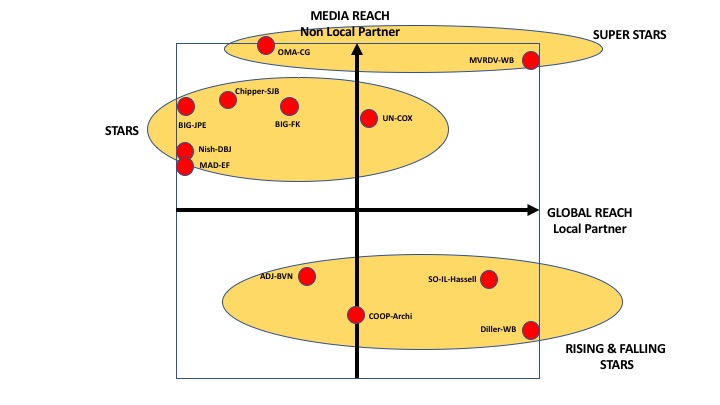
There is another issue that these two competitions point to, and that is the role of the internet and media to shape perceptions and the branding of architects. The following strategy diagrams map media impacts of the collaborations in these two competitions. I charted media hits (as measured by Google) of the stars against the reach of the local firms (number of Australian plus Internationaloffices of the local partner). I will let you make your own analysis of what all this means. My take is that clearly for some offices the match-ups appear to be ad-hoc and without any strategic intent. For other practices, the diagram shows who might gain or lose from the collaboration.

Slide1

Clearly, it also suggests who might win these competitions if this was the only criteria. It also shows which local firms may be using the collaboration to either extend their range or extend their brand by being attached to a star architect.

Slide1

For many Australian architects or any firm on the periphery of the global media starchitect system, such collaborations are perhaps necessary.  Since the early 2000s if not before, architects are no longer grounded in a particular office or geographical location. Competition amongst architects is global in the intense global competition for architectural services, arguably Australian firms need to extract value from networks and systems of patronage no matter how distant they may be. The star architects are better able to do this because they operate from larger economic centres.

Commodification of Design 

In any case, this all points to the ongoing commodification of design services. Perhaps the local/star matchups, point to the dumbing down of design into seductively drawn products with market signals that scream out “star-designer.” This is regardless of the fact that these designer products, seem to retain a threadbare relationship to what might have formerly been regarded as a traditional design process. Many of these designer products, indicate no interest in the memory of city or any sense of freedom and politics to be found in local communities.

Taken together, Australian firms need a renewed emphasis on strategic thinking, better management, a recognition of the media landscape, and internal research to gain competitive advantage. Otherwise, Australian firms will be doomed to be secondary actors, and lackeys, swilling around in the global system of architecture.

Surviving the Design Studio: Things to do at Architecture School to make sure you get a job when you finish

Lately, I have had the pleasure of hanging out with actual architects in a number of different forums. Inevitably the conversation comes around to the state of architectural education and architectural graduates. This situation may be more the case now because the employment market in my small city is currently buoyant.

To my surprise, a few common themes seemed to emerge in the conversations about graduates. The first is the sense among most architectural employers that recent graduates are less engaged with architectural culture and that there is an expectation amongst them that they will land a job in an office as a “young” and “emerging” designer leading a project team. Amazingly, for whatever reason, young architects think that they will design. Interesting to think some recent graduates think they will be leading project teams. Especially, given the widespread and prevailing dislike of group work by students. But hey, maybe that’s only in the practice class.

Others are under the illusion that they will be working the fablab machines and robots when they make the transition to practice.

I haven’t looked lately, but I am not sure how many offices have robots or are part of prefabricated supply chains. But shit hey; there is nothing wrong with learning how to code for that brave new future that the technology nutters are telling us will happen. With any luck, we might even get a few future Architects who will understand how to interrogate AI algorithms. But as argued below it is all about balance; and if architects can’t learn to manage new technologies, as compared to merely executing the technologies, then we architects will end up being next too useless.

I think making the transition from postgraduate architecture school to a working life in architecture is a pretty hard thing to do. Its not a great sapce to be in even when the employment market is bouyant. So, if you are a graduate student, here a few things you can do now to make the transition easier.

The first rule is balance

Don’t sacrifice all of your subjects for the design trophy. Keep things in balance. Being fixated on design marks actually means nothing once you graduate. Your final year marks are only one thing that architectural employers will take into consideration. What is more important is where you are positioned in your career two years out after graduation. Are you a BIM monkey drone at that point or are you beginning to assume responsibility and leadership in various practices? Do you have a strategy for your career?

You need to focus on the other things if you are to survive in a competitive marketplace: Architectural Practice (of course), History and Theory and Construction (and that doesn’t mean hanging out with the 3D printers). If you don’t know any of those things or pay little attention to them, you may not necessarily learn them in practice. Moreover, it will take an employer longer to teach you those things. As one practitioner said to me “the recent graduates are loss makers” because even though they are enthusiastic about design, they are too slow doing the other things” You need to balance your time and efforts across everything. Don’t get sucked into the design vortex.

Get with the culture

If you are going to think that you are some kind of star designer, then become one properly. Pick the hardest studios to do, expand your design skill base each time you do a studio at architecture school. Become involved in the local culture of your architecture school. Join SONA. Hang out at architectural events and be engaged. Go to the nearest peer awards presentations. Be interested in the latest architectural and urban controversies. Sitting at home on your computer with the Rhino or Revit family catastrophe is one of the most boring things you can do. You might even get off your computer and organise a studio space with your fellow travellers.

By getting involved with architectural culture, you will help to change it.

Build a profile 

Every architectural employer will look at your social media feeds to see how you fit into the culture of their practice. If your Instagram account is full of images with you taking selfies in bathrooms, skulling alcohol out of the red plastic cups, dancing at the toga parties, or latching onto a bong-pipe or vomiting in stretch limos while wearing the hire tuxedo then maybe it is not such a good look. Keep your professional profile separate from your personal one.

You need to build a “professional” profile. There best way to do this is through social media. Choose which avenues will best help you to do this. This engagement can be great as it is your opportunity to show what you are interested in on Instagram or Pinterest or Linked-In.

Get work experience while studying

Yes, sacrifice that precious studio design time and get a job in an architects office while you are studying. And that doesn’t mean getting a job that is some low-rent unpaid exploitative internship. DON’T EVER WORK FOR NOTHING. Most architectural employers enjoy having students around. Usually, they will actually think your quite smart and will be interested in your views on architecture. But that doesn’t mean you will be designing the latest Opera House.  You will learn more about design in an architects office than you might in a graduate school architectural studio. Of course, it depends on the office and the studio. This is why the balance between the two is so important.

 Be enthusiastic about doing stuff

Oh, and be sober at the job interview: Someone I know who was struggling to find a job in the early 90s recession swallowed a whole lot of homemade hallucinogenic cookies. About ten minutes later the phone rang, and the architectural firm asked if he wanted to come in for a job interview later that afternoon. He said sure. The time was just about when the cookies started to take hold. The rest is history, needless to say, he did not get the job.

In the job interview, don’t shove every design thang, every design sketch, every design robotic fab-labster-lobster thing down the throat of the interviewers. It is a mistake to think this approach will make you seem different. It’s not about you. I once got a job by saying that horse racing was in my blood and I liked nothing more than documenting the joinery and urinals in jockey’s rooms. I got another job as a site architect on a correctional centre PPP by saying I was great at anti-vandalism detailing. That was because I convinced them I could think like a sub-criminal teenage vandal.

Be different 

Better to tell the potential employers how much you enjoy doing bathroom and tiling details than saying you are some awesome emerging mini-star designer. Become an expert on the mundane things by being curious about those seemingly ordinary things now. Chances are saying that will spin out the employers out so much, at the interview, you will get the job on that basis alone. To the architectural employers, you will seem different and a cut above everyone else. Once you get that post-graduation job, because of your tile detailing or contract admin knowledge skill set, and do anything attitude, you will eventually have to do just about anything once employed in practice.

You might even get the chance to design a few real bathrooms because you will be the person who has to design and document them. There are some great bathrooms in my city designed by the students and the recent grads. And after all, isn’t designing great bathrooms and toilets what design is all about?

The William J Mitchell Archive: Digital Historiography and the fight against banality

Writing in the Introduction to The Electronic Design Studio a book he co-edited William J Mitchell was to proclaim that architects should:

“should think of design systems as open, flexible, constantly evolving knowledge-capture devices rather than static collections of familiar tools and dispensers of established wisdom. When we can do this, I think we will see the emergence of design systems that do not just mechanically assemble banalities, but that have real style and flair”

slide011.jpeg

In 1986, Mitchell was appointed Professor of Architecture and director of the Master in Design Studies Program at the Harvard Graduate School of Design. He later joined MIT in 1992 until his death in 2010. He is perhaps best for his book City of Bits.

William J Mitchell archive

The recently acquired William J Mitchell archive at Melbourne University enables an insight into Mitchell’s career as a thinker in relation to the development of Computer-Aided Design in architecture as well as the early history of parametric design.

Mitchell’s archive points to the problems with the contemporary parametric gospels as well as raising questions about the relationships between architectural theory, historiography and digital archives. In 2011 the Dean of the Faculty of Architecture, Building and Planning Prof. Tom Kvan organised for William J Mitchell’s archive to come to Melbourne University. Professor Kvan, had been a former student and collaborator of Mitchell’s.

3.5 inch floppy discs

Included in the collection now at the University of Melbourne are a variety of digital storage media including 104 iOmega Zip disks created between 1995-2001, 51 Maxell 8mm HS-8/112 Data Cartridges first released in 1989, as well as 241 3.5 inch floppy discs of various kinds created between 1985 and 1993.

Slide03

In the mid to late 1980s, Mitchell was exploring the capabilities of the Apple Macintosh computers in the network he was building at Harvard’s Graduate School of Design (GSD). In 1986, there were three Apple models available on the market these were the Macintosh Plus, the Macintosh 512Ke, the Macintosh XL. All of these models were aiming at the consumer and education markets.

Slide05

The disks in the Mitchell archive has been examined using Forensic Toolkit (FTK). FTK is mostly used in digital forensics and law enforcement but can be directly applied to archival contexts.  FTK can interrogate digital media to identify, preserve, recover and analyze digital information.

Slide04

As result of our work with FTK The software title that appears to predominate on the 3.5-inch disks in the archive relates to Topdown. These disks includes disks that were student submissions as part of teaching at Harvard. Topdown was Milton Tan’s PhD thesis was undertaken at Harvard between 1987 and 1991 which Mitchell supervised; Topdown was developed and coded by Tan, but the work probably started at UCLA in collaboration with Mitchell and also Robin S Liggett who knew how to code.

 The birth of parametrics: Topdown

Topdown was a “knowledge-based design system” that also employed some parametric functions. While AutoCAD 10 had been released in 1988 Topdown was not merely a linear drafting tool drafting tool like AutoCAD. Topdown was developed in Lightspeed Pascal for the Macintosh and in Microsoft Pascal under Microsoft Windows for the IBM P5/2. But in 1989 the system was not yet able to utilize object-orientated programming.

Slide06

As Mitchell was to liken, it at that time it, most computer drafting systems were seen to “work in a bottom-up fashion.”  As Tan and Mitchell contended Topdown was software that was an attempt to make a tool inherently parametric. Mitchell contended that a “CAD system should automatically maintain structure as a designer manipulates a geometric model.”

In using Topdown in his teaching, Topdown appeared to allow Mitchell’s students to replicate the generative exploration and selective decisions of classical architecture. However, the classical orders were no longer drawn but selected and elaborated via the graphical user interface using a Macintosh personal computer.

Emulation for digital historians 

Further research into the archive will allow for the emulation of the Topdown program itself.  Emulation is the concept that a computer program in one digital device can imitate or mimic another application or device without needing the original hardware. In other words, digital entities or fragments produced on earlier machines can be emulated on later platforms allowing them to be viewed as if they were running on the original system. The development of emulation services suggests that architectural historians must also know computer languages, hardware, networks, storage and memory capacities, graphics, user interfaces, display technology, as well as regimes of application and software development and individual applications.

Shape grammarists 

Slide07

Mitchell’s and Tan’s work and effort to develop Topdown followed on from the shape grammar work of Stiny and Gips. In the early 1970s, it was Stiny and Gips (above) who advanced theoretical notions of shape grammars and parametric design in a series of papers.

Slide08

Whereas Stiny saw the link between shape grammars and abstract art, Mitchell saw the connection between shape grammars and the games and systems inherent to classicism in architecture. This is obvious in the publication in 1990 of The Logic of Architecture: Design, Computation and Cognition.In many respects, there was an attempt to replicate the systematic and layered nature of classicism in the Topdown software.

slide09.jpeg

Positioning the digital fragment 

The Mitchell archive suggests the need for architectural historians to develop new methods of archival research. Given the history of incremental and disruptive innovation in computing, the architectural historian and digital archivist must recognize this state of flux. The history of the digital model in architecture is only a partial history if it does not position the digital fragment into its appropriate technological context.

The shift to digital practices, as exemplified in the Mitchell archive, indicates a need to revise principles governing museology, collections, and conservation. In this context, is it merely a matter of developing new technology based methods and practices to extract historical data? Or does the extant digitization of an archive shift how fragments emerge and are selected as quotations in historical narratives?

Forget chronology, style and type.

Historiographical theories and methods can no longer rely on the old taxonomies of physical media based on the verities of chronology, style, and type (isn’t Parametrics now all about overturning the old orders?) In relation to digital archives, instruments of architectural theory and criticism will need to be cognisant of technology. Digital archives suggest the need for socio-material or technical methodologies that account for the materiality of technology and its interconnection with architecture.

In some ways architecture, its canon, norms, and histories is now a creature that has become a kind of cyborg. Architectural theory as an abstract game, as it is for some historians and theorists, sourced in critical theory, continental philosophy and logic will no longer suffice. I would suggest that in this new digital context, historiographic perspectives that recognise socio-technical work and digital ethnographies of the social sciences is the work that needs to be done.

Assembling the banalities.

Mitchell’s Topdown indicates that he saw parametric design as a way to attempt to link the canon and norms of architectural design to computing. It was an effort to both translate and assert architecture as a canon of knowledge into and against the crude digitization of architectural knowledge through machine computing and an effort countering the mindlessness of engineering optimization and efficiency. The paradox is that parametric design methods have themselves now come to exemplify an architectural approach that appears to mechanically assemble the banalities that Bill Mitchell himself loathed.

This blog is based on a paper was written in conjunction with Peter Neish the research data curator at Melbourne University. It was presented at SAHANZ 2017 you can access the full paper here. We would like to acknowledge Geoff Laurenson, and Millicent Weber, who imaged and cataloged the disks as well as Naomi Mullumby, Sarah Charing and Professor Tom Kvan for their role is securing and documenting the archive.

Surviving the Design Studio: How to start making architecture with an actual drawing.

BAN Pinterest

If you think an architectural design is about merely downloading stuff on Pinterest, think again.

 Many architects have now lost the ability to draw. Hey, for some the computer is so much better. But is the machine the same kind of speculative instrument that drawing, or model making, is? I don’t think it is and my concern is that we have substituted Pinterest, and image collecting memes in general, as a way to draw.

Designing has always been about speculation, and I think it is reasonable to collect, download and collage material together and then employ techniques of estrangement and distortion. Why would you do that when everything now ready-made and easily customizable with a bit of site and user functionality and value management thrown in. Why would architectural design be anything else? Plus, those other techniques, the ones of distortion and estrangement, would mean you might actually need some kind of theoretical model or position to work from rather than slopping around in the lather of consumerist capitalism. But I guess Theming everything is oh so easy these days. Contextual theming is the worse and goes like this: “my project design is in an area with lots of (fill in the most predominant and visible thing in the local context) widgets, So I am going to make my building look like a bit like and widget.
Lousy copying in architecture seems to be rife these days. Hey, who needs to draw in the early stages of a project when you hit me up with some of that old vs. new architecture, or give me a slug of arches, or worse still, a shot of archetypal gable profiled zinc. As a friend of mine remarked: Danish or Japanese projects published in Archdaily in the morning quickly end up on Melbourne drawing boards in the afternoon. Nothing like consuming the 24-hour global design cycle.

A slight digression

Worse still are the digital poetics advanced by the digital tribes is, regardless of aesthetic appearance, which embodies an overriding sentiment of the architect’s office as a kind of frontier. A frontier where men are real men (just like in the Searchers) and where design workflows can be optimized and rationalized. Nowhere, is this ripsnorting wham-bam, boys with toys technological frontier, and associated frontierism, more evident in the discourse that surrounds the implementation of Building Information Modelling in architecture. BIM has been a central focus for the digital tribes and at the center of this crap poetics of efficiency, is an entity called the BIM model. The BIM model, the holiest of holies, the modern equivalent to the arc of the covenant, is a static centralized and hierarchical conceptual entity. (sometimes I wonder how much research money was spent ton the development of the IFCs).

Arguably, this statism combined constrains architects from design speculation through drawing. Their rhetorics of the frontier around all this stuff makes architects think they are speculating about something when they are doing no such thing. While researching this blog post I found this on the BuildingSmart website, (hey, whats in it for me) and it’s worth quoting in full:

Who benefits from standardized BIM-processes?”

  1. Owners, architects, engineers, facility managers, because they do not need to re-invent the wheel in each project, and because everyone would know the standard procedures. It will be much easier to partner-up in new projects and to build consortia. A lot of money and effort will be saved.
  2. Software vendors, because the market will become much bigger. As procedures become widely accepted state-of-the-art, vendors will increase investment in software development.
  3. Educators, because education is based on state-of-the-art, only on this basis a mass-education can be established and it is worth the effort to develop educational books/media (anything else is just short-term training). If you demand today from universities to educate their students in BIM, most of them are helpless, because they don’t know what to teach. Certificates of education need a standardized basis. State-of-the-art is also a necessary basis for accreditation of studies.
  4. Building owners, because they will ask for state-of-the-art BIM competence confirmed by certificates.
  5. Contractors, manufacturers, authorities, maintainers and operators, because their work processes will be streamlined and efficient.
  6. Everyone in society, because they use the built environment for living, working and life.

Sorry, I know I am digressing a bit. That “living working and life”  bit gets me choked up everytime. Sure, you can play with and do things with the plug-ins nowadays. But is that really the same as drawing? Drawing is a non-standard thing, and the con, of the infamous Non-Standard architecture exhibition in the early 2000s Paris, was to delude architects into thinking that we were all heading into a non-standard world of super digital design.

I wonder if all the above horrors of contemporary design, including digital design, are because we have lost the ability to conduct in-depth research through drawing and sketching

So just like last’s week’s post. Here are few clues to help you get your design drawing skills up and running.

Pinterest DETOX

1.Buy a pen and pencil and get some white paper.

IMG_5053

2. Start to do something without overthinking

img_5054.jpg

3. Think about a building or space or place you might like to design.

img_5055.jpg

4. Have a first go at drawing it. Do a section. You can even annotate if you like. You can even employ humour.

img_5057.jpg

5. It may start as a diagram and then evolve.

img_5061.jpg

6. It doesn’t even have to be neat or even legible to others

IMG_50638. Without wanting to sound like one of those awful American Architecture school composition manuals: As you draw think about how the drawing might develop: Which aspects of it could change or remain fixed? What are its limits? Which segments of it do you want to design more than others? Think about its attributes. Most simply, should it be bigger or smaller?

img_5064.jpg

9. Try and draw it in different ways and from different perspectives.

img_5065.jpg

10. Draw quickly then draw slowly and even just scribble a bit if you like.

img_5065-e1525249558781.jpg

11. Iterate a few more designs or sketches.

IMG_5064

12. Start again and repeat. Try doing all the above in a computer and see how long it takes and don’t forget only the most narcissistic architects will draw these types of sketches on yellow trace. ( if I had signed my drawings with Siza or Hejduk’s signature the might be saleable and people would drool over them).

So, if you cant do this, or couldn’t be bothered, and its more comfortable to pretend to be a BIM superhero, and you still think Pinterest is the only way to go, then don’t bother calling yourself an Architect. But if you try drawing not only will you be a better architect but the profession itself might just be that little bit more resilient, when the value managers come knocking on your door. Especially when you are sitting around a table, and they are trying to delete every bit of pathetic design you have Pinterest plastered into the project.

The feature image is a Raisbeck drawing collage from the early 90s. Its little wonder I was never invited to be a guest critic or “Assistant Professor” at Harvard, Columbia or the AA.